2026 Skid Steer Trends: Electric Models & Smart Attachments Rising
The face of compact construction equipment is dramatically changing as we move into 2026. Skid steer loader has been the backbone of job sites for decades mainly because of its maneuverability and power. Let us identify the best 2026 Skid Steer Trends to resolve every existing issue.
However, the industry is no longer just about horsepower and capability to lift. The attention today has shifted towards environmental protection, digital integration, and robotization. Being aware of the latest 2026 skid steer trends will be of great help for contractors to survive among the best as regulations of noise and emissions will be tougher for urban construction.
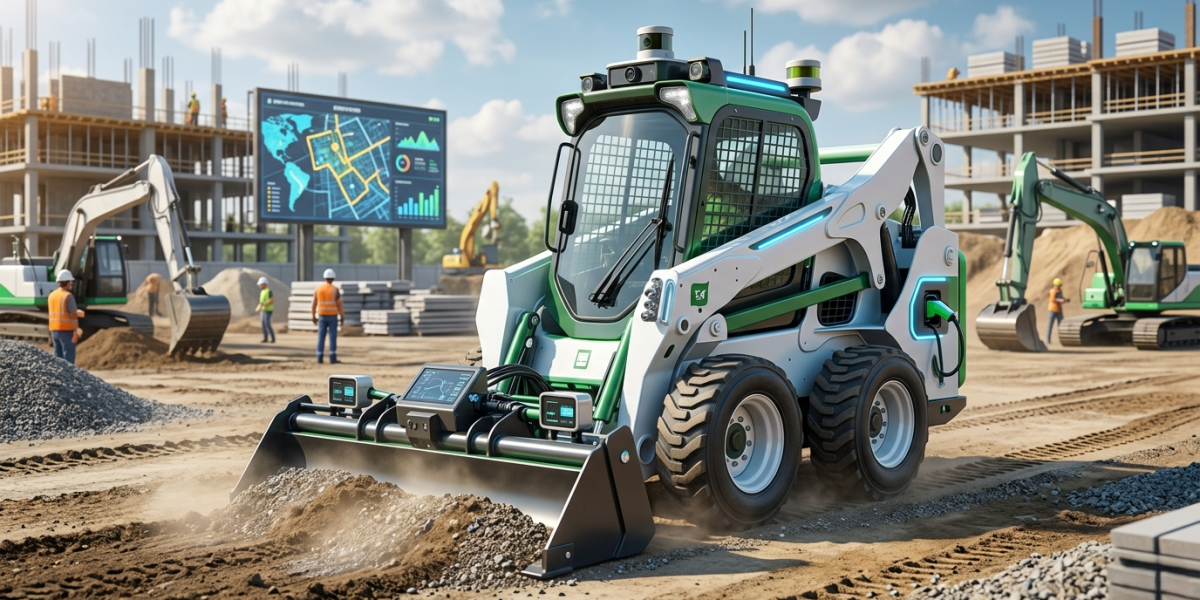
The ever-increasing number of hybrid and electric models is not a passing fashion but rather a necessity. These 2026 skid steer trends are even changing machines from being simply big earthmovers to highly modern instruments capable of doing intelligent real-time adjustments.
The Increase of Electric Skid Steer Models
The move to electric power is, without any doubt, the major story among 2026 skid steer trends.
The switch from diesel to battery-electric loaders, capable of delivering equal performance while leaving no carbon footprint, is staged not only by a few manufacturers but that of an entire industry, walking steadily and surely toward greener and cleaner solutions.
- Zero-Emission Performance: Today’s electric loaders depend largely on powerful lithium-ion batteries that enable them to last a whole 8-hour working day.
- Reduced Operating Costs: The fact that such 2026 skid steer trends do not rely on diesel fuel and engines that require complicated maintenance sheds some light on the owners’ decision to switch to electric.
- Instant Torque Delivery: The functionalities of electric motors include ones that deliver maximum torque right from the start, making bucket control feel very smooth and responsive.
Intelligent Attachments and AI in 2026 Skid Steer Trends
Skid steer “brains” are as significant as muscles in 2026. The 2026 skid steer trends are inclined toward smart attachments that possess embedded sensors and AI, equipping the machine with the ability to identify the tool being used and to automatically set the hydraulic parameters.
- One-click automated tool calibration: Smart attachment sensors communicate with the skid steer’s ECU for performance optimization.
- Targeted grade control via precision: Reaching the pinnacle of 2026 skid steer trends in precision engineering, several new attachments are equipped with embedded GPS technology.
- Real-Time Data Feedback: Operators are now able to monitor telematics particular to the attachment such as rotational speed or impact force directly through the display in their cabs.
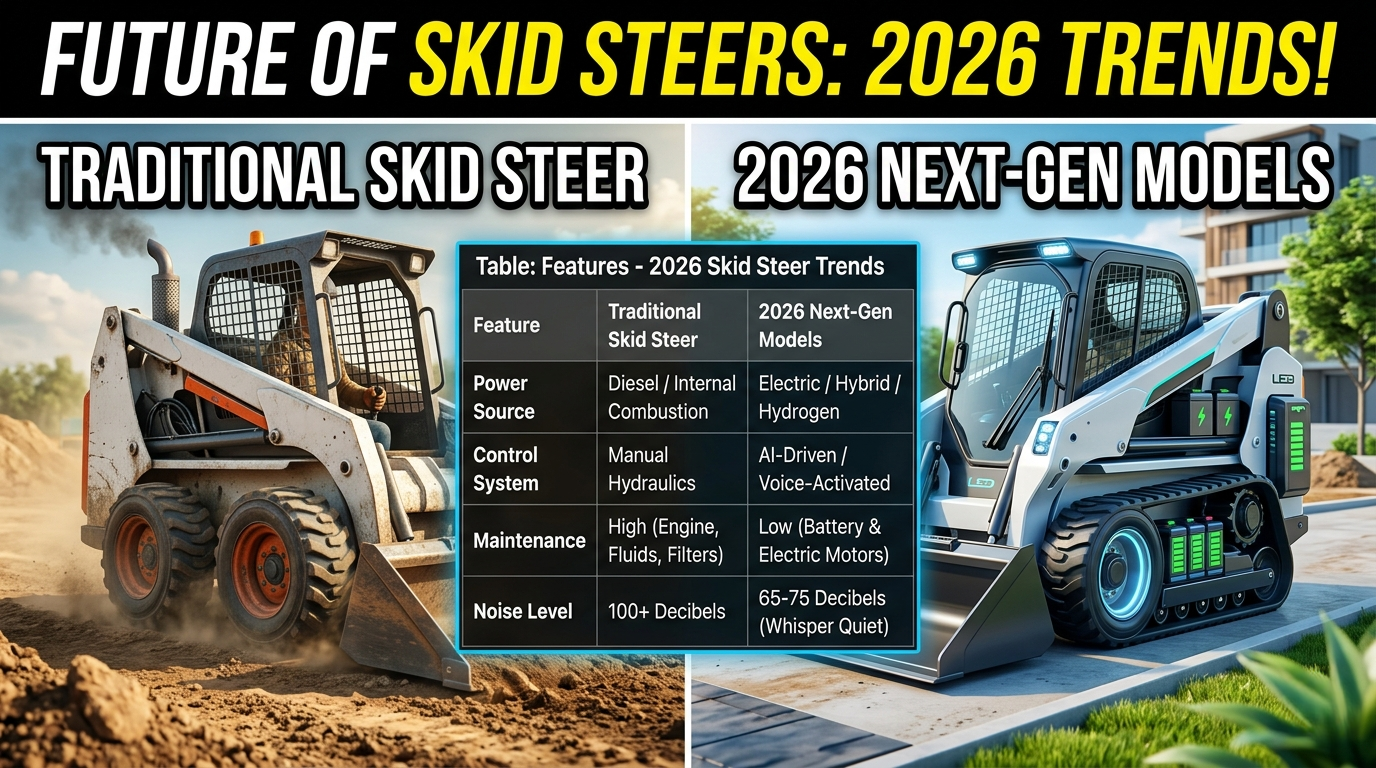
Table: Features – 2026 Skid Steer Trends
| Feature | Traditional Skid Steer | 2026 Next-Gen Models |
| Power Source | Diesel / Internal Combustion | Electric / Hybrid / Hydrogen |
| Control System | Manual Hydraulics | AI-Driven / Voice-Activated |
| Maintenance | High (Engine, Fluids, Filters) | Low (Battery & Electric Motors) |
| Noise Level | 100+ Decibels | 65-75 Decibels (Whisper Quiet) |
2026 Skid Steer Trends
Latest Operator Cabs, Safety Features and Tech
The 2026 skid steer trends focus on operator comfort more than ever before. Being aware of the fact that the industry is suffering from a labor shortage of skilled workers, producers introduce new technologies through which their machines become easier and safer to use.
- Collision Avoidance Systems: Radar and LiDAR sensors are now standard equipment. When the sensors detect an obstacle, the machine is stopped automatically.
- Augmented Reality Displays: Most cabs already have a heads-up display (HUD) that projects site plans and underground utility maps onto the windshield.
- Ergonomic Command Centers: Revised joystick layouts and climate-controlled cabs are two of the features that make 2026 skid steer trends focus on reducing the operator’s tiredness.
Sustainability and Environmental Impact
The word “sustainability” does not just mean something fashionable any more, it is actually a major engineering principle behind 2026 skim steer trends. Manufacturers instead of relying only on the power unit are considering the entire life cycle of the machine when designing it, which is one of the reasons that a drastic reduction of the overall environmental impact of construction is feasible.
- Biodegradable Hydraulics: The use of plant-based hydraulic fluids is on the rise which, among other benefits, helps decrease the environmental impacts in case of an incident.
- Regenerative Braking: Following wider 2026 skid steer trends in efficiency, electric loaders now use braking energy capture to power the battery.
- Lower Noise Pollution: Very quiet operation allows for longer working hours in residential areas which translates into more billable hours for contractors.
Market Growth and Regional Outlook
The global skid steer loader market is forecasted to exceed $15 billion by 2034, and 2026 skid steer trends is that year that will mark a turning point in the adoption of high-tech units.
- Infrastructure Investment: Demand for versatile loaders is on the rise due to massive government infrastructure projects.
- Urbanization Trends: The need for compact equipment capable of working in tight alleys and providing indoor access to sites arise as cities become more and more crowded.
- Rental Market Expansion: Contractors are making use of rentals to get hold of the latest 2026 skid steer trends without the need for a large capital outlay.
The Future: Autonomy and Remote Operation
Looking ahead to the second half of the decade, the distinction between operator-driven and autonomous machines is becoming less and less visible, with autonomy firmly establishing itself as one of the most futuristic 2026 skid steer trends.
- Remote Pilot Stations: One operator can control multiple machines from a single office-based location, thus allowing for a safer working environment.
- Repetitive Task Automation: By demonstrating a particular digging pattern once, AI learns and thereafter flawlessly performs the task with little to no supervision.
- Fleet Synchronization: By allowing communication of disparate machines, telematics enable the optimization of the entire site workflow as per 2026 skid steer trends.
FAQs: 2026 Skid Steer Market
What is the run time of an electric skid steer on a single battery charge?
Lithium-ion battery systems installed in most 2026 electric skid steers will typically allow 6 to 8 hours of uninterrupted working time. With fast charging features, these vehicles can easily reach an 80% charge during a lunch hour.
Are electric skid steers as powerful as diesel models?
Often, electric skid steers outperform diesel versions because electric motors undoubtedly provide maximum torque instantly even, and sometimes, more than the diesel units.
What are “smart attachments” for skid steers?
Equipped with sensors and software for loader communication, smart attachments represent a new and fundamentally different level of work tools. As a major element of 2026 skid steer trends, they make the operators’ life easier by automatically changing the hydraulic controls without the operator’s adjustment.
Is it possible to upgrade my old skid steer with 2026 smart technology?
Although some telematics features can be added to older machines, integrated collision avoidance and AI-driven systems require modern electrical architectures and hence only new models can be equipped with these features.
Why is the industry moving toward tracked skid steers (CTLs)?
Tracked skid steer loaders provide much better traction especially on soft grounds and also exert less ground pressure during operation. Even though wheeled skid steer loaders perform better on hard surfaces, the trend moving toward tracks is one of 2026 skid steer trends visible in landscaping.
How much does a 2026 electric skid steer cost compared to diesel?
Generally, the initial purchase price is 20-30% higher than that of a diesel model. Nevertheless, the lower fuel and maintenance costs lead to the point where the total expenditure is equal within the first two to three years.