
Is a 23HP Gas Skid Steer Enough for Your Project? Here’s the Truth
Ask ten contractors on a job site whether twenty-three horsepower is enough to get real work done, and you will probably hear ten different opinions. Half of them will laugh and tell you that anything under fifty horses belongs in a suburban garage next to a riding mower. The other half—usually the guys making money on tight residential lots, backyard renovations, and farm maintenance—will tell you a 23HP gas skid steer is the smartest piece of iron on their trailer.
Both sides have a point, depending entirely on what you are trying to move. If you buy a compact loader expecting it to rip out highway concrete or hoist full-ton pallets of wet retaining wall block, you are going to end up frustrated. On the other hand, if you need hydraulic muscle that slips through a standard backyard gate, saves your crew from pushing wheelbarrows for ten hours straight, and leaves finished lawns intact, a 23HP gas skid steer punches well above its weight class.
Looking closely at what a 23HP gas skid steer actually does on dirt means forgetting about truck-towing numbers and paying attention to hydraulics, machine balance, and attachment pairing. Take a unit like the TYPHON STOMP 2000lbs Mini Skid Steer 23HP Gas EPA Engine.
It runs an EPA-compliant 23HP Briggs & Stratton or RATO V-twin engine that feeds steady hydraulic pressure to both the drive system and the front boom. You are not buying a giant earthmover; you are buying a nimble, zero-turn hydraulic multi-tool that fits behind a half-ton pickup and gets straight to work where big machines cannot even park. Let’s look honestly at where this size shines, where it hits a wall, and whether it makes sense for your workload.
What 23 Horsepower Actually Feels Like in the Dirt
On a traditional farm tractor, horsepower goes straight through gears and axles to pull heavy plows across open fields. A skid steer works completely differently. On a 23HP gas skid steer, that air-cooled V-twin engine sits there spinning at roughly 3,000 to 3,600 RPM for one main reason: turning hydraulic pumps. Those pumps push pressurized fluid to your track or wheel motors and your lift cylinders.
Because the whole machine weighs around 1,800 to 2,000 pounds, the engine does not waste half its energy just dragging massive steel plates around the yard. Instead, machines like the TYPHON STOMP put that hydraulic pressure into lifting over 830 pounds and cruising across job sites at nearly 3.7 mph (around 5.5 to 6 kph).
- Hydraulics Do the Heavy Lifting: Rather than relying on brute engine displacement, a 23HP gas skid steer routes power through dedicated gear pumps, giving you crisp boom response and dependable auxiliary flow for front attachments.
- True Backyard Access: Most full-size loaders measure five or six feet wide and destroy sod the second they turn. A narrow 23HP gas skid steer rolls straight through standard residential fence gates and squeezes between houses without tearing up siding or sprinkler heads.
- Gentle Footprint on Finished Yards: Spread across rugged rubber tracks or wide turf-friendly tires, an operating weight under 2,000 pounds keeps ground pressure remarkably low—meaning fewer ruts and far less time spent raking out tracks after the job is done.
Where a 23HP Gas Skid Steer Earns Its Keep Every Day
Talk to landscapers, fence builders, and small acreage owners, and you quickly realize why compact stand-on loaders have taken over residential work. Picture a typical backyard patio or drainage job: you have twelve yards of gravel sitting in the driveway, a narrow side yard leading to the back, and three days to get it graded and compacted.
Bringing a 7,500-pound diesel loader onto that property means plywood sheets everywhere, crushed edging, and a heavy-duty dually truck just to haul the machine there. A 23HP gas skid steer rides on a standard single-axle or light tandem utility trailer, unloads in two minutes, and turns a three-day shovel-and-wheelbarrow grind into a single afternoon.
- Landscaping, Grading, and Sod Prep: Spreading topsoil, hauling mulch, moving partial pallets of flagstone, and smoothing out bumpy lawns with a Skid Steer Loader Land Leveler Attachment becomes fast, clean, and remarkably easy on your back.
- Fence Installation and Deck Footings: Hook up a Skid Steer Loader Earth Auger Attachment and one person can drill dozens of straight, clean post holes through stubborn clay in a morning—no two-man handheld auger kicking your ribs every time you hit a root.
- Hobby Farms, Stables, and Orchards: Tight barn aisles, low orchard branches, and muddy paddocks are tough on full-size tractors, whereas a 23HP gas skid steer slips right inside stalls to muck out bedding, haul feed bags, and dress gravel lanes.
- Tight Commercial and Municipal Cleanup: Parks departments and renovation crews love mini loaders for clearing snow off narrow sidewalks, hauling debris out of courtyards, and loading low-sided dump trailers without blocking city traffic.
23HP Gas Skid Steer vs Diesel Loader
Side-by-Side Reality Check: 23HP Gas vs. Mid-Size Diesel Loaders
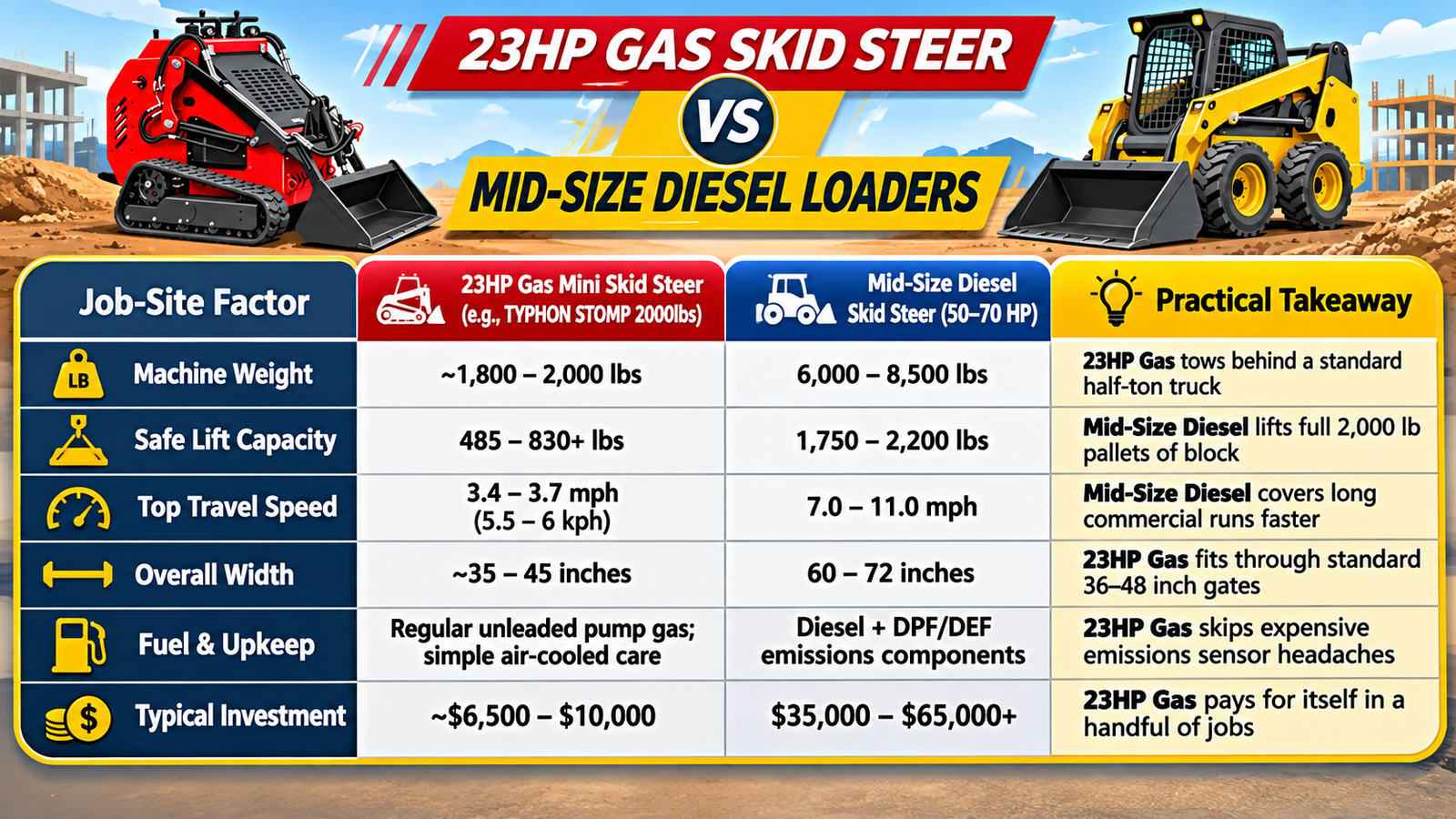
Numbers cut through sales hype faster than anything else. When you line up a 23HP gas skid steer next to a traditional 60-horsepower diesel cab loader, you immediately see they are built for two completely different worlds. One is a scalpel designed for tight access and rapid payback; the other is a sledgehammer built for bulk earthmoving and heavy pallet handling.
Table: 23HP Gas Skid Steer vs. Mid-Size Diesel Loaders
| Job-Site Factor | 23HP Gas Mini Skid Steer (e.g., TYPHON STOMP 2000lbs) | Mid-Size Diesel Skid Steer (50–70 HP) | Practical Takeaway |
| Machine Weight | ~1,800 – 2,000 lbs | 6,000 – 8,500 lbs | 23HP Gas tows behind a standard half-ton truck |
| Safe Lift Capacity | 485 – 830+ lbs | 1,750 – 2,200 lbs | Mid-Size Diesel lifts full 2,000 lb pallets of block |
| Top Travel Speed | 3.4 – 3.7 mph (5.5 – 6 kph) | 7.0 – 11.0 mph | Mid-Size Diesel covers long commercial runs faster |
| Overall Width | ~35 – 45 inches | 60 – 72 inches | 23HP Gas fits through standard 36–48 inch gates |
| Fuel & Upkeep | Regular unleaded pump gas; simple air-cooled care | Diesel + DPF/DEF emissions components | 23HP Gas skips expensive emissions sensor headaches |
| Typical Investment | ~$6,500 – $10,000 | $35,000 – $65,000+ | 23HP Gas pays for itself in a handful of jobs |
Honest Limits: When 23HP Simply Isn’t Enough
Nobody likes buying equipment only to realize on week two that it is undersized for their bread-and-butter work. Even the best 23HP gas skid steer obeys the laws of physics. Because the frame weighs around a ton instead of four tons, there is a hard cap on how much weight you can hang off the front quick-attach plate before the rear end starts getting light.
Likewise, a 23HP engine produces standard hydraulic flow—plenty for augers, trenches, and grapples, but nowhere near what massive forestry drum mulchers or asphalt cold planers demand.
- Full-Ton Pallets off a Flatbed: While a capable 23HP gas skid steer like the TYPHON STOMP lifts over 830 lbs, trying to pick up a shrink-wrapped 2,200-pound pallet of concrete bags or pavers will tip the machine forward. You either split the pallet in half or step up to a larger loader.
- Heavy High-Flow Forestry Attachments: Industrial stump grinders and big brush mulchers require 25 to 40+ gallons per minute of high-flow hydraulics, while 23HP compact machines operate comfortably in the 11 to 20 GPM standard-flow range.
- Deep Commercial Excavation in Rock: Scraping topsoil and digging two-foot drainage trenches is right in its wheelhouse, but carving out deep commercial basements in solid shale or moving 500 yards of wet clay across an acre calls for heavy diesel iron.
Getting Maximum Work Out of a 23HP Gas Skid Steer
The smartest operators treat a 23HP gas skid steer like a cordless drill—the power unit itself is only half the story, and the real magic happens when you swap attachments in sixty seconds.
Because these machines use standardized mini quick-attach plates and flat-face hydraulic couplers, you can go from digging trenches to grabbing fallen oak limbs without breaking a sweat. Over on SkidSteerLoader.net, you can match your loader with tools sized specifically so they never bog down a 23HP motor.
- 4-in-1 Combination Bucket: Lets you scoop dirt, grade backward, clamp onto awkward rocks or brush, and dump cleanly without climbing off the platform to change tools.
- Hydraulic Earth Auger: Turns fence building, mailbox installation, deck footings, and orchard tree planting into a fast one-person operation.
- Land Leveler With Ripper Shanks: Scarifies packed gravel driveways or hard backyard clay first, then floats out a smooth, seed-ready finish in just a couple of passes.
- Hydraulic Brush Grapple & Pallet Forks: Ideal for clearing storm-damaged branches, moving logs, hauling boulders, and shifting partial pallets of sod or landscape stone around tight properties.
Why Gas Beats Diesel in the Sub-25HP Class
On big 75-horsepower construction machines, diesel wins every single time for torque and longevity. Drop down into the sub-25HP compact loader category, however, and the math flips in favor of gasoline. Modern EPA-certified 23HP V-twin gas engines—like the Briggs & Stratton Vanguard and RATO powerplants—give small contractors and homeowners huge advantages in purchase price, cold-weather reliability, and weekend wrenching.
- Thousands Saved Up Front: Buying a 23HP gas skid steer costs a fraction of a comparable mini diesel model, keeping your cash in the bank for trailers, attachments, and marketing.
- Instant Starts in Freezing Weather: Anyone who has fought a stubborn small diesel on a 15-degree January morning appreciates turning a key on a gas engine and hearing it bark to life immediately—with zero worry about gelled fuel lines.
- Simple Garage Maintenance: Air-cooled V-twins have no radiators, coolant hoses, water pumps, or high-pressure diesel injectors to fail. Changing oil, spark plugs, and air filters takes twenty minutes with basic hand tools.
Frequently Asked Questions – 23HP gas skid steer
How much weight can a 23HP gas skid steer lift?
Most 23HP mini gas skid steers safely handle a Rated Operating Capacity (ROC) between 440 lbs and 830+ lbs, depending on wheelbase and counterweight design. Models like the TYPHON STOMP 2000lbs Mini Skid Steer are built to lift over 830 lbs, giving you plenty of muscle for full buckets of wet gravel, topsoil, mulch, and split pallets of pavers.
Is a 23HP skid steer strong enough for digging dirt and trenching?
Yes—as long as you use the right attachment for the soil. Paired with a tooth bucket, ripper, or dedicated trencher attachment, a 23HP gas skid steer digs through lawn turf, compacted clay, and rocky garden beds with ease, cutting utility or French drain trenches in a fraction of the time it takes by hand.
What attachments can you run on a 23HP gas skid steer?
Using a standard mini skid steer quick-attach mount and auxiliary hydraulic lines, a 23HP gas skid steer runs digging buckets, 4-in-1 buckets, hydraulic augers, trenchers, pallet forks, land levelers, root grapples, snow blades, and compact sweepers.
How much fuel does a 23HP gas skid steer burn per hour?
During normal stop-and-go job-site operation, a 23HP V-twin gas engine burns roughly 1.2 to 1.8 gallons (4.5 to 6.7 liters) of regular 87-octane unleaded fuel per hour. With a standard 6.5- to 8-gallon tank, you can easily run through a full day’s work without stopping to refuel.
Should I choose tracks or wheels on a 23HP mini skid steer?
Go with rubber tracks if you work regularly on finished lawns, mud, sand, or sloped yards—tracks distribute weight evenly and grip wet dirt far better. Choose wheels if most of your work happens on concrete, asphalt driveways, or hard-packed barn floors where speed and lower undercarriage wear matter more.
Can a 23HP gas skid steer fit through a standard backyard gate?
Yes, that is one of the primary reasons contractors buy them. Most 23HP mini skid steers measure between 35 and 45 inches wide, allowing you to drive right through standard 36-inch or 48-inch residential backyard gates without pulling fence posts out of the ground.
How long does a 23HP gas engine last on a skid steer loader?
If you stay on top of basic upkeep—changing engine oil on schedule, blowing out the air filter in dusty conditions, keeping hydraulic fluid clean, and greasing pivot pins daily—a commercial 23HP V-twin like a Briggs & Stratton or RATO routinely runs 1,500 to 2,500+ hours before needing major internal work.
Final Verdict: Should You Put a 23HP Gas Skid Steer on Your Trailer?
At the end of the day, buying the right machine comes down to being honest about your daily workload rather than chasing spec-sheet bragging rights. If your business or property demands lifting 2,500-pound pallets off semi-trailers or clearing five acres of heavy timber, step up to a larger diesel machine.
But if you spend your days tackling residential landscaping, fence building, trenching, farm chores, and tight-access site prep, a 23HP gas skid steer is more than enough—it is an absolute game-changer for your back and your bottom line. You get genuine hydraulic capability, low operating costs, easy towing, and access to jobs bigger machines have to turn down.
Check out the full range of 23HP gas mini skid steers and matched attachments at SkidSteerLoader.net to see how easily you can upgrade your workflow.