
Expert Guide: Driveway, Parking Lot, and Yard Leveling with Skid Steer Grader Attachments
Getting the surface of a driveway, parking lot, or yard perfectly level is basically what puts a gap between a long-life and a short-life outdoor project. In fact, the difference between doing a quality driveway project and throwing money down the drain is still the driveway leveling. While standard buckets have been used by many operators for such tasks, the industry was revolutionized by the introduction of specialized skid steer grader attachment.
These attachments are specially designed to remove the “washboard” effect and pave the way for precision grading of such surfaces. At SkidSteerLoader.net, we’ve always said the right attachment doesn’t only make the job smoother, it gives you the kind of results that make you look like a pro.
No problem if you’ve got a gravel driveway that’s practically a pot hole heaven, a commercial parking lot that demands a solid sub-base, or a backyard that should be perfectly sloped for drainage – grading is the skill you can’t do without. This guide unfolds the way to unlock your machine’s potential by harnessing the cutting-edge technology in grading.
Why Skid Steer Grader Attachments Are the Best Solution for Driveways
A driveway serves multiple purposes – it is a route for your car, a drainage system, and a foundation. Getting your drive surfaces flat and evenly graded with a skid steer grader attachment is the one thing that can give you an edge over the lot of bucket-draggers and manual rakers who have only your driveway’s damages in mind.
Besides, these rollers already know how to ramp up the compaction just at the tips of their dual cutting edges by loosening the pavement base and then filling it up with fresh material.
A bucket will often ‘bridge’ over a pothole while a grader will use its two blades to loosen that part of the base, and then it fills that part with fresh material.
If it is a gravel driveway, it is necessary to keep the “crown” (a higher point at the center) of the road that will help the water flow smoothly. A grader attachment gives you a fine control of the angle so you can easily change the direction of water to the sides.
By spreading the gravel or road bond accurately with these attachments, you can be sure your usage of the materials is not going to be excessive in the areas where it is unnecessary.
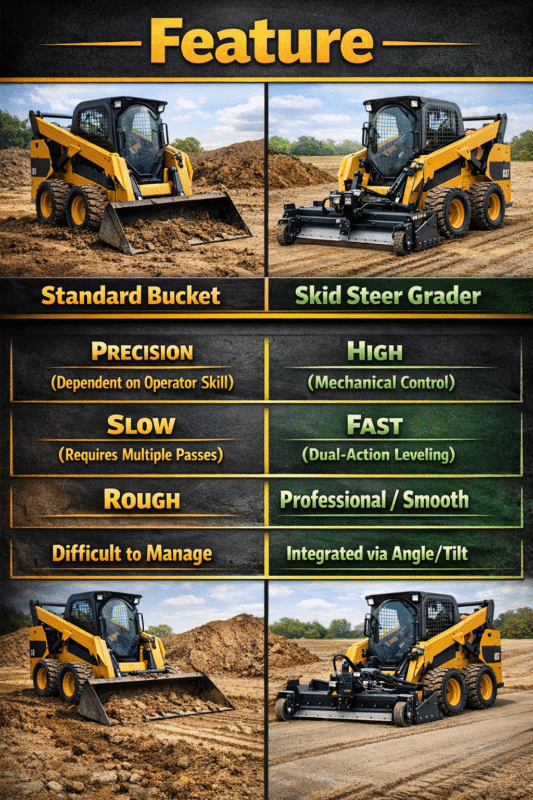
| Feature | Standard Bucket | Skid Steer Grader |
| Precision | Low (dependent on operator skill) | High (mechanical control) |
| Speed | Slow (requires multiple passes) | Fast (dual-action leveling) |
| Finish Quality | Rough | Professional / Smooth |
| Drainage Control | Difficult to manage | Integrated via angle/tilt |
In the case of parking lot preparation the stakes are escalated. These types of surfaces must be able to bear loads of heavyweight vehicles and their drainage must be in accordance with strictly imposed regulations. Skid steer grader attachment is what you install in your standard loaderset-up to transform it into a viable grading machine maximizing production, and accuracy rivaling that of a full-size motor grader all within a fraction of the space.
- Sub-Base Preparation: In order to achieve 95% compaction, it is necessary to start with a perfectly level sub-base. A grader will make sure that the entire surface of the parking lot is equally flat prior to the installation of the asphalt or concrete layer.
- Maneuverability in Tight Spaces: Large graders cannot move easily around light poles and other obstructions. A skid steer equipped with 7-foot or 8-foot grader blade has no problem getting to every corner of the parking lot.
- Hydraulic Versatility: Many professional-grade attachments offer 6-way hydraulic controls, allowing the operator to tilt, angle, and lift the blade from the cab for complex contouring.
Skid Steer Grader Attachment Features
Residential Yard Leveling and Landscape Preparation
A level yard is a delight to homeowners and landscapers alike because everything runs smoother, and simple tasks like watering and drainage won’t cause issues. Grading and leveling a yard with a skid steer grader is the fastest and most effective way if you are planning to put in sod, seed, or do hardscape. These attachments are not only capable of working on topsoil but are also strong enough to remove old sod along with other debris.
- Seedbed Ready: Grader attachments usually come with scarifiers that are used to loosen the soil and break up the hard ground, thus creating the ideal conditions for grass seed to germinate.
- Sod Peeling: Using the sharp blades of a land plane or grader, you can “strip” away unwanted grass and weeds without disturbing the soil beneath too much.
- Debris Removal: Bars built into the grader frame are working as a sieve. The large rocks and roots are caught by the bars whereas the fine soil passes through for the final smoothing.
How to Select the Right Attachment for Your Project
Not all the tooling for grading is of the same caliber. Picking the right type of skid steer grader attachment goes hand in hand with knowing the nature of your project, whether it is taking on heavy-duty parking lot construction or simple yard leveling.
The width and weight of an attachment should be compatible with the machine’s lift and hydraulic flow capacity.
- Land Planes/Levelers: These devices are perfectly suited for the finish grading as well as the smoothing of existing gravel driveways. Their operation is straightforward and removal of minor undulations is extremely efficient.
- Box Blade Graders: If you are to bring a large amount of material to or spread it out over a parking lot, then the box blade is right for you. Because the design of the box is meant to hold the material, you will be able to fill large hollows with just one pass.
- 6-Way Power Graders: The choice of professional contractors has always been the power graders because they offer laser-guided precision and work smoothly with large commercial sites as well as with building pads.
| Attachment Type | Best Use Case | Key Advantage |
| Land Plane | Yard & Driveway Smoothing | Simple and inexpensive |
| Box Blade | Material Distribution | Prevents side-spill |
| Power Grader | Commercial Sites | Maximum precision & tilt |
Mastering the Technique: Tips for Professional Grading
Even if you use the best skid steer grader attachment out there, nothing can replace the importance of technique. Professional operators treat grading as cutting—And—carrying. You see, the flow of material is just what you manage to obtain an even surface: you don’t simply push dirt. SkidSteerLoader.net shares “pro-tips” that can help with every job.
- The “Float” Position: If you are making final adjustments in your yard, then put the machine on the “float” mode. Thus, the attachment will be allowed to move along with the terrain and will not dig too much
- Overlap Your Passes: To make sure you don’t get “windrows” or ridges between your passes, it is best to overlap at least 6 to 12 inches of your previous pass each time.
- Check the Moisture: It is hard to grade soil or gravel that is completely dry. Adding water just moderately can help the materials stick to each other and can make the result last longer because of better settling.
Upkeep for Durability and Efficiency
Your skid steer grader attachment is a piece of high-precision equipment. To keep it running and producing level driveway and parking lot surfaces, you must do regular planned upkeep. Wearing and accumulation on the blades will eventually result in uneven grading as well as increased fuel costs because the machine will have to work harder to get the job done.
- Edge Rotation: Since most of the grader blades are reversible, you would do well to take a look at your edges regularly and flip them before the wear gets to the point where the frame is exposed.
- Hydraulic Checks: Power graders allow you to see the leaking cylinders and hoses at an early stage thus avoid big damages. Any loss in pressure however small, affects the blade’s ability to hold any given angle.
- Post-use Cleaning: If left unattended, moisture trapped by soil and gravel together can result in rust formation. Make it a habit to hose down your attachments when you have been working in the mud or clay after stop working to keep the metal intact.
FAQs – Skid Steer Grader Attachments
Can a skid steer really level a driveway as effectively as a motor grader?
Yes, for residential and small commercial projects, a skid steer grader attachment is often superior due to its maneuverability. A motor grader is quicker if miles and miles of highway are involved, but in tight spaces like driveways and parking lots, a skid steer can get down to the same level of precision to an “eighth-inch”.
What is the difference between a land plane and a grader attachment?
Generally, a land plane is a fixed-frame type of tool intended primarily for “skimming” and surface finishing. The skid steer grader attachment on the other hand comes with more powerful cutting edges and frequently has hydraulic controls to angle and tilt the blade so that you can make sloped surfaces.
How much slope do I need for a parking lot or yard?
Drainage-wise, it is recommended that – at the very least – 2% slope (or 1/4 inch per foot) be maintained. If the grader has a tilt plate or a laser-guidance system, it will be much easier to stick to the required slope when covering a big area.
Will a grader attachment work on compacted “hard-pan” soil?
Some graders feature hydraulic or manual scarifiers (teeth). The teeth penetrate into the hard soil and break it up so that the blade can spread out the soil. If the scarifier is not there, the ground might have to be loosen first using a tooth bucket before it can be leveled.
How do I prevent “washboarding” when leveling a gravel driveway?
The cause of washboarding is a machine bouncing or moving too fast. You can avoid the problem if you take a skid steer grader attachment that has a longer frame and is able to span dips, and also keep a slow steady ground speed.
Is a tracked or wheeled skid steer better for grading?
A tracked machine (Compact Track Loader) is generally better for yard leveling because it has lower ground pressure and provides a more stable platform, resulting in a smoother grade. Wheeled machines are fine for hard surfaces like existing parking lots.
Can I use a grader attachment for snow removal?
Yes but only for scraping and snow ice packed hard. For moving large volumes of soft snow, a dedicated blade or snow pusher will be more efficient, which is another thing you have to remember when making a choice.