Cleanup: Disaster Cleanup 101: Clearing Debris Fast with a TYPHON STOMP Skid Steer Grapple
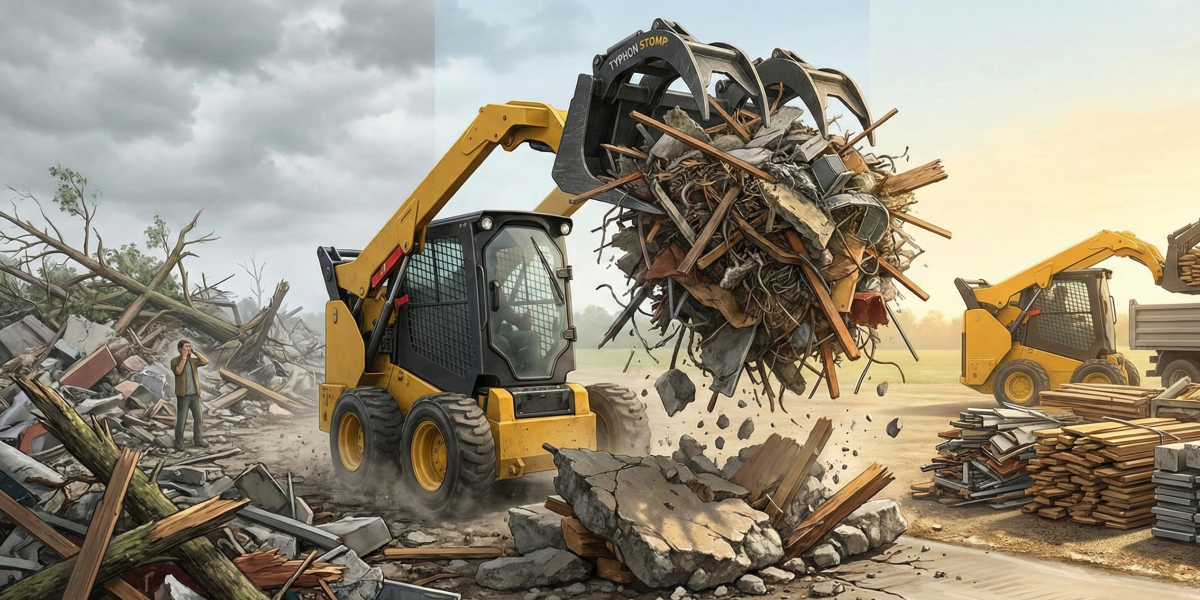
After a severe storm, when the sun finally shines through the clouds, the feeling of relief is soon replaced by the shock of devastation. Fallen trees, broken branches, destroyed fences, and piles of various debris turn your neighborhood into a nightmare.
Whether you are a homeowner, a farmer, or a contractor, your recovery work speed and efficiency will mainly depend on your tool choice. Although manual labor has its merit, it is too slow and risky in disaster areas. A skid steer grapple, on the other hand, is a versatile tool that basically makes a day’s hard labor look like a short afternoon job.
Here at SkidSteerLoader.net, we acknowledge that recovery after a disaster is about more than just moving dirt; it’s about bringing life back to normal. The small but potent TYPHON STOMP mini skid steer loader with a grapple attachment is a great way to lift heavy loads accurately and safely.
The grapple can hold onto the load firmly, just like a big steel hand, whereas a common bucket requires balancing an awkward load. We decided to share some useful tips on how to use a skid steer grapple to clear debris quickly and thoroughly.
Why a Skid Steer Grapple is Your Best Tool for Disaster Cleanup?
When time is of the essence in disaster cleanup, the most valuable thing is to be able to work efficiently. By using a skid steer grapple, you are mechanically enhancing your abilities beyond what manual tools allow.
That is, you can grab the irregular shaped items such as tree roots, concrete blocks, twisted metals that cannot be simply picked up with a bucket or bare hands. This feature will certainly come in handy when you have in front of you a diversified heap of wreckage after the storm, which is a different challenge with every scoop.
The grapple also has the ability to pick and choose which pieces to take. Bundled buckets usually take topsoil along with the trash, that’s why many grapple models feature the design with the space in between tines through which dirt falls, thus you are only taking away debris.
In this way, you decrease the load weight per trip and, if you pay by weight at the landfill, you save disposal fees. Besides, the mini skid steer is very tiny, therefore, it can easily move around narrow spaces between existing buildings and is perfect for residential cleanups where you cannot use heavy equipment that barely fits through a door.
- Unmatched Versatility: Handles the various types of materials such as logs, rocks, brush, demolition scrap, and loose hay without changing the attachments.
- Preserves Topsoil: Thanks to their open-tine designs, dirt is allowed to sift out, and the ground is not stripped while removing the mess.
- Enhanced Safety: Operators are safely enclosed within the cab (or are behind the controls of a walk-behind unit) and are protected from sharp debris, snakes, and unstable piles by a large distance.
Choosing the Right Grapple Attachment for Your Machine
Choosing the right attachment makes all the difference in how you perform with your machine. You want a grapple that has the right balance between weight and strength for a compact loader like the TYPHON STOMP.
A “Skid Steer Loader Grappler Grapple Grabber Attachment” is the one which perfectly matches the hydraulics and the responsive tension of a small piece of equipment and doesn’t tip the loader. Your machine extension is supposed to feel natural and is perfectly in harmony with the movements of your hands.
The 4-in-1 Bucket Attachment is another option that people often talk about. Even though it is a bucket in the first place, the fact that its “jaws” open makes it able to perform as a grapple when it comes to clamping onto logs and debris. This versatile tool is just right for those who need to switch from soil grading to grabbing debris and who don’t want to physically change the attachment every time.
However, if the main task is to get hold of some odd-shaped stuff and that is the really primary purpose of gripping, then a specialized grapple with independent tines is likely to offer you a better grasp on irregular loads.
- Weight Compatibility: Confirm that the grapple’s weight will not take too much of your loader’s operating capacity (e.g., TYPHON STOMP’s capacity is in the range of 1800lbs).
- Hydraulic Flow Requirements: Your skid steer hydraulic output should be checked to see if it matches the requirements of the grapple’s cylinder for opening and closing smoothly.
- Tine Spacing: If you want to work with large logs and rocks, then go for wider spacing while if you want to handle smaller brush and loose trash effectively, then choose the narrower spacing.
Essential Safety Protocols for Debris Removal
There are many dangers in disaster zones, and if you want to avoid being one of the statistics, then you have to obey the safety regulations at all times. Once you get hold of your skid steer, you cannot simply dive in without first inspecting thoroughly your work spot.
A storm can knock down various kinds of utility lines and these may not even be visible since they might be covered by the tree remnants so you should treat the lines as if they were still alive at least until you actually see that the lines have been de-energized. On top of it, the soil can also be a hazard itself if it has been softened by floodwater or if it has lost the support of the ground below due to sinkholes and here the risk of heavy machinery tipping comes into play.
When you use a skid steer with a grapple, the load being raised will especially change your machine’s center of gravity. So it is necessary to always keep your load low to the ground while transporting it in order to stay stable. You should not go crazy tearing through the debris, instead just moving the grapple over the trash so that it can clamp the material.
If you use the “ram” tens technique, then your hydros will be damaged and the operator will be hurt. It is always mandatory that you wear suitable Personal Protective Equipment (PPE) even when you are seated in the cab, because the hazard of flying debris is most likely during the crushing and moving process.
- Site Inspection: After the storm, check the whole area and identify downed power lines, damage to the gas supply, and possible secluded basements or other holes before using any machinery.
- Load Management: For better stability, always keep heavy loads near the ground when you are moving them; don’t ever travel with the grapple held up high.
- PPE Essentials: The hat, glasses, and boots are so important that their using should not even be questioned, not even for machine operators who might not need these if they never leave their machines.
Step-by-Step Cleanup Process
Randomly rushing into an area and hoping to get rid of the chaos is not the right way; instead, you need a well-thought-out cleanup plan to be most effective. First, you should designate a “staging area” where all the debris will be collected for the final removal or burning.
This will help in keeping your workspace neat and also, you will not have to do double the work by moving the same pile around twice. As your start point should be the front door of the property, clear the access route for your skid steer and other vehicles as you work your way inward.
In the case of a big tangle of branches and trees, do not attempt to grab the entire mess at once. Initially, you are going to cut the “outside” off with the grapple, pulling the loose branches before handling the heavy trunks. Thus, you avoid the stoppage of your equipment or getting stuck.
When you have various kinds of different rubbish mixtured, the grapple is your tool to separate woods, metals, and bricks into individual piles. Sorting by hand is very time-consuming, but this way, you save much money and even help the environment by being conscious of it.
- Establish Zones: Before getting into it, prepare different areas for each type of waste (burnable, recyclable, landfill).
- Clear Access Paths First: Arrange a safe, smooth path for your machine so that it can go back and forth to the dump zone without any trouble.
- Nibble, Don’t Bite: Take the large, tangled piles apart a little at a time to avoid overloading the hydraulic system or tipping the machine.
Maintenance Tips for Your Grapple Attachment
The skid steer grapple you use is a strong and rough tool, yet during the tough times of disaster cleanup, it needs you to regularly check on it and give it a little care to keep it working at its best.
There is no doubt that greasing is the most important work of maintenance. With tons of friction being produced in the grapple’s joints and the pins of the cylinders, the points that are greased should be done so every day (or after 8-10 hours of use) if premature wear and failure are to be prevented. Just by skipping this one small step, you invite seized joints and costly repairs.
Hydraulic hoses are the driving force of your grapple. conduct constant visual inspection for cuts, punctures, or leaks especially after working amidst sharp metals or jagged timbers. Besides work stoppage due to a blown hose, hot fluid coming out can result in a fire or an environmental hazard.
Lastly, the attachment should also be kept clean. Cylinders sealed by mud packed around them can get damaged over time. If you wash it under the pressure, your money will go a long way to the next job.
- Daily Greasing: Regularly grease all the pivot points and cylinder pins to ensure smooth operation and extend the life of the parts.
- Hose Inspection: Look for any signs of wear, crack, or leaks in the hydraulic hoses before starting work.
- Debris Removal: Make sure you get rid of the cobwebs and sticky things that can wrap around the tines or cylinder guards.
TYPHON STOMP Skid Steer Grapple
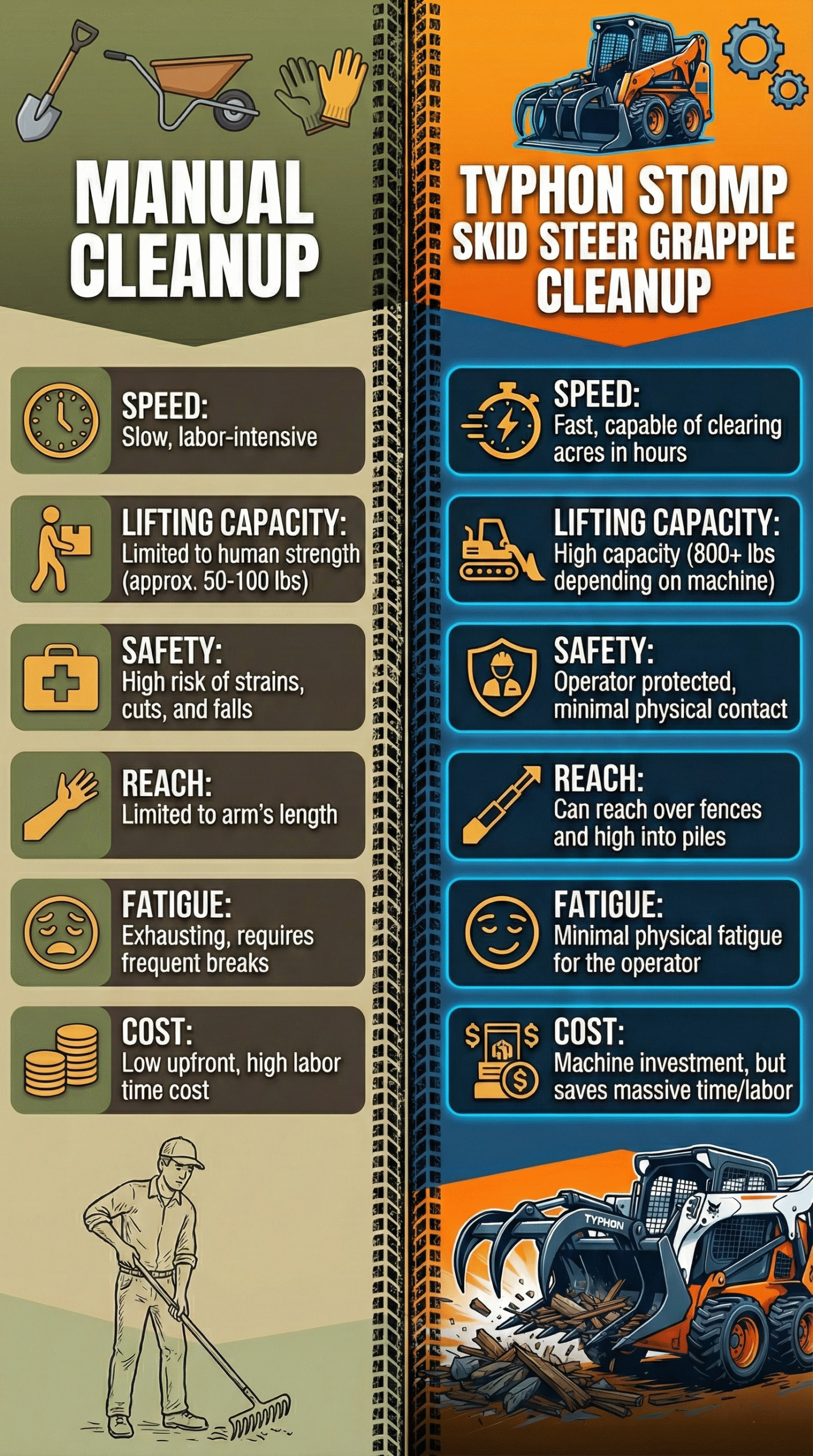
Manual Cleanup vs. TYPHON STOMP Skid Steer Grapple Cleanup
| Feature | Manual Cleanup | Skid Steer Grapple Cleanup |
| Speed | Slow, labor-intensive | Fast, capable of clearing acres in hours |
| Lifting Capacity | Limited to human strength (approx. 50-100 lbs) | High capacity (800+ lbs depending on machine) |
| Safety | High risk of strains, cuts, and falls | Operator protected, minimal physical contact |
| Reach | Limited to arm’s length | Can reach over fences and high into piles |
| Fatigue | Exhausting, requires frequent breaks | Minimal physical fatigue for the operator |
| Cost | Low upfront, high labor time cost | Machine investment, but saves massive time/labor |
FAQs: TYPHON STOMP Skid Steer Grapples for Disaster Cleanup
What is the best skid steer attachment for storm cleanup?
Root grapple or skeleton grapple is probably the most popular attachment people recognize as the best for storm cleanup. Thanks to its open-tine structure that allows dirt to fall through the wood is being held very tightly no matter whether it is in the form of logs, branches or scrap metals. This feature makes it very efficient and worthy of replacing your standard bucket in the disaster debris clearing operations.
Is a mini skid steer like the TYPHON STOMP able to use a grapple attachment?
TYPHON STOMP, out of the box, does not come with a grapple attachment but the mini units like this one are great platforms for one. Besides, there are mini grapples specifically built for TYPHON STOMP in the market. The yard and tight spots that are inaccessible to the bigger machines are quite suitable for these mini combos.
How do I go about deciding what size grapple to get for my skid steer?
A grapple that is wider than your skid steer’s track or tire width is a good idea since it stops you from driving over the debris you haven’t yet cleared. On the other hand, you have to make sure the grapple is not too heavy as to exceed your machine’s lift capacity. The width of mini loaders’ grapples is usually somewhere between 36″ and 48″ whereas the bigger ones go for 60″ to 84″.
Is a root grapple better than a bucket for debris removal?
The answer is yes if your primary concern is debris removal. A bucket will not only pick up trash but also dirt, water and mud which makes it heavier and more messy to dispose of. While a root grapple will clamp only the debris and without the heavy soil, your loads will be lighter and cleaner.
Will I need high-flow hydraulics to operate a grapple attachment?
No, you will not. Grapple buckets and root grapples that come standard work perfectly fine on standard flow hydraulic systems. High-flow is only used for attachments that operate continuously e.g. brush cutters or stump grinders. A relish in standard flow works well for the typical grapple that relies on hydraulic cylinders to open and close.
What is the weight limit to be lifted by a skid steer grapple?
A skid steer loader determines a grapple’s lifting capacity, not the grapple itself. Let’s say your TYPHON STOMP can lift up to around 830 lbs, which means that the total weight of debris plus the grapple must be less than the said limit. Your real payload can be easily calculated always by deducting your attachment weight from your machine’s rated operating capacity.
Is a skid steer grapple a right tool for concrete and rock removal?
Yes, they can be used. Generally, this type of grapples are suitable for lifting broken concrete and large rocks. A “rock grapple” or a heavy-duty unit with reinforced tines should, however, be used to move heavy stuff such as concrete slabs. Regular brush grapples will bend under the load when used to pry up huge slabs of concrete, so always match the attachment strength to the density of the material.
Final Verdict – TYPHON STOMP Skid Steer Grapple
It is a race against time in a post-disaster situation to get the place up and running and safe again. Despite the fact that the damage from the storm could be extensive, the process of cleaning up shouldn’t be a second disaster.
The reliable powerful machine TYPHON STOMP point skid steer grapple equiping the a you work not harder smarter giving leverage dozen workers single machine turning piles chaos organized stacks removal Picking up a fallen tree on the driveway or going through the debris of a building that has been damaged, however, the right equipment will always be the best of your allies.
Why not drop by SkidSteerLoader.net and check out the selection of mini skid steers and attachments that we offer which will not only help you deal with the storm but also be stronger on the other side? Leave the debris behind – Hold it, Shift it Get out of the way and Start Building again.