How to Move Odd-Shaped Loads Quickly with a Grapple Attachment
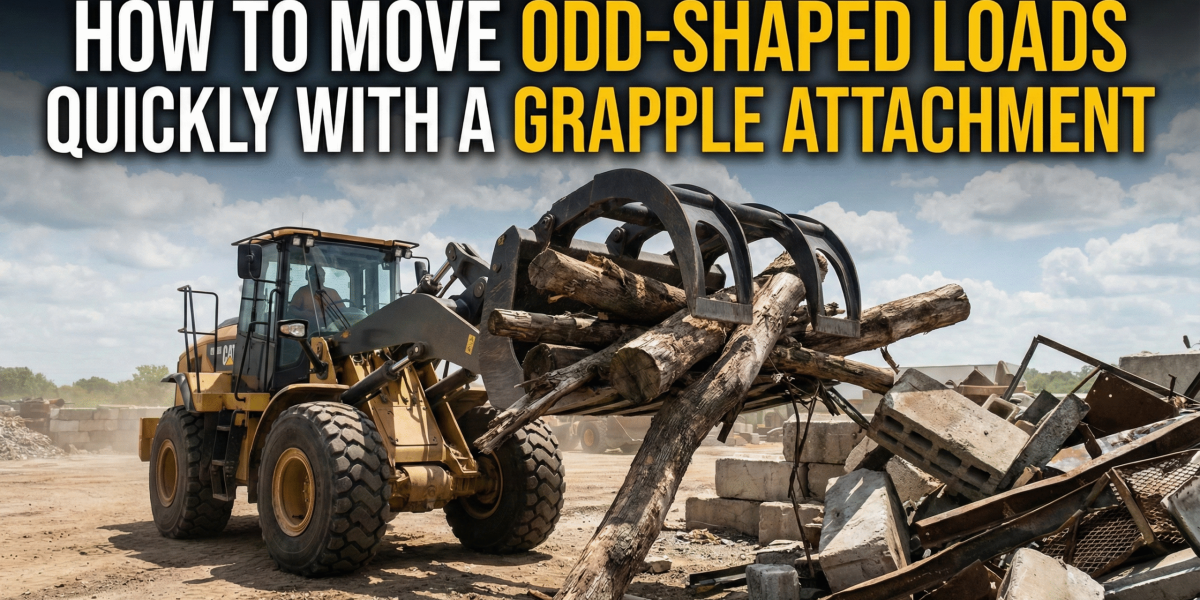
Working on construction, landscaping, and agricultural projects today is not only about being strong, but also about being precise and having the right tools and skills. One of the biggest problems that operators have is how to move odd-shaped loads efficiently – these are the materials that are too big, badly shaped, or too complicated to be handled with a bucket which can be quickly solved by skid steer grapple attachment.
So, it could be broken concrete pieces from demolition, twisted roots from a tree removal, or long and not evenly sized wooden logs – in all these cases, the bucket may not be sufficient and can result in hazardous spillage and inefficient multi-trip hauling.
The answer is in the correct use of the skid steer grapple attachment that can be a hydraulic hand when combined with a powerful machine like the TYPHON STOMP, bringing the strength and dexterity required to handle fragile or irregular loads.
Thoroughly grasping the nature of the material and carrying out sophisticated grappling maneuvers, the operator can convert a disorderly environment into an efficient production line. In this article, we focus on the professional ways of handling challenging materials that would safeguard the equipment while maintaining a high level of productivity.
The Limitations of Standard Buckets for Irregular Loads
For several years, the standard dirt bucket has been the most popular attachment for all types of material handling, but its limits become clear very quickly when dealing with irregular debris.
A standard bucket depends on gravity and volume for holding material, which is very effective for free flowing particles such as soil, gravel, or sand. On the other hand, if you are trying to move odd-shaped loads like brush, scrap metal or rocks, because there is no way to secure the load from the top, you will create a dangerous situation when the load might shift or fall during transportation.
This forces the driver to work slowly and take smaller loads to avoid accidents, thus making the working place less efficient. Also, because bulk items cannot be clamped, a bundle of tree branches will “fluff up” filling the bucket volume completely but weighing only a small fraction of the load, thus wasting time and fuel.
- Instability Risks: Odd-shaped loads without a clamping mechanism are top-heavy and unstable, hence, they can shift, suddenly change the machine’s center of gravity and even tip-over if the operator is not careful.
- Reduced Efficiency: Because of the potential for spillage, no full loads can be made once operator in a different load is made; this increases engine wear and fuel consumption over the duration of the project.
- Manual Labor Dependency: More often than not, a person is required to assist in physically stacking or balancing the debris in a standard bucket which entails additional unnecessary safety risks and workers cost.
Leveraging the Typhon Stomp and Grapple for Maximum Control
The TYPHON STOMP mini skid steer loader is a revolutionary compact material handling machine. It makes a significant difference in our day-to-day life if a machine of smaller size but more robust and versatile, unhampered by the restricted spaces of a backyard or a tight construction alley, is at our disposal.
When the residential, commercial, or even the industrial contractor is pushing or pulling large, unruly pieces through a maze of tighter-than-usual dimensions, the TYPHON STOMP, with its 23hp Briggs & Stratton or Honda, block and great hydraulic bite, is the weapon of choice.
Bearing in mind more-than-the-norm-for-its-size hydraulic torque–maxing out at 50NM when running at 3000 rpm–the grapple attachment uses this energy for masticating brush heaps or steel scrap piles, locking uneven objects in it with great solidity against the machine’s back.
By incorporating this kind of equipment with a TYPHON STOMP, the compact loader not only transports the material efficiently but also manipulates the environment actively and with spirit.With the “Sky Hooker” ability and a robust lifting capacity of over 830 lbs, even oddly shaped, wet logs or monstrous solid rocks can be handled briefly.
- Hydraulic Compression: pushing the cylinders of the grapple make it possible to pack the brush, making it less airy hence, more controllable volume load.
- Precision Maneuverability: The small size and the maneuvrability of the TYPHON STOMP give the operator the possibility of approaching odd loads from the angle which allows one to grab the asymmetrical object by its center of gravity.
- Versatile Attachment Interface: Modalities of rapid transitions between a standard bucket and a grapple (or a 4-in-1 bucket serving also as a grapple) are instrumental in ensuring machine always performs optimally for any type of irregular load.
Technique: The Center-of-Gravity Clamp Method
Among the techniques described here this is by far the most important and yet the most overlooked one. Odd-shaped loads are unbalanced and, therefore, dangerous. A large tree root or a piece of scrap metal can be very heavy on one side only.
If the operator grasp the object with his grapple randomly, the heavier end will inevitably pull the machine off-balance, causing it to tip over.
What is commonly called the “center-of-gravity clamp” methodhelps one avoid this hazard by basically forcing the loader arms to be in perfect balance during the pick up. It does so through the operator pre-visualizing the weight distribution of the odd load and by engaging the hydraulic clamping mechanism precisely at the point of the load’s center of gravity.
- Operator Experience and Knowledge: This post-mapping visual inspection is aided by operator’s experience that enables better and quicker judgment of mass centers.
- Face-to-Face: When the operator and the load are engaging closely; not only the accurate positioning can be done but the tactile feedback also helps greatly in load control.
- Three-Point Contact: Make sure that the object is in contact with the bottom tines, the back of the bucket/frame, and the top clamp; this three-point contact triangulation offers the highest stability.
Approaching and securing Debris Piles
Thinking about and handling loose and irregularly shaped component piles is a matter of adopting another strategic approach – the ‘Rake and Compress’. When faced with a pile of mixed and matted vine, broken pieces of wood, concrete pieces, a simple scooping action is not going to be the solution.
So, an operator will tilt (skid steer grapple attachment) forward so as the bottom tines of the grappler are acting like a rake. The operator should move forward the machine as the tines go down low enough into the pile.
During this whole operation, the tines are working like a shovel in that they scoop the bigger parts of the debris. Once the tines are full you must keep on pushing the pile even in the grapple throat thus forcibly storing the material. Once this is done you can simply pull back the attachment and clamp the top jaw.
The compression is a kind of lock that is achieving the result of a single piece from various odd-shaped fragmented parts. No more consecutive dropping of debris as it happens when inexperienced operators attempt to move debris with a standard bucket.
- Sifting Action: The use of skeleton grapples with open bottoms allows costly topsoil disappearance as the dirt can be sifted out and retained with the sparse top debris imo the soil less heavy load saving on the fill dirt.
- Aggressive Compression: A reasonable amount of hydraulic force used by the grapple to crush the load (if the contained materials are crushable) is not to be feared; this is actually safer transport fitted with a tighter bundle.
- Approach Angle: Choose the attack angle so that debris piles can be reached from the bottom up instead of a downward top attack; the ground is here used as the starting point for the first counter-force to assist in loading the tines fully before clamping.
Safe Transport Techniques for Asymmetrical Loads
After fastening the load which is odd in shape securely, the phase of moving it presents some challenges of its own. In fact, irregular loads often stick out over the sides of the unit, so the operator has to be very careful with the spatial aspects of the loading environment. Hence the introduction of the “Low and Slow” rule.
Usually just 2 inches below the loaded part is the preferable carrying height. If the operator follows this guideline always no incident should happen because the center of gravity stays low which is extremely important if the load happens to be unbalanced.
On top of that, when the operator wants to turn left or right but the load is hanging way out on one side (like a log or a pipe), he has to think beforehand about the swing radius of his machine. Thus, the swing radius of his machine is needed to be considered in advance.
- Swing Radius Awareness: Constantly monitor the protruding ends of odd-shaped loads, as they effectively increase the width of your machine and can clip obstacles during turns.
- Terrain Management: Avoid traversing slopes sideways with an odd-shaped load; always travel straight up or down slopes to maintain lateral stability and prevent tipping.
- Load Height Discipline: Never raise an odd-shaped load high in the air until you are directly in front of the dumping zone; traveling with a raised, unstable load is a recipe for disaster.
Skid Steer Grapple Attachment
Comparison of Attachment Efficiency
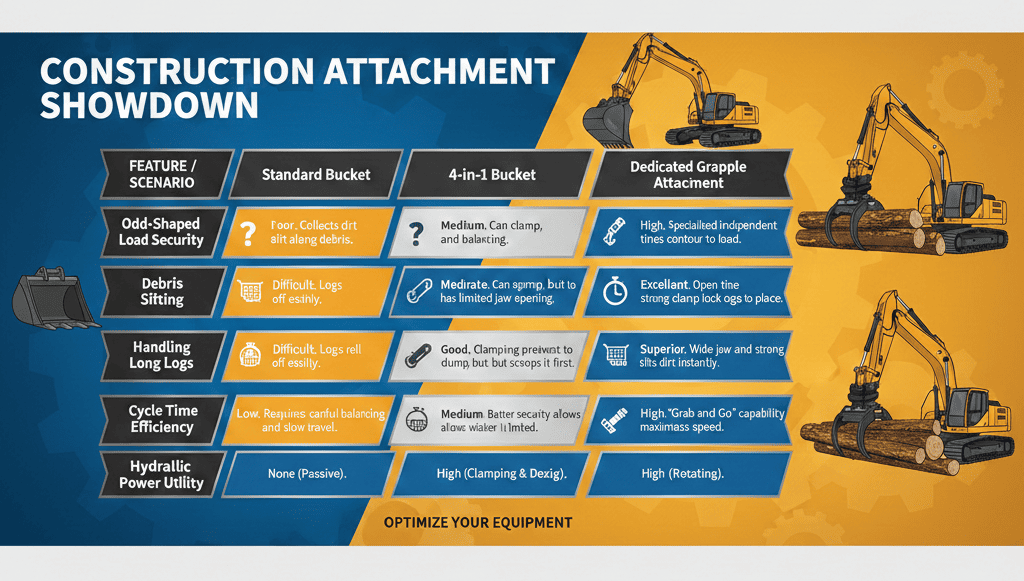
A grasp at the fundamental reasons leading to the success of the use of a grapple in this specific task might be achieved through a direct comparison with other attachments typically used in similar situations.
| Feature / Scenario | Standard Bucket | 4-in-1 Bucket | Dedicated Grapple Attachment |
| Odd-Shaped Load Security | Low. Relies on gravity and balancing. | Medium. Can clamp, but has limited jaw opening. | High. Specialized independent tines contour to load. |
| Debris Sifting | Poor. Collects dirt along with debris. | Moderate. Can open bottom to dump dirt, but scoops it first. | Excellent. Open tine design sifts dirt instantly. |
| Handling Long Logs | Difficult. Logs roll off easily. | Good. Clamping prevents rolling, but width is limited. | Superior. Wide jaw and strong clamp lock logs in place. |
| Cycle Time Efficiency | Low. Requires careful balancing and slow travel. | Medium. Better security allows faster travel. | High. “Grab and Go” capability maximizes speed. |
| Hydraulic Power Utility | None (Passive). | High (Clamping & Dozing). | High (Clamping & Rotating) |
FAQs on Grapple Attachments
What is a grapple attachment used for?
If you want to have an attachment that can grapple, hold, clamp, and move all kinds of oddly shaped and bulky objects, then you need a grapple attachment. It is the perfect attachment for removing brush, lifting big stones, taking logs from one place to another, and disposing of demolition wastes. One of the features that the hydraulic clamp brings to the table is, no doubt, keeping these difficult loads safe and stable, thus, significantly raising the level of safety and efficiency at jobsites.
Can I install a grapple attachment on any skid steer?
As a general rule, yes, if the skid steer is provided with a universal mounting plate, which is sometimes known as the Universal Skid Steer Quick Attach, and the auxiliary hydraulic ports are available. Nevertheless, it is important to consider that the size and the weight of the grapple must correspond to the machine’s working/{operating} capacity. For example, the TYPHON STOMP is compatible with compact grapples only since these can go within its lifting capacity of 830 lbs and hydraulic flow rates.
How do I maintain my grapple attachment?
Basically, maintenance consists of lubricating all the moving parts and cylinder joints with grease so as to prevent wear. Additionally, one should always perform a pre-use inspection of the hydraulic hoses to look for potential leaks or abrasion. One should also routinely examine the tines and the teeth for any damage or excessive wear, and it is very important to keep the hydraulic couplers clean and free of dirt in order not to contaminate the skid steer’s hydraulic system.
Is training required to operate a grapple attachment?
Formally getting certified by an authority might not always be required for individually owned machines, but operator training is certainly recommended. Being a grapple user means you have some new controls (open/close jaws) as well as a changed center of gravity for the whole machine. Novices shall, therefore, carry out their first practice sessions on flat ground with light loads, in order to get a feeling of the attachment before trying to handle heavy or odd-shaped loads on active job sites.
What is the difference between a root grapple and a bucket grapple?
A root grapple (sometimes called a skeleton grapple) possesses a bottomless design with tines spaced far apart that permits the soil and minor waste to filter through while the large debris like roots, stone, and wood is held on top. In contrast to this, a bucket grapple (also referred to as a scrap grapple) resembles a standard bucket in that it has a closed bottom, but it features a top clamp here and there. The bucket grapple is useful in handling the loose material that is mixed with scrap, such as metal or gravel with trash, and you want to avoid sifting out the small pieces.
How do I choose the right grapple for my project?
The type of material and the specification of your equipment play a big part when it comes to making a choice. Depending on whether the project involves brush earth the desire is to leave the soil behind so the open-tine root grapple would be the most appropriate. On the other hand, demolition and scrap yards require a solid-bottom grapple bucket. The amount of weight that your loader can lift is the main limiter when deciding on the grapple that you will use. For a very small machine such as the TYPHON STOMP, the optimum choice is a lightweight but high-strength steel grapple.
Why is my grapple losing grip strength?
If your grapple is losing grip, the most common culprit is a hydraulic issue. Check for low hydraulic fluid levels in the skid steer, or inspect the hoses and cylinder seals for leaks. It could also be a sign of air in the hydraulic lines or a worn-out hydraulic pump on the machine. Ensuring your couplers are fully engaged and not damaged is the first troubleshooting step.
Conclusion: Skid Steer Grapple Attachment
Changing odd-shaped loads from a bottleneck to just a point in your workflow that keeps on with the rest of the flow is now simple. Work with a perfect combo: a TYPHON STOMP and a high-quality skid steer grapple attachment, and your versatility and efficiency will know no bounds.
In no time you will see projects getting finished on time as you have been able to clamp, lift, and maneuver irregular objects with precision. The risk of accidents becomes a thing of past while the laborers get to save their energy as the physical strain is greatly reduced.
No matter whether you are planning to be a professional landscaper, a farmer, or a construction contractor, you will definitely benefit from mastering the center-of-gravity clamp and the rake-and-compress techniques if you really want to work smart with your equipment.
Matching the job with right skid steer grapple attachment and obeying the laws of physics forming the load will be a winning formula for you given the correct tools and correct techniques even the most awkward load will turn out to be just another simple lift.