
Technique: How to Efficiently Move Odd-Shaped Loads with a Grapple Attachment
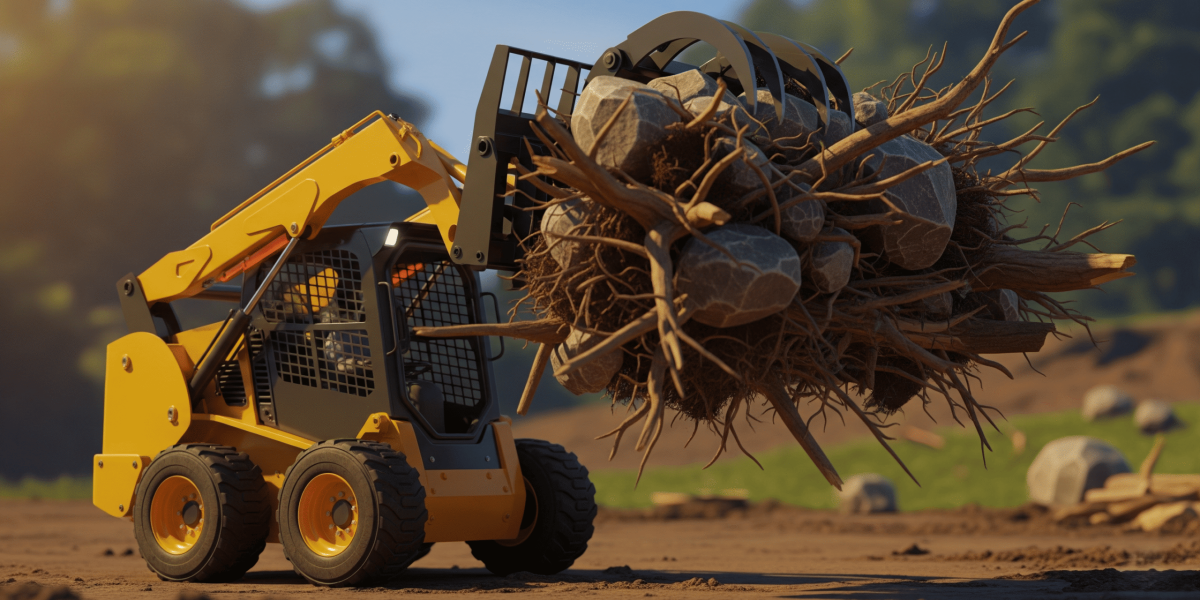
Among the hardest things for heavy machinery operators to do is clearing up debris with odd shapes. In most cases, a regular bucket simply will not be able to handle such diverse materials, like twisted tree roots, jagged concrete slabs, or tangled demolition scrap, effectively, hence the best solution is Grapple Attachment.
Materials handling experts should not limit themselves to knowing just one method: they should learn how to use the grapple attachment for moving loads of irregular shapes fast and easily.
This tool with a high degree of accuracy enables your skid steer to firmly grip the objects, but your productivity will only be boosted if you are able to do more than just closing the jaws. You will have to come up with a plan that considers not only the hydraulic force and the center of gravity but also the durability of your machine.
A grapple attachment is a solution that a regular bucket simply doesn’t provide. A grapple, by means of its own hydraulic cylinders, is able to flex its halves so as to tightly wrap the pieces of a load that are of different shapes and sizes.
To get the most out of your skid steer and its attachments as well as safety and productivity, this guide will provide you with the right work techniques which professionals use.
Understanding the Mechanics of the Grapple Attachment
Knowing why the grapple is the right tool for lifting odd-shaped objects is a must before getting your hands dirty. A grapple attachment is very different from a regular bucket in that it uses hydraulics to perform the clamping.
Top-of-the-line grapples, which are also listed on skidsteerloader.net, may have the dual independent cylinders option allowing two halves of the jaw to clamp the load at different places.
- Dual Independent Cylinders: This technology grants the grapple the capability to give equal pressure to both sides of the uneven object that it is gripping.
- High-Strength Steel Construction: It is advisable to confirm that the grapple’s steel is Grade 50 or stronger for resisting the stress of irregular loads without the tines bending.
- Open Bottom Design: This is a very important feature that allows dirt and small debris to fall through while retaining the main, oddly shaped material that you intend to move.
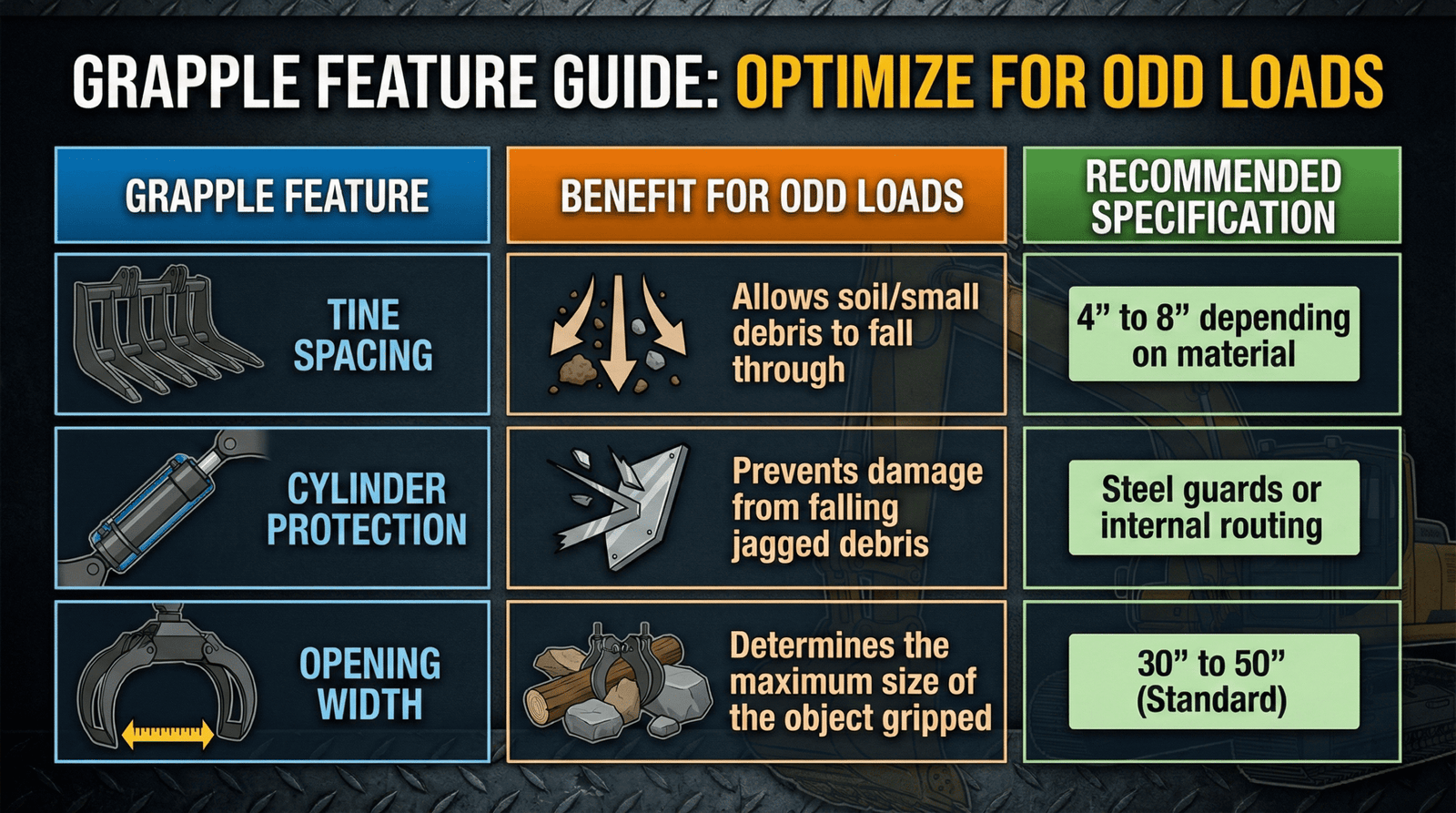
| Grapple Feature | Benefit for Odd Loads | Recommended Specification |
| Tine Spacing | Allows soil/small debris to fall through | 4″ to 8″ depending on material |
| Cylinder Protection | Prevents damage from falling jagged debris | Steel guards or internal routing |
| Opening Width | Determines the maximum size of the object gripped | 30″ to 50″ (Standard) |
Grapple Attachment Features
The “Scoop and Clamp” Technique for Bulk Debris
If the heap that you need to clear is mainly composed of disordered brush and waste from construction, then the most effective technique: how to efficiently move odd-shaped loads with a grapple attachment will be “Scoop and Clamp”.
Many operators think it is enough to put the grapple down on the pile from the top. In most cases, this will give you an unstable load that is likely to spill or shift during transport. Instead, think of the bottom tines as your fork and make them penetrate the pile’s base before anything else.
- Approach Low and Level: When getting to the load, run the tines parallel with the ground and for the base of the load.
- Tilt and Lift: As soon as you go into the pile, tilt the attachment back a little so that the material will be settled against the frame’s back.
- Final Clamp: Use the hydraulic jaws only after the load is settled to get the closest grip possible.
Balancing Long and Linear Odd Loads
If you are working with long cylindrical stuff like logs, telephone poles, or pipes, then you will need a totally new way of handling the matter. Due to the fact that these goods are long in comparison to their width, your main concern should be the center of gravity.
In case you grab a log too much on one end, the weight will create torque, which will either put stress on the loader arms of your skid steer or even make the machine overturn when turning.
- Locate the Center Point: Before getting to the load, make a visual estimate of its middle.
- Low-Level Testing: After clamping, the only height that the load should be lifted is just a few inches from the ground and this is in order to check whether it is balanced.
- Travel Position: If you want to keep your center of gravity low, then the principle is to always bring the odd and lengthy load close to the ground.
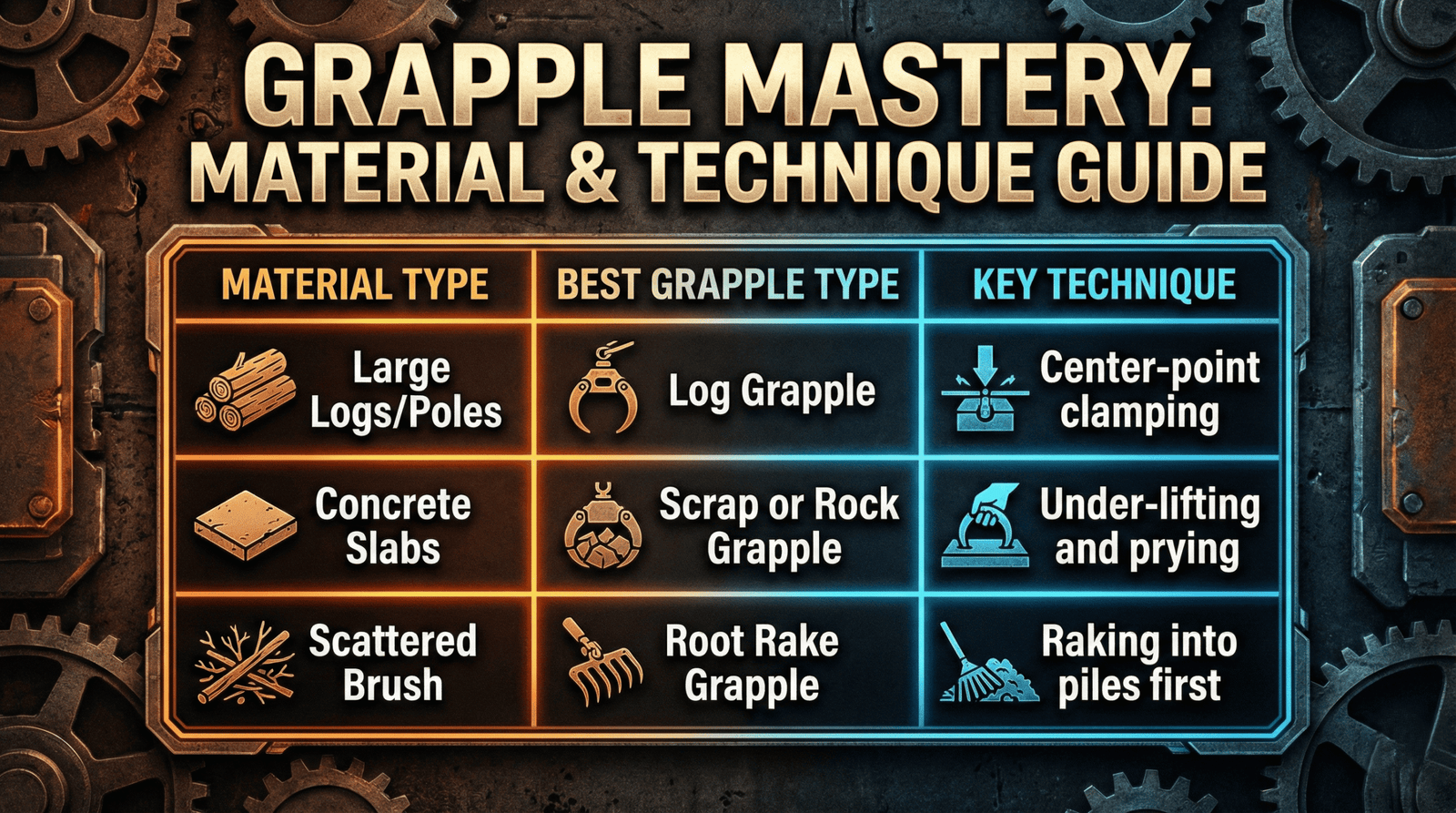
| Material Type | Best Grapple Type | Key Technique |
| Large Logs/Poles | Log Grapple | Center-point clamping |
| Concrete Slabs | Scrap or Rock Grapple | Under-lifting and prying |
| Scattered Brush | Root Rake Grapple | Raking into piles first |
Grapple Attachment Guide
Raking and Consolidating for Maximum Efficiency
Carrying out tasks efficiently does not only mean transporting the product wrongly prepared. One of the most efficient uses of a grapple is actually for raking purposes. Instead of running after the debris pieces scattered around a site, you can get the open jaws and tines’ strength to gather the loose material into a concentrated “power pile.” As a result, there will be fewer trips for your skid steer thus saving fuel and less tire wear.
- Back-Raking: Use the cleaned tines by opening the jaws and pulling the debris toward the machine with the top tines.
- Consolidation: Make a large pile in a single location before you start the loading process.
- Clean Sifting: While raking, shake the attachment slightly to let valuable topsoil fall through the tines.
Safety Protocols for Heavy Irregular Loads
Safety is the most significant aspect of any technique: how to efficiently move odd-shaped loads with a grapple attachment. Since odd loads are less predictable, they have the potential to shift at any time during transport.
A log that you think is secure might slide out if you take a corner too fast. Make sure the combined weight of the grapple and the material doesn’t exceed the skid steer’s Rated Operating Capacity (ROC).
- Hydraulic Pressure Check: Before disconnecting or connecting hoses, always release the hydraulic pressure first.
- Visibility: Make sure the load does not completely block your line of sight. If it does, then you should either travel in reverse or have a spotter with you.
- Maintain Your Equipment: Greasing the pivot points of the grapple jaws regularly will keep them from seizing or moving erratically.
FAQ: Grapple Attachment
What is the difference between a root grapple and a rock grapple?
A root grapple usually has wider tine spacing (5-8) inches and it is made for pulling out roots and large brush. On the other hand, a rock grapple has narrower spacing (2-4 inches) but is more suitable for picking up smaller stones while also sifting out the dirt.
Can I use a grapple attachment on a small or mini skid steer?
Yes, but you have to ensure that the grapple is not heavier than the mini skid steer and that its hydraulic requirements are within the range of the machine’s capacity. Mini skid steers have to use lightweight “mini” grapples to make sure that they won’t tip over.
How do I prevent my grapple tines from bending?
Always select an attachment that has a high yield strength of more than 50,000 PSI and do not “ram” into a pile with the jaws closed. You should use the bottom tines for scooping, instead of top jaws for hitting.
Why are dual-cylinder grapples better than single-cylinder models?
Dual-cylinder grapples are equipped with two cylinders, which enable each half of the jaw to move separately. It implies that when you pick up a load which is thick on one side, both cylinders can still apply maximum pressure, whereas a single cylinder might leave one side of the load loose.
How much weight can a standard skid steer grapple lift?
This lifting capacity limit is dependent on your skid steer’s ROC. Normally, a grapple is able to carry anywhere within the range from 1,500 to 4,000 lbs, but you have to subtract grapple weight when calculating total machine capacity for lifting.
Do I need high-flow hydraulics to run a grapple?
The truth is that most grapple attachments perform well on standard-flow hydraulic setups. High-flow is usually reserved for continuous-rotation tools such as mulchers or cold planers.
How often should I grease my grapple attachment?
If you use your grapple attachment intensively then you must lubricate the pivot points after every 8 to 10 hours of operation. Using the correct amount of lubricant will protect the pins and bushings from early wear due to friction.
Maximizing Longevity Through Proper Maintenance
It is the maintenance of good equipment that keeps it at its best performance level. The working conditions of grapples are full of dust and earth, mud, and fragments of stones and other jagged materials, which are all factors that contribute to the wear and tear of machinery.
Sticking to a maintenance routine will not only keep the tool clean but also allow your technique: how to efficiently move odd-shaped loads with a grapple attachment to be your secret weapon for years to come.
Hoses should be inspected every day especially near the most vulnerable areas, such as the pivot points where the hoses are prone to being pinched.
The bolt tightness check should be part of your daily routine since the vibration caused by lifting and moving heavy uneven loads can inevitably loosen the bolts over time.
After each use, if there is a possibility that rust or other damage can occur, and mechanical should be avoided as if by magic, then clean as well as make use of the appropriate rust preventer.
For any professional, whether in landscaping or construction, operating a grapple attachment on a skid steer will definitely make the work easier. Problems with debris that are beyond easy clearing can be tackled successfully if you think about the balance, go for the “scoop and clamp” method, as well as keep the equipment up to date.