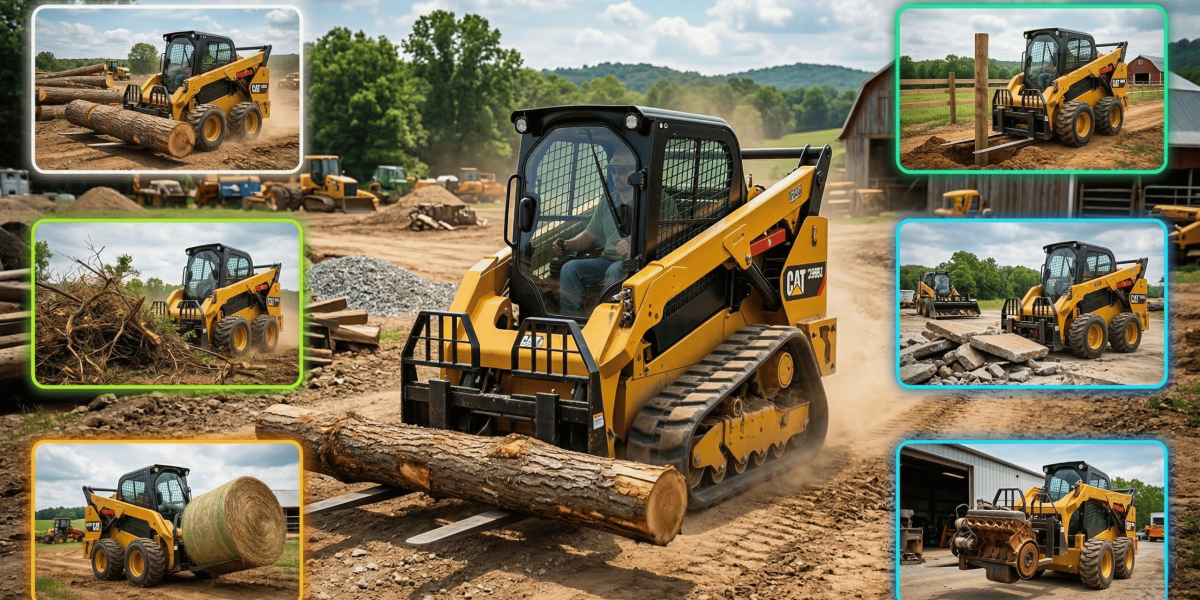
Beyond Pallets: 7 Creative Uses for Skid Steer Forks You Haven’t Anyway!
When an operator thinks about skid steer forks, they usually first picture the scenery of a warehouse loaded with tidy pallets of wood. Of course pallet forks are the best when you need to move palletized goods. However, their usefulness is not limited to merely the warehouse area. We at SkidSteerLoader.net are of the opinion that one attachment like Skid Steer Forks should be enough to get you more return of investment from your whole fleet.
The latest skid steer forks are made by using high tensile steel and a universal quick-attach system. These features make the fork a lot more than a “mere forklift imitation”. If pallets are the only items that you are handling by using your fork, then you are making a triple mistake of losing money, time, and efficiency whereas this attachment can be used for landscaping and agricultural work.
Here is a big list of ways how you can creatively use skid steer forks. Prepare to be amazed at how your loader can be changed in to a multi-purpose machine!
Top 7 Creative Uses of Skid Steer Forks:
1. Putting Boulders and Large Rocks in the Right Spots with Lofty Precision
If you are changing your backyard into a Korean Zen garden, you will most likely have to handle large, heavyweight, and unbelievably beautiful rocks. A round-the-corner type of bucket will hardly help you position those boulders in the intended spots. On the contrary, by simply hitching skid steer forks, you are able to go beneath the rock and tilt it securely to the frame of the loader.
- Tine Adjustment: Thin down your skid steer forks to house the rock safely in the center, so that the rock does not slip in the way during haul.
- Visibility Advantage: Contrary to a closed bucket, the line of vision is not obstructed by the forks, so that you can accurately place rocks very close to one another in your rock garden.
- Ground Protection: The slimness of each tine means that they come in less contact with the ground, taken into account that a heavy-duty bucket has a wider edge.
| Feature | Benefit for Rock Handling |
| Adjustable Tines | Fits various rock widths and shapes |
| Slim Profile | Accesses tight crevices in retaining walls |
| High Visibility | Reduces risk of hitting surrounding structures |
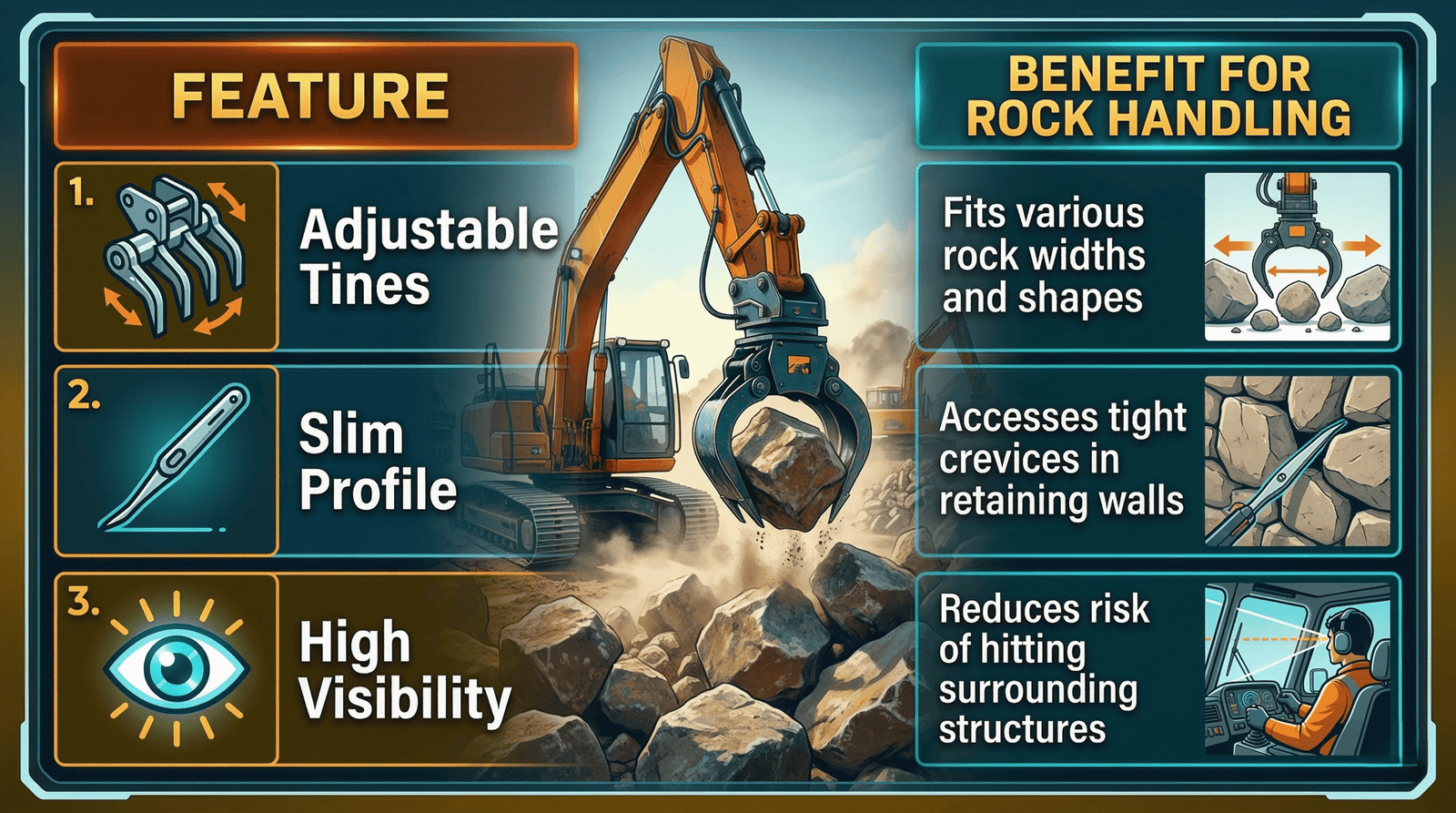
Skid Steer Forks Features
2. Using Your Skid Steer Forks to Remove Construction Debris That is Beyond the Capability of a Bucket
The nature of construction sites is that they are always dirty and some debris is too long and awkward to fit a bucket. Skid steer forks work like a cross between a rake and a lift, allowing you to move coiled lengths of discarded PVC, off-cuts of long timber, and metal framing very efficiently.
- Overhead Clearance: Use the forks to lift bundles of debris straight into dumpsters with very high sides, thus giving you a break from manual workers.
- Sorting Efficiency: Discard small rubble and dirt while you “sift” through a pile to pick out valuable scrap metal or lumber.
- Teaming with Chains: You can hang heavy generators or compressors with you chains if be using the lift points of high-quality skid steer forks.
3. Your Farm’s Very Own Agricultural “Swiss Army Knife”
Farmers appreciate that a bale spear is a great tool, but a set of sturdy heavy-duty skid steer forks can often perform the same task while providing even more stability for square bales. Besides hay, they are indispensable for tackling almost all tough aspects of farm life.
- Feed and Seed Bags: Carry large bags (tote bags) by simply placing the forks through the support loops at the top—much safer than piling up in a bucket.
- Gate and Fence Prep: Move bundles of fence posts or wire mesh rolls straight to your installation spot without breaking a sweat.
- Livestock Management: Apart from elevating feeders and water troughs, the forks can even be used to assist in large game harvests processing.
4. Physical Roof Work and Second-floor Deliveries
Carrying materials to the roof by ladder can be a dangerous task. When you use skid steer forks as a vertical lift that goes with you wherever you go, you actually make much more money. Seating your machine near the eaves, you can offer a “supply station” service for your crew.
- Shingle Distribution: Your capable loader can lift shingle pallets to the rooftop level, so workers can grab bundles when desired.
- Waste Management: With a bin placed on the forks, one can be handed the roof level collecting torn off shingles.
- Safety First: Do a double-check of your loader’s Rated Operating Capacity (ROC) before lifting a load in height and weight to ensure there is no step over in the tipping angle.
5. Salvage and Vehicle Maintenance Support
Use of skid steer forks in a workshop or salvage yard is regarded as one of the most important tool for moving vehicles not in running condition or lifting them for undercarriage examination. Mechanics love them for their ability to reach under a chassis.
- Lawnmower Maintenance: Zero-turn mowers or small tractors can be lifted in order to clean the mower decks or change the blades (never forget to use jack stands for secondary support).
- Engine Swaps: Add a lifting hook, and skid steer forks become a mobile crane to pull out engines or heavy transmissions.
- Scrap Car Moving: Tines can be pushed under the frame of a scrap car to reposition it in a yard where a tow truck may be unable to enter.
6. Wrangling Brush Pile and Land Clearing
Though a grapple is the typical king of brush, skid steer forks can be what many call their “Plan B” for such a task. Operators not wanting to switch between attachments constantly can surprisingly use forks to handle large quantities of vegetation.
- The “Fork-and-Roll” Technique: Pile up a bunch of downed limbs by sliding the tines under and “roll” the nice bundle for transport.
- Log Skidding: Lift one end of a large log off the ground and skid it out of the forest without the log digging into the ground.
- Stump Assistance: Use the long tines to loosen the root ball from the ground once it is ground or broken.
7. Facility and Event Management Made Easy with Creative Use of Skid Steer Forks
You can never anticipate when skid steer forks attachment will come in handy whether it is a local festival or a sports complex you are managing.
- Portable Hoop Stations: Borrow the idea of a basketball court out and put a backboard and rim on the forks, lift to the regulation 10-foot height.
- Bleacher Moving: In fact quite a few portable bleacher systems come with fork pockets internally, so with only one operator, seating for hundreds can be moved in a matter of minutes.
- Temporary Lighting: A frame with fork-mounted LED light banks can be used to provide top-notch lighting for nighttime work or even emergencies.
| Use Case | Recommended Fork Type | Key Benefit |
| Landscaping | Floating Tines | Follows ground contours |
| Construction | Heavy-Duty Braced | Handles impact and high weight |
| Farming | Long Tines (48″+) | Better stability for hay and bags |
Frequently Asked Questions (FAQ) – Skid Steer Forks
Can I use skid steer forks to lift a person?
No. Using skid steer forks to lift a person is a major safety violation. Only use OSHA-approved work platforms that are specifically designed to be secured to the fork carriage if your machine and local regulations allow it.
How much weight can a skid steer fork attachment typically carry?
Most standard skid steer forks are rated between 2,000 lbs and 6,000 lbs. However, the true limit is your loader’s Rated Operating Capacity (ROC). Always check your machine’s manual before lifting heavy loads like boulders or wet lumber.
What is the difference between fixed and floating pallet forks?
Fixed forks stay at a set angle relative to the carriage, offering precision. Floating forks allow the tines to pivot slightly, which is excellent for picking up loads on uneven ground or “floating” over bumps without dropping the material.
Can I put a bale spear on a pallet fork frame?
Many modern fork frames are “combo” units. They feature slots for pallet tines and threaded holes for bale spears. At SkidSteerLoader.net, we recommend checking your frame’s compatibility before attempting to swap tines for spears.
Are skid steer forks universal?
Most modern attachments use the Universal Quick-Attach (SSQA) system, which fits brands like Bobcat, Cat, Kubota, and John Deere. However, some older or very small “mini” skid steers use proprietary mounting systems.
Do I need hydraulic forks?
Hydraulic skid steer forks allow you to adjust the width of the tines from inside the cab. While more expensive, they are a massive time-saver for operators who frequently switch between different load sizes throughout the day.
How do I maintain my skid steer forks?
You should check the tines every day to see if there are cracks or bends. Make sure the locking pins work and that the rails are free of dust and debris. Using a little grease on the rails can make it easier to slide the tines when you adjust them.
Boost the capacity of your heavy equipment to the maximum. No matter if it is log moving or roof tile lifting that your work involves, the proper set of skid steer forks from SkidSteerLoader.net will assist you finish the task both faster and safer.