How to Choose the Right Skid Steer Forks Based on Pallet Fork Capacity, Class, and Frame Type?
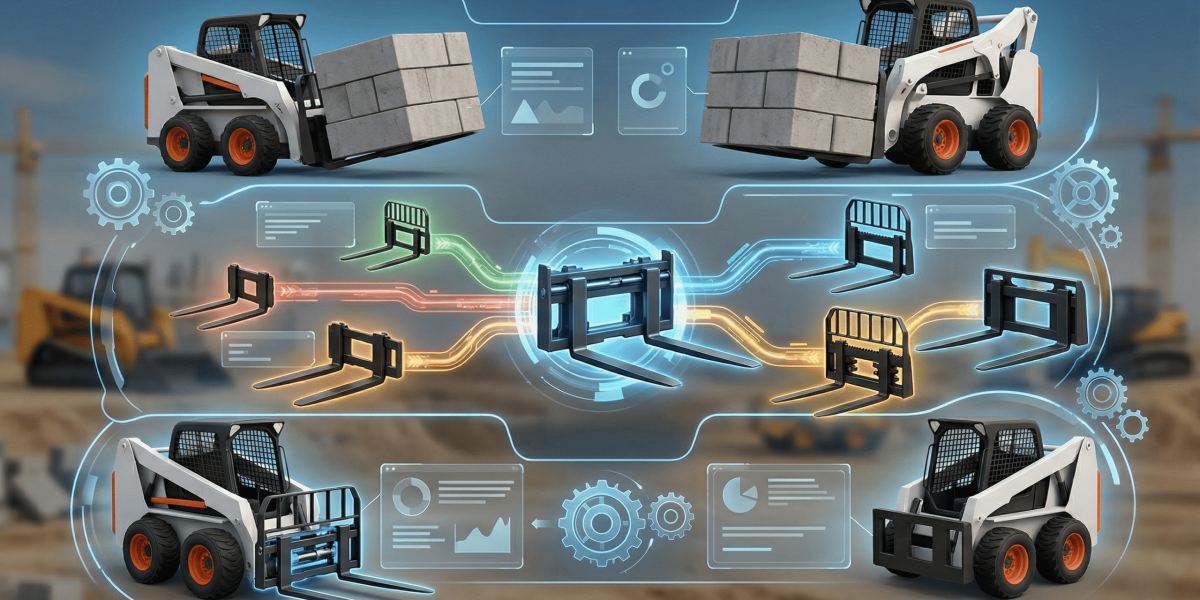
One of the most important things an operator can do to keep the site safe and the skid steer running smoothly is to choose the right set of pallet forks. Many people think of forks as just a “two-pronged” attachment, but the truth is that their engineering is very different depending on the load capacity, mounting class, and frame design.
At SkidSteerLoader.net, we know that the only way to get the most out of your investment is to make sure that the fork’s specifications match the capabilities of your machine, whether it’s a small TYPHON STOMP or a heavy-duty industrial loader.
This guide goes into great detail about the technical aspects of choosing a pallet fork, making sure you pick one that can handle your heaviest loads without damaging your skid steer.
What you need to know about pallet fork capacity and load ratings?
Your pallet forks must always be able to hold as much or more weight than the Rated Operating Capacity (ROC) of your skid steer loader. People often think that “heavier is always better.”
Using forks that are too heavy for a small machine actually makes it harder to lift things, and using forks that are too light for a powerful machine can cause the metal to break or become fatigued. Most heavy-duty skid steer pallet forks can lift between 2,000 and 4,000 pounds, but some industrial versions can lift much more.
- Check the ROC: Before you buy forks for your skid steer, make sure they don’t go over the machine’s balance point.
- Safety Factors: High-quality forks usually have a safety factor, which means they can handle forces that are higher than what they say they can. This is usually 3:1 or 4:1.
- Be aware of the load center: The capacity rating is usually based on a 24-inch load center. Moving the weight further out on the tines makes it much less safe to lift.
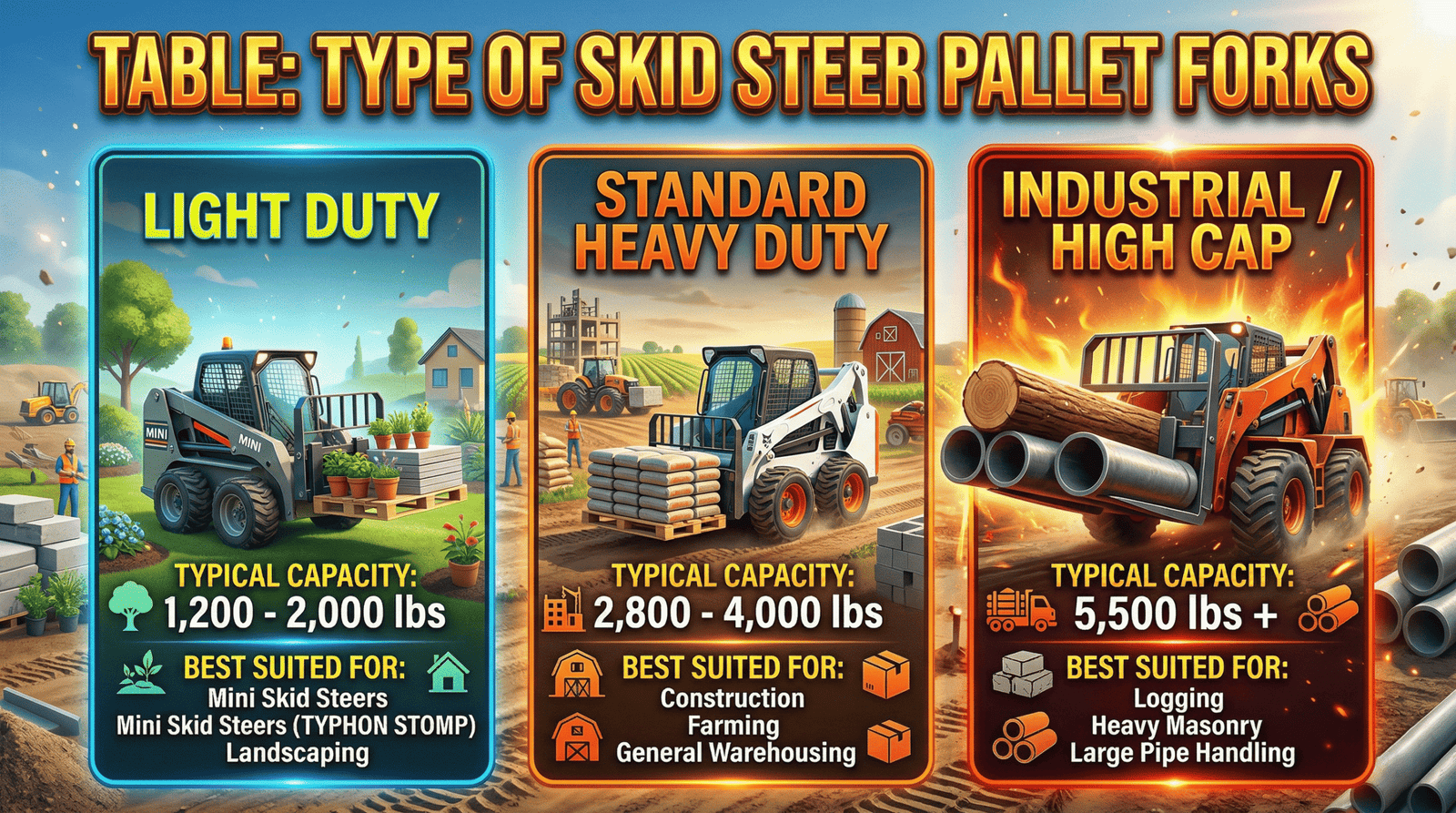
Table: Type of Skid Steer Pallet Forks
| Fork Type | Typical Capacity | Best Suited For |
| Light Duty | 1,200 – 2,000 lbs | Mini Skid Steers (TYPHON STOMP), Landscaping |
| Standard Heavy Duty | 2,800 – 4,000 lbs | Construction, Farming, General Warehousing |
| Industrial / High Cap | 5,500 lbs + | Logging, Heavy Masonry, Large Pipe Handling |
Skid steer Pallet Forks Types
Understanding Pallet Forks Classes (ITA Standards)
Based on the height of the frame they attach to, pallet forks are divided into “Classes.” The International Truck Association (ITA) sets these standards so that forks from one company will fit the carriage of another, as long as the class matches.
Most skid steer loaders will need Class II or Class III forks. Knowing these measurements will keep you from getting angry when you order tines that won’t fit on your frame.
- Class II: This is the most common type for skid steers. It has a carriage bar height of 16 inches and can hold up to 5,500 pounds.
- Class III: These are on bigger, high-flow skid steers and telehandlers. They have a carriage height of 20 inches and can carry up to 10,000 pounds.
To find out what class you’re in right now, measure the distance between the top of the upper fork bar and the bottom of the lower fork bar on your attachment frame.
Different kinds and styles of pallet fork frames to look into
The frame is the most important part of the attachment because it connects the fork tines to the quick-attach system on your skid steer. A good frame doesn’t just hold the forks; it also gives the operator a better view of the field and adds safety features for the load.
Our heavy-duty frames at SkidSteerLoader.net are built with “easy-to-see-through” designs that let the operator find the entry into the pallet without having to guess, which is important for keeping the product safe.
- Walk-Through Frames: These have an open center or a side step that makes it easy for the operator to get in and out of the skid steer cab without having to climb over the attachment.
- Brick Guard Frames: These have a high backrest that keeps materials from leaning back toward the operator or the machine’s hydraulic lines during high lifts.
- Rail-style vs. Pin-style: With rail-style frames, you can move the forks left or right to fit different pallet widths. With pin-style frames, the forks pivot on a shaft.
The Length and Material of Tines Are Important
Choosing the right tine length is a fine line between being able to move around and being stable. Standard pallets can be moved with tines that are 42 inches or 48 inches long, but for larger loads or farm use, longer tines (60 to 72 inches) are often needed.
Longer tines, on the other hand, move the center of gravity forward, which can make the skid steer feel “tippy.” To keep them from bending under pressure, you need to pick tines made of boron steel that has been heat-treated and is very strong.
- 42-Inch Tines: These are the best for tight spaces and standard 40×48 pallets. They make it easy to move around in warehouses or on busy job sites.
- 48-Inch Tines: These are the best for general construction because they fully support standard pallets and have enough overhang for safety.
- Fully Tapered Ends: Look for forks with a sharpened or tapered tip, as this makes it significantly easier to slide under pallets or debris on uneven ground.
Finding the Right Forks for Your Skid Steer Model
Not all pallet forks work the same way. To stay agile, a mini skid steer like the TYPHON STOMP needs a frame that is light and easy to see. On the other hand, a large tracked loader needs a strong frame with reinforced quick-attach areas to handle the machine’s high breakout forces.
If you use the wrong “weight class” of attachment, it can cause your machine’s bushings and pins to wear out too quickly.
- Mini Skid Steer Compatibility: If you’re using a smaller unit, make sure the forks have the “Mini-Universal” or “MT” style attachment plate.
- Hydraulic Adjustability: If you work in a place with a lot of production, you might want to look for frames that let you move the forks around with hydraulics so you can change the width from inside the cab.
- Weight Distribution: Make sure that the weight of the attachment doesn’t take away too much of your machine’s lifting power. For every pound of the frame, you can carry one less pound of cargo.
Pallet Forks: Tips for Keeping Them Safe and Well-Maintained
Even the strongest forks need to be checked on a regular basis to make sure they don’t have any tiny cracks. Overloading is the main reason forks break, but wear from the environment is also a factor.
The “heels” of the forks (the 90-degree bend) are under the most stress because people often use them to pry or “bulldoze” things they weren’t meant to.
- Daily Inspections: Check for cracks, especially at the heel and the mounting hooks. If a fork is 10% thinner than it should be because of wear, it should be replaced right away.
- Don’t load from the side: Forks are made to lift things straight up and down. Pushing things sideways or prying logs with them can bend the tines and throw off the alignment.
- Keep the Load Low: Always keep the load as close to the ground as possible when you travel to keep the center of gravity low.
Questions About Skid Steer Pallet Forks
How big of pallet forks do I need for a skid steer?
The most common size is 48 inches, which is perfect for standard shipping pallets. But if you work in tight spaces, 42-inch forks are easier to move around. You might need 60-inch or 72-inch forks for round hay bales or big machines.
How can I tell if my forks are Class 2 or Class 3?
Find out how tall the carriage bar is. The fork frame is Class 2 if the space between the top and bottom lip is 16 inches. If the distance is 20 inches, it is in Class 3. Most mid-sized skid steers use Class 2 as their standard.
Can I use pallet forks from a tractor on a skid steer?
Only if the systems for mounting are the same. A “Universal Quick Attach” (SSQA) system is used by most modern skid steers. You can use your tractor forks if they have the same mounting plate and the lift capacity matches the machine. Just make sure the frame can handle the skid steer’s higher breakout force.
What is the difference between pallet forks for rails and shafts?
Rail forks slide along a notched carriage bar and lock into place with a pin that is spring-loaded. This makes it easy to change the width. Shaft (or pin) forks are usually found on bigger backhoes or heavy industrial machines. They hang from a solid round bar.
How heavy can the forks on a skid steer lift?
Most ratings are between 2,000 and 5,500 pounds. You need to pick a fork rating that is equal to or higher than the Rated Operating Capacity (ROC) of your skid steer. A 2,000 lb rated fork is perfect for mini loaders, and a 4,000 lb fork is standard for full-size machines.
Why are my pallet forks bending?
When you put too much weight on a fork or “shock load” it, which happens when you hit a bump while carrying a heavy load, it usually bends. If you only use one tine to lift a heavy object, it can also bend because of uneven stress.
Is a pallet fork frame with a walk-through better?
Yes, for a lot of operators. There is a space in the middle of the headache rack of a walk-through frame that lets you step through the attachment to get to the cab. This is a lot safer and easier than climbing over a solid frame, especially when it’s muddy.