
Best 7 Skid Steer Attachments for Asphalt Maintenance and Road Repair
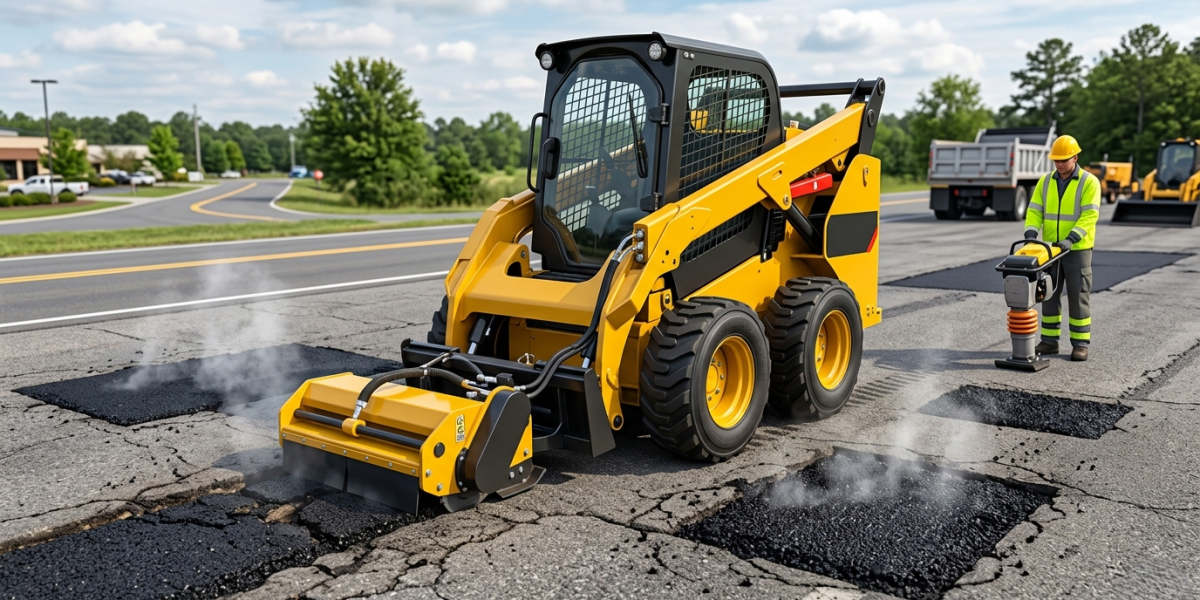
Asphalt surfaces are the foundational element of today’s infrastructure. However, they need to be constantly monitored in order to remain safe and functional. It doesn’t matter if the issue is a single pothole or a whole highway that needs clearing, equipment will have a huge impact on your work’s efficiency. Choosing a skid steer loader for asphalt maintenance and road repair is a really efficient decision as they are small, very easily maneuvered but the main strength lies in the specific attachments you select.
- Here we look at some of the best skid steer attachments for asphalt maintenance and road repair, so that your team can produce high-quality results with minimum downtime.
- A single skid steer machine with the addition of suitable attachments can fulfill the whole road work cycle – starting from the demolition of the damaged surface right up to the cleaning of the site.
- Purchasing top-notch attachments not only enhances your productivity, but also cuts down the amount of manual labor considerably. Here we list the best attachments that no road maintenance contractor should be without in their fleet.
Top 7 Skid Steer Attachments for Asphalt Maintenance and Road Repair
1. Cold Planers: The Ultimate Tool for Asphalt Removal
Cold planers, also called pavement millers, are by far the most essential skid steer attachments for pavement maintenance and repair. They work with a rotating drum fitted with carbide-tipped teeth which grind the asphalt or concrete layer to be removed. The result of the operation is a clean and rough surface so that the new asphalt will properly bond to it.
- Accurate Milling: The depth and width of cutting can be precisely controlled with cold planers, this makes them perfect not only for trimming edges but also for taking out only the damaged parts.
- Hydraulic Flow: Double hydraulic flow from high-flow and standard-flow models makes it possible to match machine power to a skid steer’s potential.
- Self-Leveling: A number of new cold planers feature self-leveling brackets that keep the cutting depth at a constant level even if the loader moves from one uneven ground to another.
2. Hydraulic Breakers for Extensive Demolition
Where the road surface is so deteriorated that deep breaking is necessary or the concrete section is too thick, the hydraulic breaker (or hammer) is an indispensable tool. This attachment produces powerful impact hits that will pulverize the hardest surface into small pieces. It is the tool mainly employed in breaking apart the old pavement near manholes, curbs, and utility lines when both precision and power are required.
- High impact energy: This type of tool is designed to deliver the maximum possible foot-pounds of energy, making it feasible to break even the strongest reinforced concrete or aged asphalt layers.
- Low-maintenance engineering: Most of the breakers for road repair kept their internal functioning components simple to withstand wear and tear.
- Noise reduction: Top-of-the-line models usually have sound insulation which is a great advantage while doing maintenance in residential areas or hospitals.
3. Sweepers and Angle Brooms for Site Preparation
It is not a question of if but when new asphalt will adhere to the existing surface if not cleaned properly. Besides new hot mix is laid only at clean dust-free areas, so cleaning can become a major part of your maintenance work schedule. Skid steers equipped with sweepers or angle brooms can quickly and efficiently clean the sites far better than manual push brooms or leaf blower/power tools.
- Pickup brooms: They push debris directly into an enclosed compartment from where it can be unloaded easily into a dump truck which means that your work area remains very clean.
- Angle brooms: Perfect for large surfaces, they easily push debris to the side to make large stretches of roadway quickly cleanable.
Along with the many other features, dust control with options for water spraying also comes from many sweepers.
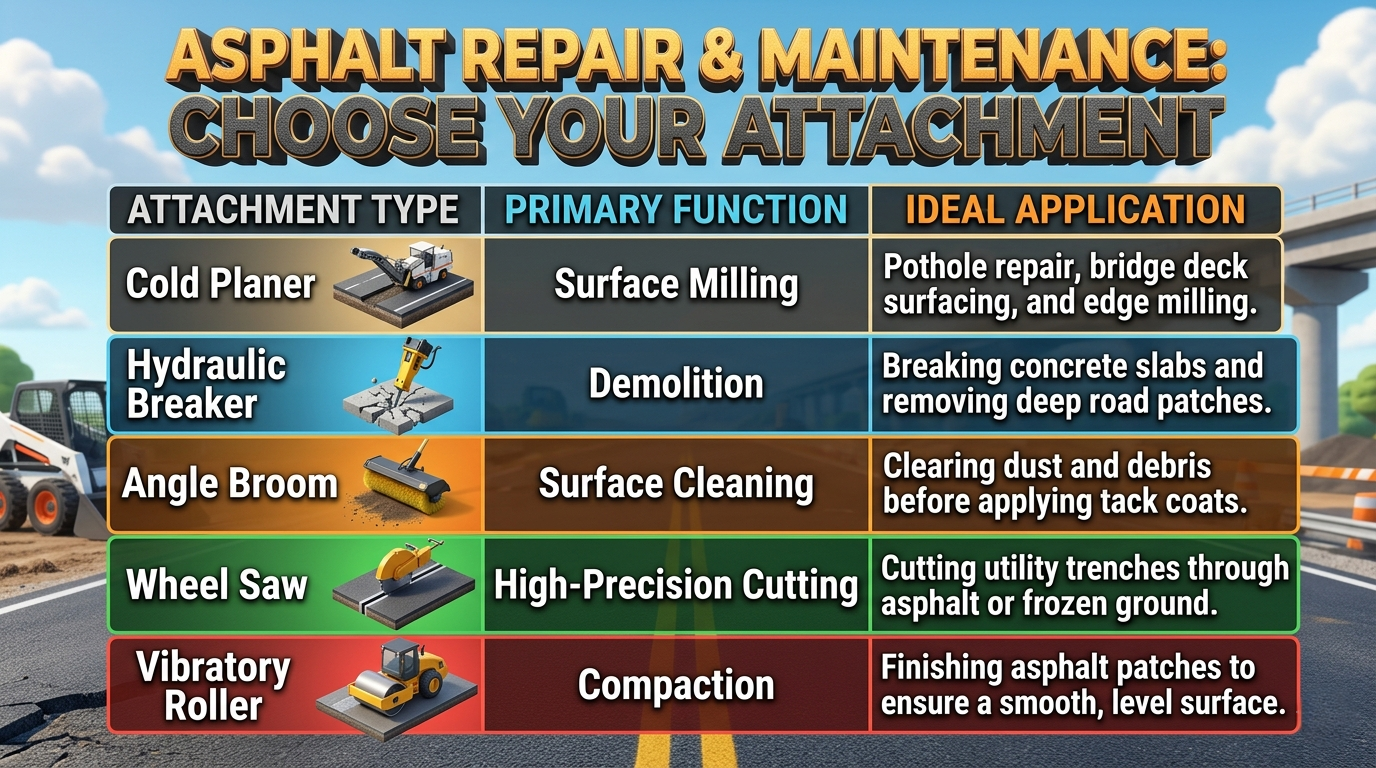
4. Primary Road Repair Attachments Comparison
| Attachment Type | Primary Function | Ideal Application |
| Cold Planer | Surface Milling | Pothole repair, bridge deck surfacing, and edge milling. |
| Hydraulic Breaker | Demolition | Breaking concrete slabs and removing deep road patches. |
| Angle Broom | Surface Cleaning | Clearing dust and debris before applying tack coats. |
| Wheel Saw | High-Precision Cutting | Cutting utility trenches through asphalt or frozen ground. |
| Vibratory Roller | Compaction | Finishing asphalt patches to ensure a smooth, level surface. |
Skid Steer Attachments for Asphalt Maintenance and Road Repairs
5. Wheel Saws for Trenching and Utility Works
A wheel saw is usually preferable to a cold planer for road repair involving utility maintenance. The cutting capability of these attachments includes making narrow cuts as well as deep trenches in asphalt, concrete, and even soils with rocks. Also, a wheel saw cuts much more cleanly which results in less patch material being needed and prevents “over-breaking” the neighboring pavement.
- Recognized depths: They are depth regulated and wheel saws are very important for safe excavation of existing utilities while removing the layers above.
- Intensive pressure cutting: The machines are engineered so that they still function when getting sharp pressure thanks to the super torque motors.
- Edges: After repair, the wheel saw leaves the surface solid which prevents any eventual cracking by making very clean cuts.
6. Vibratory Rollers for a Flawless Finish
Asphalt compaction is a must to get the right density so that no water would find its way into the layers thereby causing potholes. Compaction using a vibratory roller attachment for your skid steer would give you professionalism in the finish achieved without the necessity for a dedicated walk-behind or ride-on roller for small patch jobs.
- Bi-directional Vibration: Also, these rollers can compact vertically and horizontally, which makes the asphalt particles compacted tightly, maximizing durability.
- Drums padded or smooth: Your choice between different drum types depends on whether you are compacting the base layer or the final asphalt finish layer.
- Roller of a small size: Using a skid steer for compacting is perfect for narrow lanes, parking lots, and paths where larger rollers cannot be maneuvered.
7. 4-in-1 Buckets for Multi-Tasking Versatility
For a road crew that needs a “jack of all trades” the 4-in-1 bucket or multi-purpose bucket provides a four in one alternative that is as traditional bucket, dozer blade, grapple, and scraper. In terms of road repair, the bucket is highly effective when it comes to site cleanup and spreading base materials like gravel or cold mix.
- Like a clamshell: The bucket is capable of opening to allow a precise “bottom-dumping” of the materials, which is very helpful when spreading asphalt or gravel evenly across a repair area.
- Grappling capability: The hydraulic jaws can pick up even the large pieces of broken asphalt or other types of debris that a standard bucket would not be able to handle.
- Back- dragging: Opening the jaws slightly, the rear edge of the bucket can be used as a leveling tool before final compaction.
FAQ’s for Skid Steer Attachments for Asphalt Maintenance and Road Repair
What is the best skid steer attachment for fixing potholes?
Having the right combination of tools for pothole repair includes a cold planer to take off the damaged parts and a vibratory roller to compact the patch. When using a cold planer the results show the hole has vertical walls so the patch adheres better.
Can I use a standard-flow skid steer for a cold planer?
You may do so, but there is a catch. Although standard- flow cold planers are available, they are slower and made for smaller jobs. However, for professional level repairs, high-flow skid steers are almost always used so that the drum speed can be maintained under heavy load when using the instrument.
How deep can a skid steer wheel saw cut?
Most skid steer wheel saws have a cutting depth range from 6 to 24 inches, depending on the model. This means that they are suitable for both surface repairs and deep utility trenching.
Are hydraulic breakers better than wheel saws for asphalt?
The hammer is better suited to mass demolition operations and breaking up massive slabs of concrete. Wheel saws are preferable when precision, a clean cut, and less patching work are needed afterwards.
Why is a sweeper necessary for asphalt repair?
The reason behind a sweeper being a must-have is that fresh asphalt won’t stick if the surface is covered with dust and dirt. It is utmost important to remove fine particles so that the tack coat and asphalt layer remain intact, and the repair doesn’t fail prematurely.
Do I need a high-flow hydraulic system for all road attachments?
Not at all. Standard flow capacity only is good for buckets, brooms, and some rollers. But when it comes to high productivity tools like cold planers and heavy-duty mulchers, high-flow hydraulic systems are really necessary.
How do I maintain my asphalt attachments for longevity?
If you want to lengthen the life of your equipment, then regular maintenance is key such as, daily greasing of all pivot points, checking hydraulic hoses for leaks, and inspecting wear parts like planer teeth or broom bristles. It is very important to replace carbide teeth on planers before they wear down to the drum.