Future of Skid Steer Loaders: Autonomous Technology & Hybrid Engines
Safer job sites, lower carbon emissions and improved productivity are all driving changes in the compact equipment market. This industrial revolution will be led by the new age of small machines and the future of skid steer loaders will be radically changed by the employment of autonomous technologies and advanced hybrid powertrains.
For those equipment-dependent contractors, landscapers and farmers utilizing platforms such as SkidSteerLoader.net, awareness of these key technology advancements is now a prerequisite for remaining competitive.
The Evolution and Future of Skid Steer Loaders
The conventional skid steer loader has been the favored job site workhorse for many years due to its small size, strong frame, and outstanding attachment flexibility. Whether they were the traditional TYPHON STOMP mini models fueled by internal combustion engines or massive industrial machines, all these appliances have performed various tasks ranging from trenching to leveling the ground on a large scale.
Nevertheless, current financial and environmental circumstances force manufacturers not only to simply upgrade mechanical hydraulic designs anymore but to integrate intelligent systems that boost output and at the same time decrease cost of ownership and wear and tear on operators.
- Changing Global Rules: More stringent emission standard worldwide compel the heavy machinery manufacturing industry to quickly change away from diesel engines used for a long time, toward alternative cleaner configurations.
- Labor Shortage Solutions: Since the number of skilled operators available is continuously decreasing, this has hastened the adoption of intelligent making systems that allow much easier and safer operation even for smallest equipment.
- Extending Component Life: Next-generation machines track performance in real time and minimize the risk of sudden component breakdowns by adjusting engine operation during heavy work dynamically.
Autonomous Technology is Transforming Job Site Operations
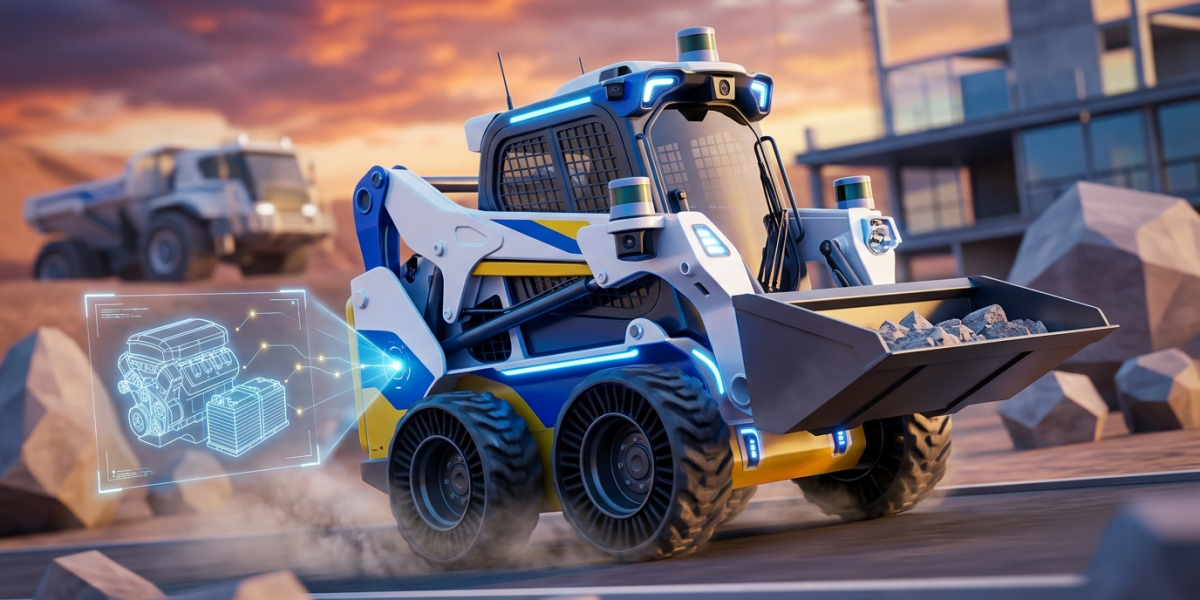
Without any doubt, the adoption of autonomous systems is the most drastic change that the compact machinery sector is experiencing these days. Self-driving and remote-operated skid steer loaders that were initially only found on prototypes are continuously being introduced to real-world operations on construction sites, farms, and roads.
By combining a sophisticated set of built-in sensors, cameras, and AI algorithms, these machines can perform repetitive, high-accuracy tasks even without the presence of people. Besides being safer as human operators are removed from dangerous situations, the change brought about is productivity increase.
Here is the architecture organized into a clean, structured table format for better readability:
| System Component | Primary Operational Role |
| LiDAR Sensors | Scans 360-degree job site topology |
| Stereo Cameras | Identifies real-time physical obstacles |
| AI Control Hub | Computes optimal pathing & bucket load |
| Hydraulic Actuation | Executes precise digging or leveling |
- High-level Sensor Fusion: Future self-operating skid steer machines depend on a mix of LiDAR, radar, and high-definition cameras to create a current, three-dimensional map of their surroundings.
- Geofencing and Usage Limitations: The user is allowed to define specific digital perimeters on a job site that will ensure the automated loader carries on its work only within the designated area and stops immediately if a person comes near.
- Tool Recognition and Auto-Configuration: The smart loaders identify independently the tools that have been mounted on them—whether it is a 4-in-1 bucket, an earth auger, or a land leveler—and change their hydraulic flow rates immediately without manual calibration.
Hybrid Engines: The Perfect Power and Efficiency Couple
The global market share of fully electric heavy equipment is continuously increasing; still, the hybrid engine technology offers a perfect, immediate transition solution for the operations that require a lot of power.
One of the main reasons is that the electric machines without hybrid support carry the serious disadvantages of needing battery charging stations at job site locations which are usually very remote, thus making it nearly impossible to have continuous multi-shift projects.
On the basis of combining a mini internal combustion engine with a powerful electric motor, hybrid skid steer loaders produce great amounts of torque on demand while at the same time cutting down the use of fuel to a level never before seen. Such a solution guarantees you do not run out of energy during a job while at the same time your negative impact on the environment is greatly reduced.
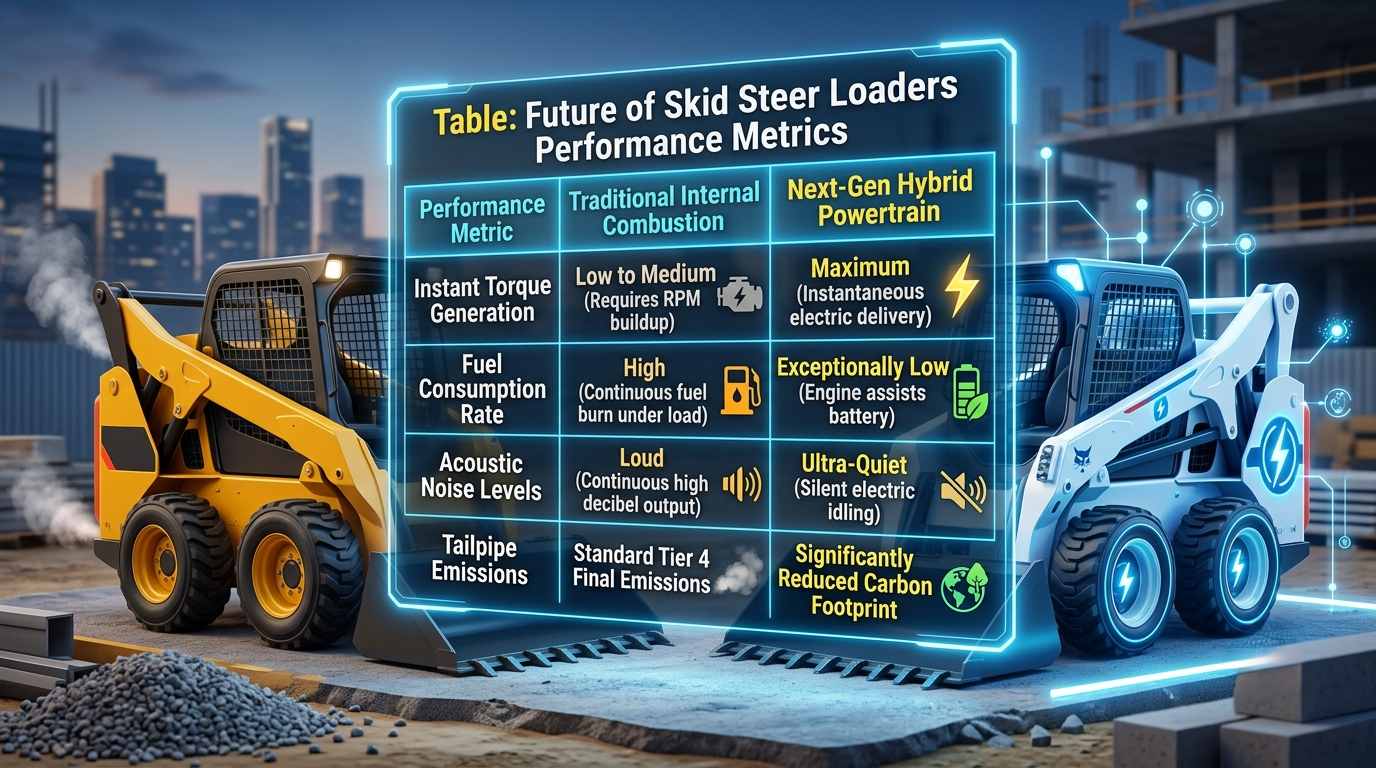
Table: Future of Skid Steer Loaders Performance Metrics
| Performance Metric | Traditional Internal Combustion | Next-Gen Hybrid Powertrain |
| Instant Torque Generation | Low to Medium (Requires RPM buildup) | Maximum (Instantaneous electric delivery) |
| Fuel Consumption Rate | High (Continuous fuel burn under load) | Exceptionally Low (Engine assists battery) |
| Acoustic Noise Levels | Loud (Continuous high decibel output) | Ultra-Quiet (Silent electric idling) |
| Tailpipe Emissions | Standard Tier 4 Final Emissions | Significantly Reduced Carbon Footprint |
The Future of Skid Steer Loaders
Significantly Reduced Carbon Footprint
- Power Management That Works for You: Hybrid machines can manage their battery storage during less demanding periods automatically, which allows them to reserve their full output level of the engine for the heavy tasks such as big rock breaking or deep digging.
- Huge Fuel Economies: Tests under real conditions demonstrate that hybrid powertrains might lower the cost of fuel by as much as 30 to 40 per cent compared to traditional purely internal combustion arrangements.
- Mechanical Longevity That Lasts: Since the electric motor is supporting the engine when it is at peak load, the physical stress on the main engine is extensively decreased, resulting in lower maintenance costs over time.
Intelligent Attachments and IoT Connectivity
Future skid steer loaders are not only the machines themselves but also the entire accessory ecosystems and digitally linked tracking devices. Eventually, things like pallet forks, grapples, rippers, etc. will have embedded IoT sensors which will communicate with the base loader’s computer system.
Such a network allows telemetry tracking in real-time, predicts when maintenance will be needed and performs automatic optimization of performance programs based on the material type being handled etc. via cloud-based mobile applications.
- Live Load-Sensing Analytics: Sensors integrated into the lifting arms can accurately determine the weight of the materials in a bucket. This data is useful in preventing accidents due to tipping while performing handling tasks.
- Predictive Maintenance Alerts: Using vibration and temperature data from attachments, fleet management software identifies situations where components require greasing or mechanical inspection.
- OTA Updates: Manufacturers offer software patches that improve a loader’s hydraulic efficiency or expand its autonomous path-finding capabilities overnight.
Environmental and Economic Impacts on the Industry
The dual goals of environmental stewardship and economic viability have been the major driving forces of this transition toward autonomy and hybrid powertrains. Moreover, the future of skid steer loaders in the construction firms and solo contractors are feeling the squeeze to meet strict green building certifications and mitigate local air pollution especially in congested urban areas.
Meanwhile, overhead cost reduction is still a critical aspect that will determine the survival of any business. Leveraging the future of skid steer loaders is an excellent option as it helps companies simultaneously achieve both targets thereby demonstrating that adopting sustainable environmental practices can directly lead to higher profit margins.
- Lowest Town Noise: Due to the silent operation of hybrids, these equipment can be used at nigh time for municipal utilities, landscaping work in residential areas, and even indoor demolition.
- Lower Total Costs of Ownership: By paying less for fuel and mechanical replacements as well as reducing operator fatigue, one can finally have a very profitable investment in the long term.
- Future Readiness: Purchasing hybrid and smart tech will guarantee that your vehicle fleet always meets the strict rules of ever-expanding zero-emission urban zones.
FAQs – Future of Skid Steer Loaders
What is the future of skid steer loaders in the construction industry?
Skid steer loaders are going to be primarily focused on the use of advanced autonomous operating systems and efficient hybrid engines in order to keep both safety and productivity at their highest levels. Machines equipped with such technologies will be capable of handling repetitive excavation, grading and material transport with very little human involvement though.
How do hybrid skid steer loaders compare to traditional diesel models?
The hybrid skid steer implements an electric propulsion system that runs in conjunction with the smaller engine giving the machine the ability to deliver the torque instantaneously thereby resulting in a reduction of fuel usage by up to 40 percent. On the other hand, diesel units do not possess this immediate offering of power plus their carbon emissions are at a considerably high level not only in the working but also in the production stage.
Can existing skid steer loaders be retrofitted with autonomous technology?
Absolutely, there are already a few companies that specialize in after-market kits that include LiDAR, cameras and actuation modules to transform old machines into the ones that can work autonomously. Nevertheless, it is widely accepted that factory-made versions are more reliable for smooth system integration and comprehensive safety features.
What are the main benefits of autonomous skid steers on job sites?
Besides ensuring maximum safety on construction sites through the removal of human operators from dangerous environments, autonomous skid steers also make it possible for machine movement to be continuous and highly accurate. They additionally provide a solution to the ongoing problem of skilled labour scarcity as the level of work a single technician can oversee extends to multiple automated units at once.
How does weather affect the performance of autonomous skid steer loaders?
State-of-the-art autonomous loaders employ multiple sensor fusion technology which includes not only radar but also LiDAR so that they can remain very accurate in their spatial awareness even when subjected to heavy rain, dust or snow. Software then filters out the environmental noise for the operation to be safe no matter the weather.
Are hybrid engines reliable for heavy-duty attachments like rock breakers?
Hybrid motors are definitely up to the task of high load tools since the electric side of the system is present giving immediate torque which is required when the tool is resisting the operator’s action. The result of such a burst of power is that it relieves the internal combustion engine and stops it from potential stalling as well as reducing wear and tear.
What maintenance do hybrid and autonomous skid steer loaders require?
On one hand, the mechanical engine pieces need the usual replacements of oil and filters. On the other hand, the operator has to clean the sensor lenses on a frequent basis and also do updates on the software. The components of the electric powertrain are mostly free of maintenance, thus leading to fewer instances of mechanical repairs over the life of the machine.