Electrification: The Rise of Electric Skid Steers and What It Means for Fleets
Big changes are occurring in the heavy equipment sector. For many years the unmistakable diesel engine roar was the dominant noise at most construction sites, farm areas, and landscaping jobs. But a silent revolution is underway. Electrification: The Rise of Electric Skid Steers and What It Means for Fleets is a drastic departure from the traditional small equipment design, usage, and management.
Fleet operators who previously thought that battery-operated machines were only suitable for niche applications are discovering that electric compact loaders are not only highly productive and cost-effective but also practical tools for today’s worksite.
Because of tougher regulations, the decline in the cost of battery manufacturing, and a greater focus on the efficiency of operations, the development of compact utility loaders is gradually moving to a zero-emission future.
Fleet managers that want to stay ahead of the competition, get the most out of total cost of ownership (TCO), and use these modern assets in their daily work must become familiar with this transition. Therefore, fleet owners thinking about their long-term investment plan should carefully consider how the electrification changes power, maintenance, and logistics.
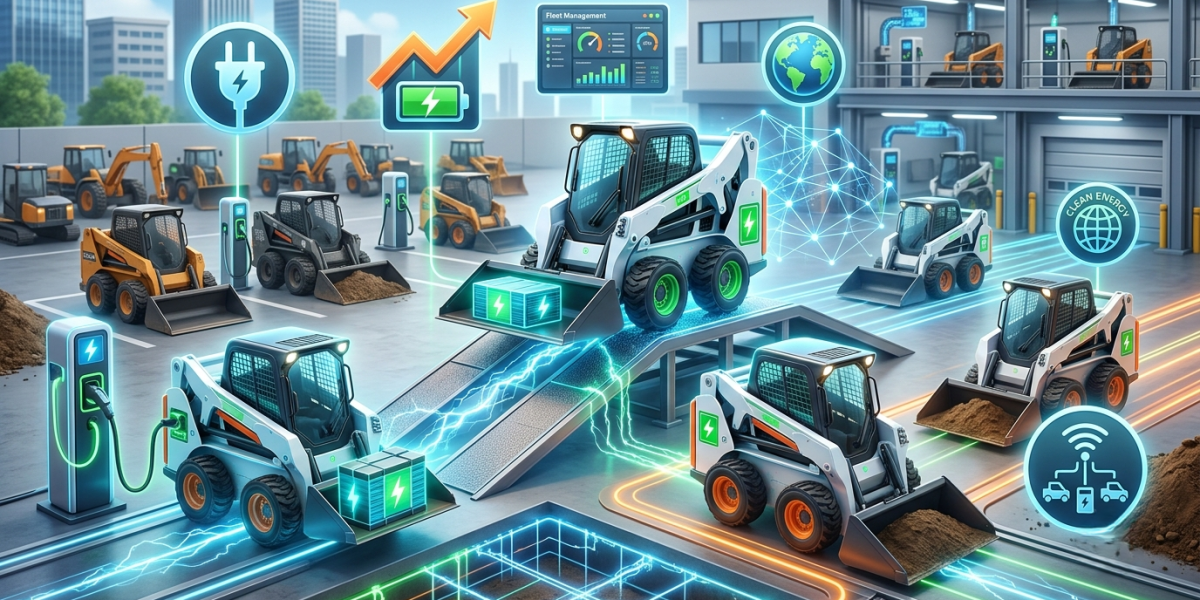
Electrification: The Rise of Electric Skid Steers and What It Means for Fleets discusses in detail the main points that have driven the rise of electric machines, the substantial advantages that they provide to commercial fleets, and the challenges of charging infrastructure setup.
By looking into these points, fleet managers can move away from merely responding to changes towards actually becoming leaders in their industries.
Top Features for the Rise of the Electric Skid Steers
1. The Technological Drivers Behind Electrification
The shift towards electric heavy equipment is made possible by the rapid progress of battery technologies and electronic drivetrain systems. Internal combustion engines have traditionally been used in heavy equipment. These engines have mechanical linkages, fuel systems, and exhaust treatment systems that are quite complicated.
They provide hydraulic and tractive power. New electric skid steers are replacing these components with very efficient lithium-ion battery packs and individual electric motors. Simplifying the mechanism not only enhances the durability of the structure, but also unveils performance features that diesel engines cannot match, like the ability to deliver peak torque from a complete stop instantaneously.
Key Technological Advancements
- High-Density Lithium-Ion Powertrains: The latest models use lithium-ion technology that offers energy densities ranging from 150 to 200 Wh/kg. Due to this, battery packs can hold enough energy to support a full 8-hour shift without making the machine bigger.
- Independent Dual-Motor Systems: Separate electric motors are used for each drive tracks/wheels as well as the auxiliary hydraulic systems, so energy is only consumed during actual work which reduces parasitic power losses.
- Advanced Battery Management Systems (BMS): Cell protection is achieved by the integrated thermal management and monitoring software that prevents cells from being deeply discharged and from getting too cold or too hot; these measures can help the battery to last for about 10 years.
2. Comparing Operational Costs: Electric vs. Diesel
To make the case for adding electric equipment to the roster, commercial operators need to consider factors beyond the upfront cost and assess the total cost of ownership throughout the lifespan of the equipment.
Electric skid steers tend to have a higher initial cost compared to similar diesel machines, but their operating costs are far less. Diesel equipment faces continuous expenses because they need changes of engine oil, fuel and air filters, and the use of diesel exhaust fluid (DEF), among others, as well as having very complex after-treatment systems for exhaust such as diesel particulate filters (DPF).
On the other hand, electric loaders are free from all these maintenance-related troubles, leading to a reduction of routine service demands by up to 70%.
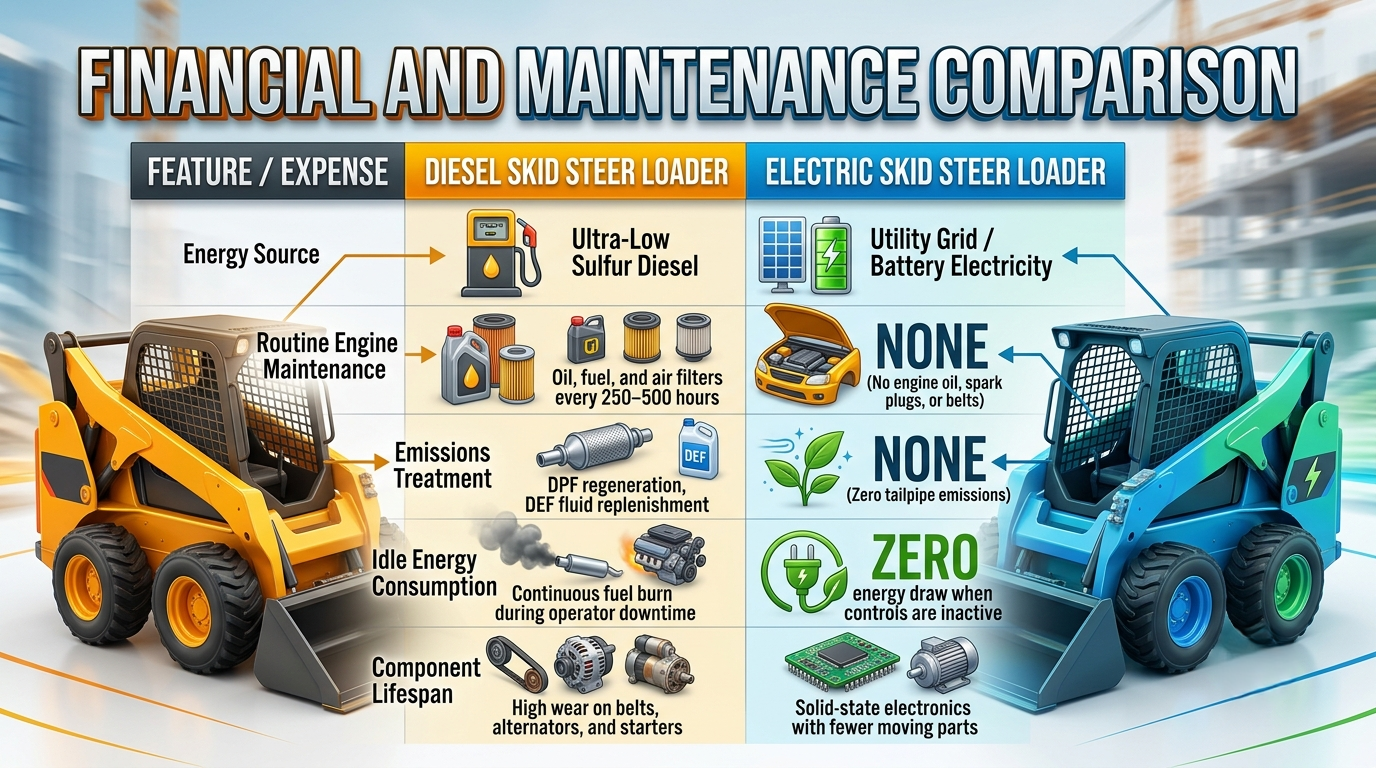
Financial and Maintenance Comparison
| Feature / Expense | Diesel Skid Steer Loader | Electric Skid Steer Loader |
| Energy Source | Ultra-Low Sulfur Diesel | Utility Grid / Battery Electricity |
| Routine Engine Maintenance | Oil, fuel, and air filters every 250–500 hours | None (No engine oil, spark plugs, or belts) |
| Emissions Treatment | DPF regeneration, DEF fluid replenishment | None (Zero tailpipe emissions) |
| Idle Energy Consumption | Continuous fuel burn during operator downtime | Zero energy draw when controls are inactive |
| Component Lifespan | High wear on belts, alternators, and starters | Solid-state electronics with fewer moving parts |
- Major Reduction in Downtime: With fewer movable mechanical parts, less time will be required for servicing and the rate of production of the machines will be high due to the availability of the machines on site.
- Lower Fuel and Energy Costs: Unlike fluctuations in diesel prices in the market, electricity costs per kilowatt-hour are significantly smaller and more stable, thus leading to more predictable operating margins.
- Complete Removal of Idling Costs: Diesel loaders usually spend 30% to 40% of their operating time idling while workers refer to blueprints or wait for materials. On the other hand, electric models hardly consume any energy when the operator releases the joysticks.
Electric Skid Steers Comparison
3. Jobsite Versatility and Capabilities
Electric drivetrains possess certain inherent features that make it possible for fleets to undertake projects that were impossible to do with conventional diesel machinery. Among other things, the biggest selling point here is that these machines can function without producing harmful gases, thereby making them safe for operation even inside buildings, tunnels, and other closed spaces where ventilation is poor, and this can be done without the need for expensive air-scrubbing devices.
Apart from this, the almost silent working of electric equipment creates a scenario whereby goods in densely populated areas with stringent municipal noise restrictions can be marketed without the fear of arrests and fines.
Newly Opened Frontiers in Operations
- Indoors Without Any Restrictions: Perfect for interior demolition, warehouse retrofitting, food processing facility maintenance, and operating greenhouses.
- Work Time Expansion: Given that the sound levels are ultra-low, contractors can carry out their work during the early morning or late at night hours in residential neighborhoods, hospitals, and school zones without breaching noise regulations.
- Hydraulic Power On Tap: Since electric motors can instantly react to the commands of operators by delivering immediate full hydraulic flow to the heavy attachment, ie., augers and trenchers without needing to rev the engine.
4. Overcoming Charging Infrastructure Hurdles
Going electric will mean that the fleet manager has to plan for electricity supply and the charging logistics. He will have to work out where and when the machinery can be charged – at yard and worksite.
Charging the battery during break time will allow the operators to work longer but the recharge speed is largely dependent on the availability of the electrical infrastructure. It is very important to have a balance between overnight slow charging and quick charging to be able to work without any interruption.
Infrastructure Best Practices
- Offering Different Charging Levels: Fleet yards should place a combination of regular Level 2 AC chargers for overnight recharging and high-power DC Fast Chargers for quick battery top-offs halfway through shifts.
- Portable Power Banks: For sites located in remote areas without a power supply, fleet operators may resort to using transportable, solar-powered battery storage units to recharge compact machines in the field.
- Electrical Upgrades: Grid Enhancements: To avoid running out of power, it is very important for fleet owners to consider the upgrading of the electrical services at their facilities as early as possible so that when multiple machines with the high-amperage requirements are charging at the same time, the local grid will be able to cope with it.
FAQs – Rise of Electric Skid Steers
How long does the battery last on an electric skid steer?
Commercial-grade electric skid steers are designed to continuously perform work for 6 to 8 hours on a single charge. This provides enough time to cover an 8-hour shift since workers of compact loaders are rarely engaged in continuous, heavy pushing. Operators may use the standard 240V Level 2 charging or DC fast charging to add hours of extra runtime during breaks.
Are electric skid steers as powerful as diesel models?
Equally or higher performance is delivered by electric skid steers compared to their diesel counterparts, especially since the electric motors provide peak torque very quickly and the response of these machines is near instantaneous. Performance levels in terms of lifting and hydraulic capacity are maintained at levels comparable to or exceeding those of diesel machines, and there is no lag as in the case of diesel engines that need to be revved
What is the lifespan of an electric skid steer battery pack?
In today’s high-tech electric compact construction equipment, the lithium-ion battery packs are designed to endure up to 3,000 to 5,000 cycles of full charges. Based on the average user’s behavior, this equates to a useful life of 8 to 10 years before the battery’s capacity falls below 80%. However, once they are no longer suitable for heavy-duty field operations, these batteries are most often still quite valuable as sources for secondary stationary power storage.
How do you charge an electric skid steer on a remote job site?
For remote and off-grid sites, users may employ portable zero-emission power banks, towable battery storage units, or temporary jobsite power drops. Many fleet owners have some transportable solar-assisted battery trailers that accumulate energy during the day to recharge their equipment overnight. With the widespread adoption of electrification in various sectors, there are also hybrid power generators that run on clean fuels and are being used as clean backup alternatives.
Do electric skid steers require specialized attachments?
Not at all, electric skid steers are made to be fully compatible with standard mechanical and hydraulic attachments that are already being used throughout the industry. Industry-standard quick-attach couplers, as well as standard or high-flow auxiliary hydraulic connections, are their features. This makes it possible for fleet owners to use their existing buckets, pallet forks, augers, sweepers, and trenchers without any problems, whether the equipment is diesel or electric.
Is the total cost of ownership (TCO) lower for electric fleets?
The initial purchase price of an electric skid steer is higher, however, the total cost of ownership over time for electric models is much less than that of diesel models. Switching to electricity helps fleet owners save heavily on the costs of fuel and besides that, they also do away with many maintenance expenses such as engine oil changes, fuel filters, DEF, and DPF maintenance. Thanks to fewer moving parts, mechanical breakdowns are less common which leads to more equipment uptime.
How do cold temperatures affect electric skid steer performance?
Severe cold may cause the battery to temporarily operate at reduced efficiency and also slow down the movement of hydraulic fluid, similar to what happens to diesel equipment. To counter performance loss, modern electric loaders are equipped with an integrated thermal management system that warms the battery cells automatically during charging as well as during operation. Storing and charging the machines in enclosed or temperature-controlled environments during winter months will ensure the greatest battery efficiency.
Strategic Implementation for Fleet Managers
Electrification: The Rise of Electric Skid Steers and What It Means for Fleets needs to be brought about by fleet managers in a phased and data-driven manner. Initially, fleet managers should consider the current usage of their equipment so that they can pick out machines that mainly get used for indoor work like urban landscaping or for boring/high-idle utility tasks.
Electrifying these specific roles will give teams opportunities to get used to the charging procedures, experience the maintenance cost savings directly, and do all of that without disrupting the main operation.
When global emissions and urban noise levels become really strict, new electric compact machine users will definitely benefit from a competitive differentiation. They will be able to offer bids on very strict municipality projects, they shall have the freedom to operate in indoor environments, and also promote themselves as a sustainable brand to eco-friendly clients.
By working closely with experienced equipment dealers, immediately improving charging infrastructure, giving operator training on how to use regenerative braking and energy efficiency, the fleets shall be in a position to do the business of tomorrow. Going away from diesel is more than an environmental initiative; it is a smart business transformation that boosts overall profitability and agility.
Watch The Bright Future of Skid Steers
Why They’re Still Essential to understand these engineering changes and see how manufacturers are equipping modern jobsites with electric powertrains. This analysis compares standard loader designs with features of evolving fleets to assist managers in visualizing how these machines are adapting to changing power and layout requirements.