
Skid Steer Brush Cutters: Clear Heavy Brush, Saplings, and Grass Like a Pro
If you are in the land management, agriculture, or construction industry, you do understand that vegetation clearing is among the dirtiest tasks in the schedule. Be it thick underbrush, stubborn saplings, or tall, unruly fields of grass, the right hardware can convert a week of misery into a few hours of highly efficient work. It is precisely in such scenarios where the skid steer brush cutter stands out as the major breakthrough.
A powerful brush cutter attached to a trusty TYPHON STOMP Mini Skid Steer Loader can be your tool for quick and safe land recovery. Not only can a skid steer brush cutter dramatically uplift the property value, it also enables to you professionally line up fences or clear construction sites at lightning speed.
Attach a brush cutter to a handy helper like the TYPHON STOMP which is equipped with a 23hp Briggs & Stratton engine and can lift over 830 lbs, and you get a spot-on instrument in the operator’s hands.
This attachment makes it possible for the operator to reach confined areas like orchards, narrow property lines, and tightly packed construction zones, which are out of reach for larger forestry equipment.
When you combine a small-sized loader with a strong cutter, you get the ability to easily bypass obstacles and at the same time have enough torque for vegetation mulching. Knowing how to go about these attachments, benefits and how they operate will get you to the professional level of land clearing.
Power of Skid Steer Brush Cutters in Land Clearing
The basic reason why skid steer brush cutter is popular is because it is very versatile and powerful. If compared with a regular lawn mower whose primary purpose is to work on neat turf, a brush cutter is better in doing heavy-duty clearing works.
These attachments operate through the use of either high-speed rotary blades or flail systems which they project against thick vegetation, crushing it and turning the small trees and brambles into compost for the ground. In the case of TYPHON STOMP owners, this means that your compact machine is capable of operating in a much higher capacity, performing tasks that a forestry mulcher or a dedicated tractor would have carried out.
The skid steer which powers mechanically through its hydraulic system subsequently propels the cutter, thus sustaining the blade tip speed even during the cutting of hard saplings and thick vines.
- Versatile application: From clearings of tall field grass to cutting down 3-diameter-inch saplings, which is only the tip of the variety of works this machine can accomplish.
- Better mulching: By shattering the vegetation at high-speed rotation, the resulting mulch is a bed of nutrients that will enrich the soil when decomposed.
- Productivity: The need for human power in land clearing falls drastically, thus one operator is capable of doing what ten people can do.
Choosing the Correct Brush Cutter for Your Machine
In order to pick up the right brush cutter, you have to be very familiar with the hydraulic system of your machine. Like the TYPHON STOMP which is built with certain hydraulic flow rates (expressed in Gallons Per Minute or GPM) as well as operating capacities in mind, it is very important that the size of the brush cutter’s motor matches the power output of your loader.
In case you choose a “High Flow” cutter while your machine is “Standard Flow”, the product will be disappointing because the cutter won’t be able to spin at the required speed to make clean cuts. On the other hand, if you put a small cutter on a high-output machine, the motor of the attachment is the most likely part to get damaged.
For compact utility loaders such as the Typhon series, a standard-flow, light-to-medium duty brush cutter is generally the right choice since it provides the right level of cut power and weight that holds the loader’s balance.
- Hydraulic Compatibility: Make sure the GPM demand of the cutter aligns with the output of the Typhon Stomp (usually optimized for standard flow attachments).
- Weight Considerations: The cutter weight should not exceed the rated operating capacity (830 lbs for the Typhon Stomp) to avoid tipping and to allow safe lifting.
- Deck Design: Decide if you want open-front decks for raw cutting of brush and trees, or closed-front decks for better looking grass and weed finish.
Essential Characteristics of High-Performance Brush Cutters
When looking for the right attachment to match your SkidSteerLoader.net machine, different design elements that influence the performance will meet your eyes. Usually, a first-rate brush cutter comes with a heavy-duty steel deck, extra support around the edges for resisting the impact of debris.
There should be “stump jumpers” or a pan-shaped piece that is fastened to the bottom underside of the blade carrier which allows the cutter to leap over rocks and stumps without damage being done to the gearbox or drive shaft. Besides, the blades need to be made of heat treated alloy steel, double-sided if possible, so that they can be flipped when one edge gets dull, hence giving double the lifespan.
- Direct Drive vs. Gearbox: Direct drive motors often have less parts and hence more durable, while gearbox models can provide torque multiplication feature to cut tougher materials.
- Safety Chains and Guards: The safety chains and guards are absolutely necessary in order to prevent the operator or others around the area from being hit by debris, especially in places where public traffic is high.
- Reinforced Decking: The deck should be at least 3/16 ” or 1/4 ” steel thick to withstand crushing by trees or be resilient against rock bouncing without warping.
Operating Techniques for Maximum Efficiency
To some extent, a skid steer brush cutter is a painting with an animal tool without the brush where both the hereby controlled machine and the strategic thinking are required to come up with an effective product.
Therefore, in order for a single operator to be able to clear brush on a big scale, using him/her to the full extent is a must, and this is mainly done by one who just rolls out blindly without a plan.
At first, the best method for getting around a bunch of closely growing trees will be to allow the deck to go up while also slightly tilting it so the blades come in contact with the tree trunk, and after that, the boom should be let down to do the mulching from the top.
Otherwise, to let the tree drop on the loader is to cut the one thing from the other, but you will get a finer mulch with this technique. Considering the fact that a grass cutter is also a like a rough-terrain mower, keeping the height steady and going at a uniform pace will do the job.
- Unto the tree first! Turn the deck backwards in order to have the blades exposed for direct contact with the trees, and then you provide the levels for point blank mulching of the stumps.
- A smart way to trim (overlapping your passes). A 15-20% overlap of your cut path guarantees zero mowed “mohawks” or bare land strips, which is better-looking.
- Engine RPM Management: Engine RPM is always maintained high deliberately to keep up with the hydraulic flow rate which in turn maintains the blades spinning at the right cutting speed.
Brush Cutting Safety Protocols
When it comes to the use of heavy equipment’s that cut parts of the earth at high speeds involving major risks, safety comes first at all times. The blades of a brush cutter can spindle at a frequency of more than 150 mph; therefore, even a small round stone or unsuspecting loose wood can be turned into a potential missile with devastating effects.
The manufacturers of the TYPHON STOMP looked into the walk-around feature and made it easy for the user, nevertheless, rushing is not the right behavior as seeing clearly is rather as well. The operator’s machinery must be equipped with safety door if you are dealing with brush that has wood as the main component (at best a forestry-rated polycarbonate door separating the operator’s chamber from outer blazing).
While the blade keeps spinning, never raise the cutter deck above the cab height as this will expose the operator to the flying debris. In addition, do a quick reconnaissance of the work zone before commencement; if any, remove objects like wire, old fence posts, or big stones which can harm the equipment seriously.
- Perimeter Safety: Persons not involved with the operation at least 200-300 feet away should be ensured to avoid getting hit by the thrown objects.
- Cab Protection: a rigid door or screen should be used by the operator to avoid getting hit by flying debris.
- Pre-Operation Inspection: It is important for every shift to start off with a thorough check for leaks on hydraulic hose, and blade bolts are tightened at correct tension.
Maintenance Tips to Extend Equipment Life
Your machine is a valuable asset that you want to keep for as long as possible, and this cannot be achieved without good care and maintenance which forms the core philosophy of the SkidSteerLoader.net.
Since the brush cutters are working even harder than the other equipments, they go through a lot of dirt, dust, and plant debris on a daily basis. Greasing pivots and bearings for blade carriers should be done regularly without fail.
Hydraulic oil level should be regularly checked to make sure that it won’t be low or too hot because the motor of the brush cutter is always running and using up the fluid if not in perfect condition.
Additionally, braking the grass with dull blades results in shattered wood, therefore, the impact will travel back through the machine and cause unbearable wear on the bearings and boom arms.
- Daily Greasing Routine: Grease all fittings on the cutter shaft and caster wheels (if equipped) before starting work each day.
- Blade Care: Inspect blades for deep nicks or cracks; replace them in pairs to maintain the balance of the flywheel and prevent vibration.
- Deck Cleaning: Remove caked-on mud and vegetation from the top of the deck after use to prevent rust and allow for proper cooling of the hydraulic motor.
Compatibility with Typhon Machinery
The TYPHON STOMP is an ultra-versatile mini skid steer that was specifically designed for small-to-medium-sized construction and agricultural projects. Due to its minimal ground cover, it is the perfect carrier of smaller, 42-inch to 48-inch brush cutters.
The market for attachments is overflowing with oversized attachments; however, matching your Typhon loader with the right-size cutter means that you not only don’t exceed the lifting capacity of 830 lbs but also the limits of hydraulic flow.
With this perfect match, it becomes a “piece of cake” to get around in small areas,” a very typical trait of the Typhon. The Typhon machinery has a choice of 4-wheel drive or tracks so that you will always have enough traction to push the cutter through thick and wet vegetation without getting stuck no matter if you are going up in an orchard or just clearing the backyard for the patio installation.
- Right-Sizing: The cutter width should be in line with or slightly greater than the machine’s width (typically 42-48 inches) to effectively cover your tracks without overexerting the engine.
- Hydraulic Efficiency: Typhon’s reliable Briggs & Stratton engine delivers the right amount of torque for direct-drive brush cutters that handle grass and light brush.
- Quick Attach System: Use the standard quick-attach plate to switch between brush cutter and other Typhon tools such as the 4-in-1 Bucket or Grapple in a matter of seconds.
Brush Cutters vs. Flail Mowers: A Comparative Review
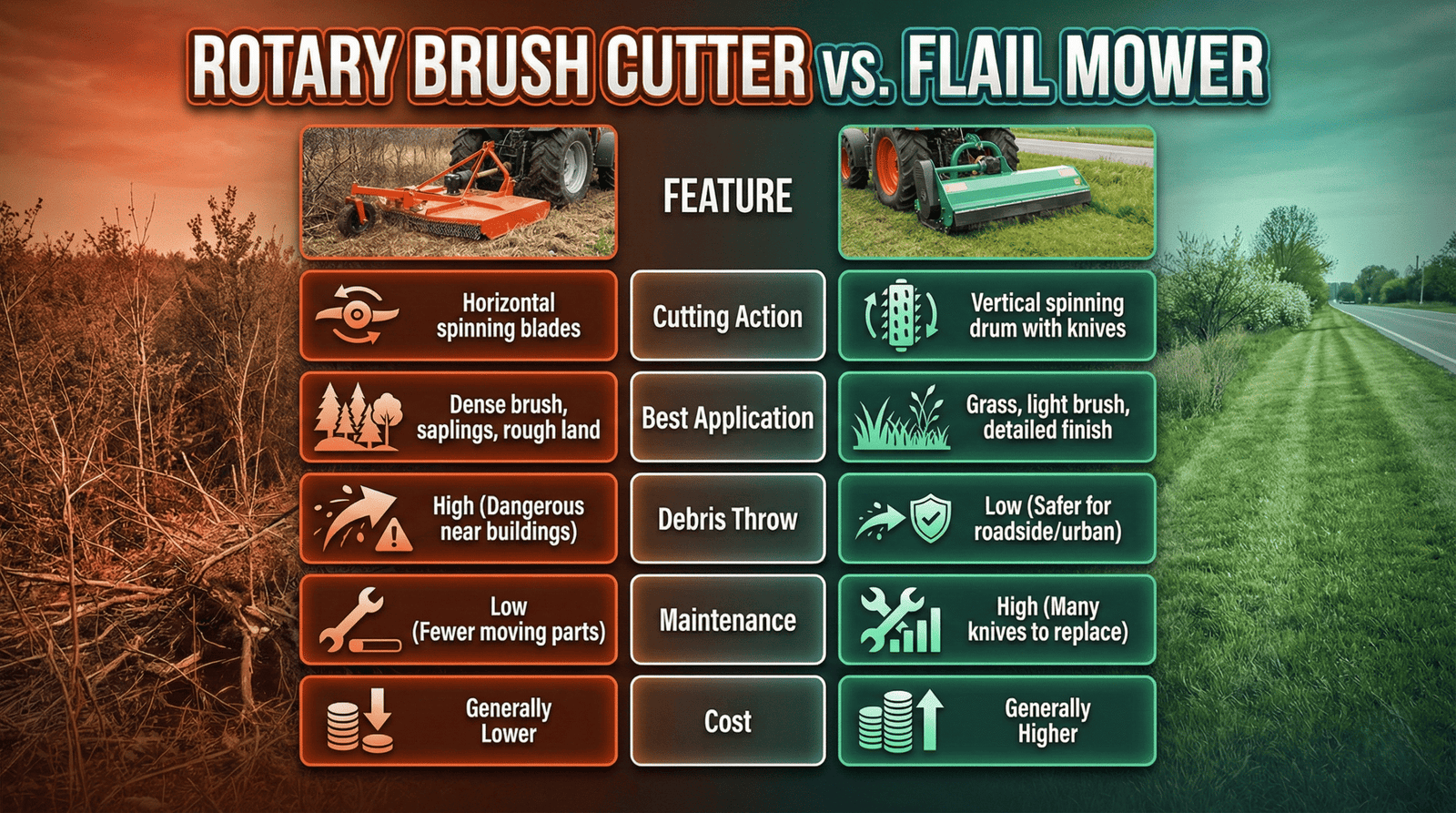
Many operators wonder which is better: a rotary brush cutter or a flail mower. Rotary brush cutter resembles a heavy-duty lawn mower with horizontal spinning blades and that is why commonly it is the more effective method used for rough clearing of saplings and wild overgrowth.
It is sturdy enough to break through very thick stuff with the momentum it has. On the other hand, a flail mower employs a drum with a big number of tiny knives (flails) that are set to spin vertically.
Flail mowers deliver a much better finish and you have less concern about safety when operating them near houses because they throw back less debris, yet they tend to consuming more power and are the priciest ones to maintain.
In fact, for the broad versatility demanded by most SkidSteerLoader.net clients—ranging from agricultural to road construction works—the rotary brush cutter usually turns out to be the more affordable and tougher option.
| Feature | Rotary Brush Cutter | Flail Mower |
| Cutting Action | Horizontal spinning blades | Vertical spinning drum with knives |
| Best Application | Dense brush, saplings, rough land | Grass, light brush, detailed finish |
| Debris Throw | High (Dangerous near buildings) | Low (Safer for roadside/urban) |
| Maintenance | Low (Fewer moving parts) | High (Many knives to replace) |
| Cost | Generally Lower | Generally Higher |
Skid Steer Brush Cutters
Cost vs. Value: Considerations on Investing in Land Clearing
At first glance, it might look like a pretty major initial expense to equip a brush cutter attachment; still, you will recoup that money quite quickly. The cost of a bulldozer rental or a forestry crew can be into the thousands of dollars daily.
On the other hand, owning a brush cutter for your TYPHON STOMP means you literally have the power in your hands forever. Maintenance work done on time will not be expensive thus avoiding large-scale projects.
Besides that, contractors can increase the scope of their business to include “brush cutting and land clearing” which are different lines of businesses for which they can bid on lot clearing, trail maintenance, and fire prevention services all by simply using the same machine that is doing the digging and grading.
- Say goodbye to rental charges: You cannot be paying for the renting of equipment which is not even up to the mark on a day-to-day basis. Own the product and use it whenever you want to.
- New Revenue Streams: Building a portfolio of brush clearing services for agents of real estate, farmers, and local municipalities.
- Property Value Increase: Properly maintained properties that have clear land are invariably worth more than the same size properties that remain wild; therefore, your investment in equipments will also serve to increase the value of your assets.
FAQs About Skid Steer Brush Cutters
Must a skid steer have high-flow hydraulics to operate a brush cutter?
Not necessarily. Many standard-flow brush cutters come with features and designs that allow efficient operation at 15-25 GPM where this range covers most of the standard skid steers such as TYPHON STOMP. Though some bespoke forestry mulching high-flow models (26-40+ GPM) exist, the majority of equipment doesn’t require this level of power. Of course, you should always consult your machine manual for GPM output-attach pairing.
What makes an open-front brush cutter different from a closed-front brush cutter?
Basically, an open-front brush cutter has a deck front cutout which exposes the blades. This layout is quite aggressive and perfect for tree saplings because here you do not have to be moving the brush over the top so the blades can get a virgin contact every time. On the contrary, closed-front cutter is a solid deck that will better control debris and gives a neater finish on the grass, however, it might not be very effective in “feeding” bigger saplings to the blades.
What size dendron can a skid steer brush cutter cut?
Regular-duty brush cutters are quite capable of handling just pretty round trees of a diameter not more than 3 or 4 inches. Heavy-duty or “extreme” cutters that are combined with high-flow vehicles can go as far as cutting 6-8 inch thick trees. In the case of TYPHON STOMP or similar kinds of mini skid steers, sticking with brush and saplings below 3 inches is the best way to prevent machine overload.
Can a mini skid steer be fitted with a brush cutter?
Indeed, it is! Mini skid steers like the TYPHON STOMP make a perfect platform for brush cutting mainly because you don’t want to be hampered in the last 10-15 meters of your work area simply because you don’t have the right size of machine. It is just about the right tool to get into backyards, through narrow fence gates, is good for tight spot wooded areas and generally a full-sized track loader cannot fit in these spaces.
What should I wear when working adjacent with a brush cutter?
Operator should always have in place hearing and eye protective apparatus. More importantly, the skid steer should be fitted with a shatterproof front door (polycarbonate is preferred over glass) because brush cutters can throw rocks and wood chunks at very high speed. Not only is that dangerous but also the door will be hit several times, hence its robustness becomes one of the necessities. An open-front cutter should never be operated without the cab door being fitted with required protective mesh.
What problem am I facing if my skid steer brush cutter is just not cutting effectively?
Blades can be sharpened while still on the machine using an angle grinder only if the deck is properly blocked to prevent it from falling. However, for best results, take the blades off and perform the sharpening on a stationary grinder for sure you are keeping the angles intact. Immediately replace the blade if it has a deep chip or crack or is bent as it can cause serious injuries to you, luckily, premature vibrations will also give you a warning in such a case.
What could be the reason that my brush cutter is vibrating excessively?
Almost always an unbalanced blade carrier is what causes excessive vibration. This becomes the case when any of the blades is broken, too, if there is a huge piece of jute lodged in the carrier or when the blades are not evenly worn. Stop operation right away, return deck to normal, and check the blades. If the cutter is vibrating, then this means that the gearbox and skid steer’s lift arm pins will be destroyed if you continue running it.
Summary
Outfitting your TYPHON STOMP with a skid steer brush cutter is no doubt one of the most intelligent moves that you could make as far as land management is concerned. In fact, the compact loader is basically converted to a land of mass clearing power, implying it can work on anything, from tall grass, to even stubborn undergrowth.
Also, with the knowledge on one hand of why hydraulic compatibility is key, safety protocols, and the other hand of proper maintenance, then you have at your disposal an equipment that will serve as a trusty companion for years to come. Farmers, landscapers, and constructions workers are just a few categories that the strength of Typhon combined with the cutting power will have on the productivity.