

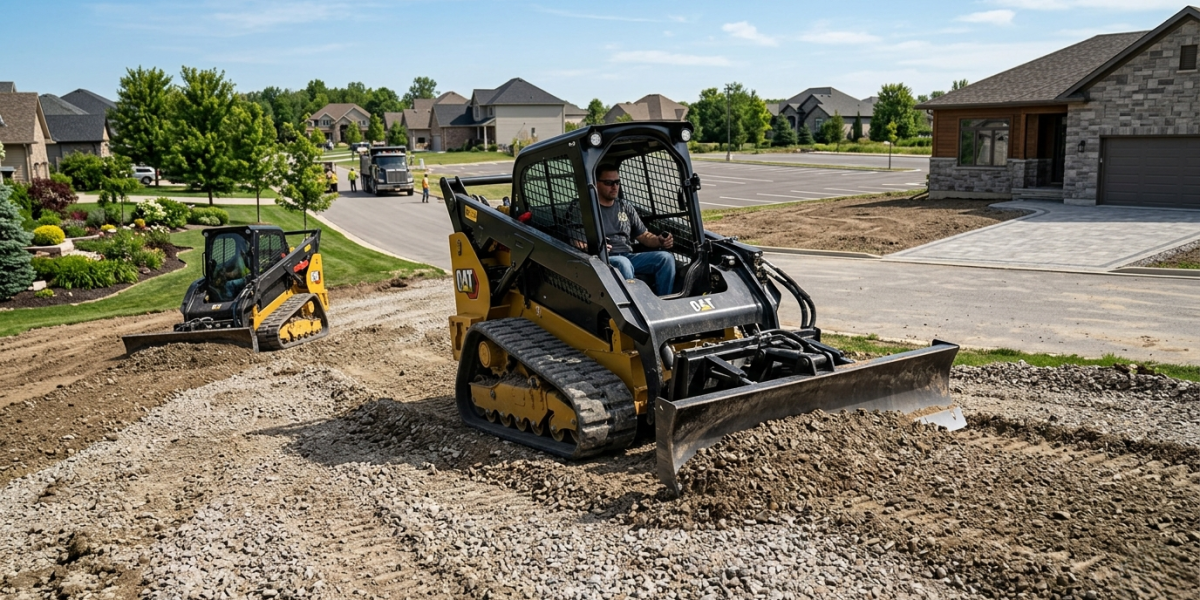
Master the Terrain: Driveway, Parking Lot, and Yard Leveling with Skid Steer Grader Attachments!
To give your property a professional look, the game is not only about power, but accuracy as well. No matter if you are fixing a gravel path full of potholes, a commercial parking area with uneven pavement, or a backyard that fills with water after every rain, the equipment will make the difference with Skid Steer Grader attachments.
Driveway, Parking Lot, and Yard Leveling with Skid Steer Grader Attachments has been the preferred method for property owners and contractors that want efficiency and high quality.
With the use of these attachments, a standard loader can be converted into a high-performance grading machine, you can work the ground, lay down gravel, and build drainage slopes with ease. Here, we’ll show you why a grader attachment is a must-have tool and how to make the most of it.
Reasons to Use Skid Steer Grader Attachments for Professional Leveling
A bucket works fine for scooping and moving heaps of earth, but it is not suitable for “fine grading” where you need to achieve a smooth and even surface. Skid steer grader attachment that are specifically built for this purpose feature multiple cutting edges and side pans that span over the depressions, thus ensuring that you are not just moving earth around but actually leveling the surface to a high standard.
- Enhanced accuracy: Different from a bucket, a grader attachment can keep a constant cutting depth, which is very important for asphalt or concrete sub-base preparation.
- Saving time: You can do the grading tasks 3 to 4 times faster than with the traditional methods, thus cutting down on labor costs and machine hours.
- Getting the most out of your material: The design of the grader blades allows “sifting and relaying” of existing gravel, so most of the time you’ll be able to repair a driveway without having to buy new stone.
Comparison: Standard Bucket vs. Skid Steer Grader Attachment
| Feature | Standard Skid Steer Bucket | Skid Steer Grader Attachment |
| Primary Use | Digging, scooping, and hauling | Precision leveling, grading, and crowning |
| Finish Quality | Rough; requires high operator skill | Smooth; professional-grade finish |
| Surface Application | Bulk earthmoving | Driveways, parking lots, and seedbeds |
| Drainage Control | Difficult to maintain consistent slope | Easy to create crowns and valleys |
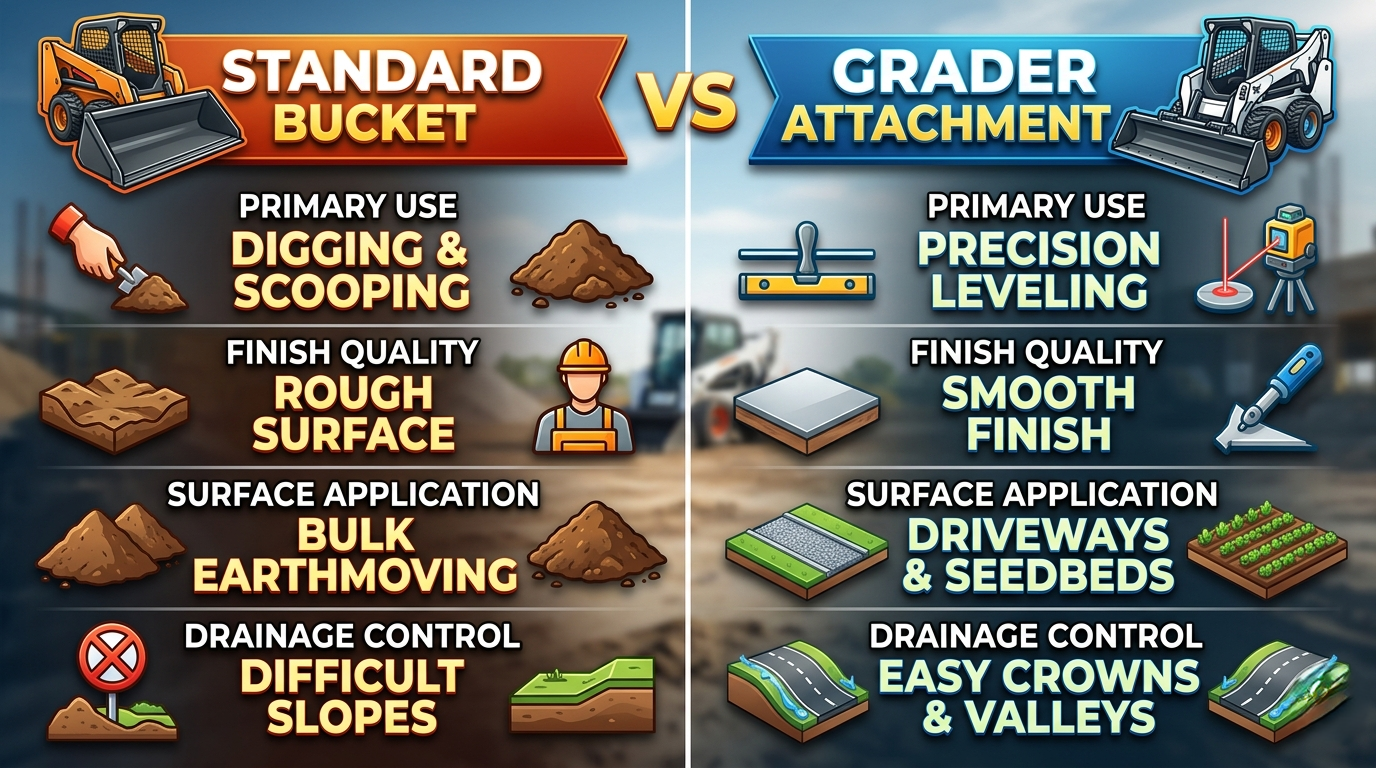
Skid Steer Grader Attachment Comparison
Repairing Gravel Driveways: The Definitive Guide to Surface Restoration
Drives get damaged by heavy vehicles and various weather conditions. Wash boarding and potholes eventually turn the surface into a nearly impassable terrain. Driveway, Parking Lot, and Yard Leveling with Skid Steer Grader Attachments will help you get to the base and pull out the buried aggregate, in other words, you’ll be “recycling” your driveway.
- Get rid of Potholes: Simply covering a hole with loose gravel is a short term fix; a grader will cut the compacted surrounding area so that the patch bonds permanently.
- Forming a Crown: After water damage is prevented, a grader can be used to create a gradual peak (crown) in the center of the driveway so that water runs off to the sides.
- Serrated Cutting: Leading edges of many attachments feature serrations that can break up even the most compacted hardpan soil typical of older rural roads.
Keep Commercial Parking Lots Safe and Lasting by Regularly Maintaining Them
Even if from a visual point of view, an uneven parking lot is not pleasing, it is also a source of liability for the owners. Collecting water may cause icy patches in winter and lead to the deterioration of asphalt even faster in summer. Skid steer grader attachment makes unpaved lot reconditioning almost instant and sub-base preparation for paved ones done with precision.
- Continuously Sloping: Find out that the parking directs water towards catch basins or drainage ditches rather than entrances to buildings.
- Durable Construction: Mold boards made of reinforced steel are commonly used for professional-grade attachments because they must withstand the high- volume material moving phase for large lots.
- Compatibility with Any Machine: Most of recent grader attachments come with a universal quick-attach system, which means they can be put on your machine within seconds.
Key Specifications for Parking Lot with Skid steer grader attachment
| Component | Specification / Benefit |
| Blade Width | Typically 6ft, 7ft, or 8ft to match machine power |
| Hydraulic Options | Dual hydraulics allow for on-the-go angle and tilt adjustments |
| Wear Parts | Reversible and replaceable cutting edges extend attachment life |
Yard Leveling and Landscape Preparation
If you want a lawn that looks great, start from a level surface. Stated in another way: a level lawn that is beautiful is the result of a level foundation. Prepare a site for sod or trample your yard in a way so that it is uneven for a long time, you will always have a problem with your grass. A skid steer grader attachment or land leveler is your best tools. Removing high spots and filling low spots happens each in one pass to make a perfect seedbed.
- Cleaning Up Debris: Grader units can be easily used like “monster rakes” that pull out big stones and tree roots while leaving the fine soil behind.
- Preventing Damage to Turf: Because of the wide work area of a grader attachment, the weight of skid steer is distributed and the soil compaction that kills grass is minimized.
- Making Smooth Transitions: Use your attachments to finish the edges in your yard blending into existing sidewalks, curbs, or flower beds so that you get a perfect look without a joint.
Deciding Between Manual and Hydraulic Grader Attachments
First of all, you need to determine if you want a manual or a hydraulic grader attachment when you start to think about Driveway, Parking Lot, and Yard Leveling with Skid Steer Grader Attachments. Largely, the deciding factors will be types of projects and financial resources.
- Manual Graders: These are less expensive and are suitable for just a simple, flat leveling. Usually, you have to do the blade angle manually (usually with pins or bolts), and then the machine does the rest of the work.
- Hydraulic Graders: These give the operator a possibility to adjust blade pitch and tilt from inside the cab. This is a must-have for grading where slopes need to be frequently changed.
- Laser-Ready Versions: There are graders that can have attached laser receivers which automatically carry out blade height adjustment so as to keep a perfect grade around millimeters.
Basic Principles of Maintenance for Longevity and Performance
Keeping your grader working well for a long time will require some regular maintenance on your part. Since these are working tools intended to engage with abrasive materials like gravel and stone, wear and tear is natural and inevitable.
- Inspect Cutting Edges: Frequently check the bolts and sharpness of the blades. Many of them are reversible, so you can get twice the life out of one set.
- Grease Pivot Points: Attachments that have moving parts for angling or tilting should be greased daily.
- Check Hydraulic Hoses: Make sure the hydraulic lines are in good condition, especially if you are working in rugged terrain with thick brush or rocks.
FAQs: Skid Steer Grader Attachments
Can a skid steer really level a large parking lot?
Certainly. A full-sized motor grader is great for highways, but a skid steer with a grader attachment is the favorite tool for commercial parking lots. Besides, it can move better in tight spaces and achieve the same fine grade finish.
What is the difference between a land plane and a grader?
It is the land plane that is mostly employed for lighter work “smoothing” and maintenance of existing surfaces. On the other hand, a grader attachment is more powerful and often equipped with ripper teeth in addition to adjustable blades for going into hard ground and reshaping the area.
Do I need high-flow hydraulics for a grader attachment?
Generally no. A normal flow hydraulics system would be adequate for powering cylinders that tilt and angle the blade. You should, however, compare your machine’s specs with the attachment’s ones before deciding on the buy.
How do I prevent “washboarding” when grading my driveway?
Washboarding arises as a result of a fast moving machine or blade that is too light. Long side pans and a heavy-duty grader attachment bridge the ripples, and slow, steady speed ensures material fills in the gaps.
Can I use a grader attachment on a compact track loader (CTL)?
Yes. Actually, some of them are quite happy to utilize a CTL as the tracks give more stability and smoother ride than wheels, which yields an even better finished grade.
Is it better to grade a driveway when it is wet or dry?
The best thing is that the material is “moist” bit not muddy. Moisture allows the aggregate to stick together and at the same time, reduces dust. If the ground is extremely dry and hard, it might be difficult for the blades to penetrate.
How much does a skid steer grader attachment cost?
One’s cost depends mainly on the width and type of features (manual or hydraulic). Budget models may be priced around $2,000 while professional hydraulic, laser-ready graders can even be more than $10,000.