


Common Skid Steer Hydraulic Issues Fixed in 5 Steps
The hydraulic system is the heart of your skid steer, allowing it to lift, push, and precisely operate heavy-duty attachments. But, when the pressure is low or a hose starts to leak, your work might just stop. So, knowing how to identify and fix these common skid steer hydraulic issues is a must for anyone who owns or operates a skid steer and wants to keep the machine in a great state.
We will look at the most Common Skid Steer Hydraulic Issues Fixed in 5 Steps to give you the confidence to troubleshoot effectively, minimize downtime, and ultimately save money on expensive professional repairs.
Common Skid Steer Hydraulic Issues Fixed in 5 Steps
Besides providing your skid steer with fuel and grease, you also have to keep an eye on its hydraulic system. From the lift arms that work so slowly to the noises that you don’t understand, most of the time, the root of these five problems will be just five main areas. The machine’s performance will be brought back to normal, and its long-term reliability will also be secured by you following a step-by-step method.
1. Diagnosing and topping off low hydraulic fluid levels
Not enough fluid is the reason for the majority of hydraulic breakdowns. The pump will not be able to generate the pressure needed for moving the lift arms or powering the attachments without sufficient oil. This then causes cavitation, which is the formation and subsequent collapse of air bubbles that result in internal pump damage.
- Check the Sight Glass: After parking your machine on a level ground, arms down, and with the sight glass at eye level, you will know with the highest accuracy the fluid levels.
- Identify the Symptoms: At the same time, your machine may respond with some delays in its movements, it may perform a few jerks, or you may even hear the high-pitched sound of “whining” when the machine is operated.
- Use the Right Fluid: Always check your machine’s manual before going to the wrong oily side. It would be disastrous, to say the least, to come and find your seals damaged the next day due to the mixing of incompatible oils.
Table: common skid steer hydraulic issues
| Indicator | Normal Range | Warning Sign |
| Fluid Level | Center of Sight Glass | Below Bottom Line |
| Fluid Color | Clear / Amber | Milky (Water) or Dark (Burnt) |
| System Noise | Smooth Hum | Whining or Grinding |
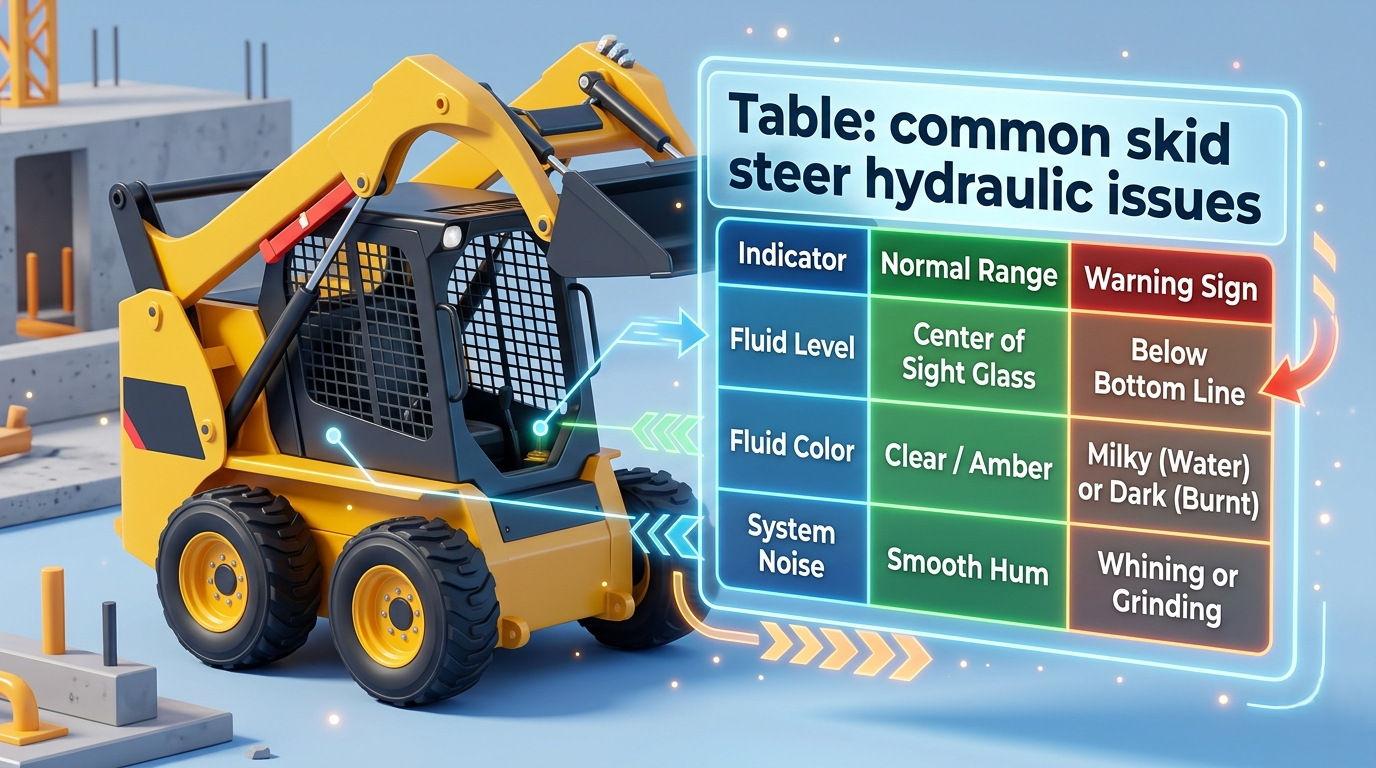
Common skid steer hydraulic issues
2. Spotting and getting rid of fluid contamination
Usually, contamination is called the “silent killer” of hydraulic systems, and quite rightly so. The dirt, water, and metal pieces actually form the internal “sandpapering” of your valves and cylinders. For example, a tiny piece of grit that cannot be seen even with a microscope might cause the valve to stick or a pump to fail prematurely.
- Spot Milkiness: When the oil has a milky appearance, water has been introduced into the system, which most of the time comes through a faulty breather cap or damaged seal.
- Temperature Watch: It has been found that contaminated oil does not melt heat very well which results in heating up of system and component wear that is very fast.
- Regularly Change Filters: You should remember that when you miss a filter change, a raw debris filter cannot be avoided anymore and your machine will be circulated by it.
3. Fixing problems and changing worn-out quick couplers
The main connecting point between your skid steer and its attachments is the quick couplers. The environmental factors such as dust, mud, as well as the pressure extremes cause these elements to develop leaks, or the flows get limited that even the attachments bring their performance to a choke.
- Clean Before Connecting: Make sure that you clean the coupler’s ends with a rag before you connect them; this way, you will not be pushing the dirt down into the system.
- Burrs or Damage: Afterward, you can take an eye at the locking balls and O-rings and then move on with the replacement of the one which is likely to be causing the leakage of a high-pressure environment in dangerous to operator.
- Relieve Back Pressure: Only if back pressure makes the coupler refuse to seat one can use the machine’s pressure-release function before doing a connection.
4. Bleeding air from the hydraulic system
The air that is present in the lines turns the hydraulic fluid “compressible,” which is a state it should not normally be in. This ultimately leads to control sponginess and attachments slightly dropping in load. Air mostly gets into the system either during the hose replacement or when the fluid level falls very low.
- Cycle the System: What requires the least effort to do is to cycle the lift arms and tilt cylinders through their complete ranges to push the air back to the reservoir.
- Check Suction Lines: Take a look at the hoses that are leading to the pump; even the smallest pinhole will actually act like a straw and draw in air into the system painlessly.
- Observe the Reservoir: One may see foam in the sight glass that is a sign to stop the machine for a while so that the air bubbles disappear gradually and then work has to be slowly resumed.
5. Checking hoses and sealing leaks
The hydraulic hoses are actually the veins of your skid steer, and in addition to that, they also take a lot of wear and tear. A hose burst is not only a maintenance problem but also a safety risk. Doing checks regularly might be able to detect a leaking hose, albeit a small one, long before it ends up as a huge problem on your job site.
- Spot Bubbles or Cracks: Feel the whole pipeline (hand only (still glove protective must be heavy)) running it down/off the machine each time looking for the soft spots or outer jackets cracked.
- Check Cylinder Seals: If you observe oil flowing down the chrome rod of a cylinder, it most probably means that seal is defective inside and needs to be replaced immediately.
- Tighten Loose Fittings: Because of the engine vibrations, nuts and bolts may become loose; turning them with a wrench once is sometimes sufficient to stop the minor leaks.
Table: Skid Steer Hydraulic Issues
| Component | Inspection Frequency | Common Failure |
| Hydraulic Hoses | Daily (Pre-start) | Abrasions & Cracks |
| Cylinder Rods | Every 10 Hours | Pitting & Seal Leaks |
| Filter Housing | Every 50 Hours | Loose Gaskets |
FAQ’s – Common Skid Steer Hydraulic Issues
Why are my skid steer hydraulics moving so slowly?
Hydraulics running slowly are typically caused by the level of hydraulic fluid being low, the hydraulic filter being clogged, or the hydraulic pump failing. In the event that the oil flow is limited or the volume is not enough, the cylinders will not be able to move at their rated speed. You can start by verifying your fluid and replacing your filters.
What causes a skid steer hydraulic system to overheat?
Generally, overheating is caused by a clogged oil cooler, low fluid levels, or the use of the wrong type of hydraulic oil. Make sure that the radiator and cooler fins are free from debris such as mud and grass. A machine system of that overworked one, especially using high-flow attachments on a standard-flow piece, can also be a reason for high-temperature.
How often should I change my skid steer hydraulic fluid?
The general advice is that the hydraulic fluid must be changed every 500 to 1,000 operating hours. However, in the typical case, hydraulic filters are to be replaced more frequently, at intervals of 250 to 500 hours. Do not forget to refer to your particular owner’s manual for the exact service intervals.
Can I mix different brands of hydraulic fluid in my skid steer?
In some cases, different brands can be mixed but never different types or viscosities (e.g., ISO 32 vs. ISO 46). Mixing those fluids can result in a change to the lubricating properties that may cause seal damage. It is always best to stick to the manufacturer recommended fluid.
How do I know if my hydraulic pump is going bad?
Symptoms of a failing pump include an almost constant, high-pitched whining or growling noise, a dramatic loss of power when the machine is under load, and running very hot. Even with full fluid and clean filters, the machine’s inability to lift a fully loaded bucket may indicate a pump that needs pressure testing.
Why won’t my hydraulic attachments work?
The most common cause for attachment failure is a defective or improperly connected quick coupler. If the couplers are clean and fully seated, the problem could be that the auxiliary hydraulic solenoid is faulty or a fuse in the control circuit has blown.
Is it safe to check for hydraulic leaks with my hand?
No, never use your bare hand to check for leaks. The hydraulic fluid is under very high pressure and it is capable of causing severe injuries or “fluid injection” which is a medical emergency. Use a piece of cardboard or wood to pass over the suspected area to see where the fluid is spraying.
Fix the Common Skid Steer Hydraulic Issues before its too late:
Learning the Common Skid Steer Hydraulic Issues Fixed in 5 Steps will leave your equipment a reliable asset at your disposal rather than a liability. The best way to avoid expensive repairs and keep your job site moving forward is maintaining the regular habits such as checking fluids, cleaning couplers, and replacing filters you know are the most basic yet essential ones. For more expert tips on maintaining your loader, visit SkidSteerLoader.net.