
How to Use a Skid Steer Power Rake for Perfect Finish Grading
If you want a professional-grade landscape finish, you need precision, a lot of patience, and the right kind of equipment. Whether it’s a large commercial site or a final residential project, using a skid steer power rake for perfect finish grading is the secret weapon that most landscapers keep to themselves.
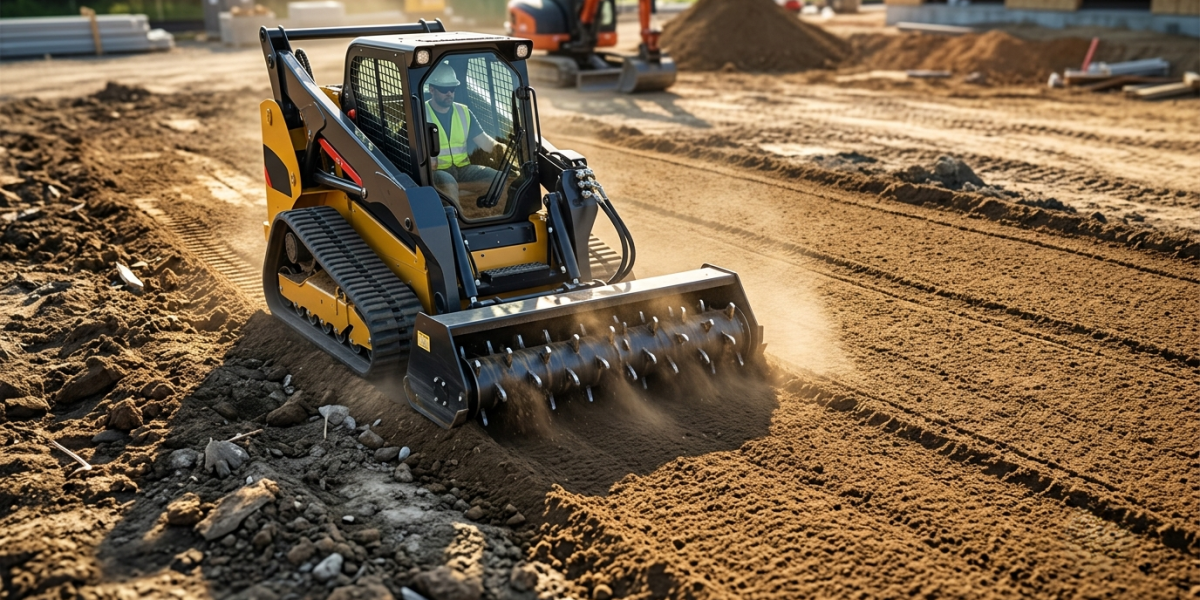
A power rake is a powerful implement that makes rough uneven soil areas into a smooth, clean seedbed by firstly pulverizing the soil and at the same time separating unwanted material and leveling the high spots.
When you combine a top-class compact machine such as the TYPHON STOMP mini skid steer available at SkidSteerLoader.net with a top-quality power rake attachment, you can reduce manual labor time from several hours to a few minutes.
Making perfect finish grading requires a good knowledge of how machine hydraulics work, the right roller angles and skillful driving to avoid the most common finish grading errors.
Top Uses of Skid Steer Power Rake
1. Familiarize Yourself with Both Power Rake and Skid Steer
You should have an intimate knowledge of how your equipment works as a whole grading system before you roll to the site. A power rake consists mainly of a heavy-duty, hydraulically operated cylindrical drum with carbide-tipped teeth that are turned in the direction opposite to the machine travel to help chop down hard soil.
Installing this attachment on a very agile, high power machine such as the TYPHON STOMP with gives you the right amount of hydraulic flow needed to keep the roller spinning smoothly without stopping. Proper coordination between your loader’s ground speed and that of the attachment’s rotation helps you avoid patchy soil surface.
- Always check the hydraulic quick-connect couplers to be sure that the connection is clean and secure before you switch the power on.
- Make sure the carbide-tipped teeth on the drum are whole and untangled with roots or wires.
- Set your power rake dual tracking wheels to the right depth level so that you achieve a consistent baseline throughout your work area.
2. Site Preparation for Finish Grading
Throwing the power rake into the soil without preparing it first is one of the major errors that is committed. If you want to be a real master in how to use a skid steer power rake for perfect finish grading, you need to tap into some removal of oversized obstacles first.
Large-sized rocks, a handful of tree stumps, and old construction debris can either break the teeth of your power rake or misalign your grading plane. In case you are fighting with very tightly packed clay or hardpan soils, then utilizing a first pass with a skid steer loader ripper attachment or digging bucket from SkidSteerLoader.net is very helpful in loosening sub-grade layers before you start with the finish work.
- Walk the entire site perimeter ahead of the work in order to identify and mark hidden utilities, irrigation heads, iron stakes, etc.
- If you need to remove stones larger than 4 inches in diameter, use your hands or a grapple bucket.
- Use your regular front bucket to smooth down large dirt piles or deep washouts so that the power rake will work on an almost level surface.
3. Adjusting the Roller Depth and Angle to the Best
Setting your power rake’s drum at a certain angle and working depth is where real finish grading goes. Leaving the roller straight will help you only herein that, you will scoop up loose dirt in front of the drum and it will be carried forward into low areas naturally to fill them.
In case you want to get rid of excess rocks or windrow materials on one side, just turning your drum 15 to 20 degrees to either side will do the trick by pushing debris off to the margins. Usually, the depth should be set very shallow, namely between 1 and 2 inches deep to modify topsoil rather than digging.
- Drop the power rake’s adjustable gauge wheels so that it maintains the exact working depth that lifts the attachment over surface variations.
- Tilt the drum angle from the operator’s seat to the desired side to divert rows of stones away from structural elements or fences.
- Use your skid steer’s hydraulic controls in the “float” mode so the attachment goes along with the ups and downs of the landscape.
4. Forward and Reverse Grading Pass Mastery
When you want to get a perfectly finished result, forwards and reverse work should be mixed in a balanced manner. The primary structural grading should be done on the forward drive as this allows the maximally cutting and pushing of the soil to be done with the reverse-rotating carbide teeth.
- Back-dragging in reverse with the roller spinning is a finishing maneuver and once you have the area generally flat, it leaves a velvety finish. The reverse pass also fills your machine’s tire or track marks and leaves you with a seedbed that was aerated.
- When in use, move your skid steer loader very slowly and slowly (into 2-3 mph) so that it is maximizing the tearing and chopping action of the rotating teeth on the soil particles.
- Overlap the end of one pass by 6-12 inches so that you can cover the seams and create a totally smooth transition of the soil surface.
- Keep the drum rotating while the attachment is on the ground so that you do not create deep gullies by stopping the drum.
5. Managing Soil Moisture Levels for Optimal Results
Soil moisture is a huge factor that often gets overlooked when learning how to use a skid steer power rake for perfect finish grading. Trying to do finish grading on a site that is still wet will just turn the soil into a sticky mass that will clog the spaces between the faces of the rake teeth.
On the other hand, soil that so dry that it does not contain water at all and is therefore quite hard, will just fly a lot of dust clouds and the power rake will keep bouncing off the surface. The best case scenario is “shuttle-dry” soil – earth that when squeezed in your hand forms a loose ball but breaks down easily under slight finger pressure.
- Following a heavy rainfall, wait at least 24 to 48 hours before undertaking the fine finish grading on clayey properties.
- If you have very dry and dusty job sites you can lightly mist them with water from either a water truck or a garden hose so as to get them to settle and also improve their compaction characteristic.
- Be sure to regularly clean mud off the drum shield in case you find it sticky so that the roller will not lock up.
6. How to Windrow Rocks and Manage Debris
One of the top features of a power rake is its soil cleaning capability while at the same time leveling the soil. During drum rotation, small stones, sticks, and dirt clumps are sifted out and moved along the angled roller towards the edges.
The result is a clean, narrow debris pile that is called a “windrow” which is found along your pass edge. After you have managed to direct all stones into a clean line, you can easily switch over to a multi-use attachment like a 4-in-1 bucket or a grapple grabber from SkidSteerLoader.net that will allow you to pick up the debris pile for disposal.
- Keep the same drum angle while creating windrows so that stones and other materials flow off the edge smoothly rather than be spilling over the top.
- Research found that by consolidating windrows into collection zones this will help to streamline final cleanup.
- Employ side shields on your power rake to keep rocks confined within your path when working near fragile glass windows or parked vehicles.
7. Key Power Rake Maintenance and Safety Practices
A power rake is a high-vibration, high-stress attachment that requires very disciplined maintenance if it is to stay in its prime operating condition. Home-gardening enthusiasts might be tempted to overlook this, but you must check grease levels, look for loose bolts, and hydraulic leaks in hoses before and after every grading job.
The drum surface is exposed to particles that are ejected forcibly, so safety must be at the forefront of your concerns. Make sure that bystanders remain at least 50 feet away from the operating radius and always wear comprehensive eye and ear protection inside the cab.
- Lubricate the main drum bearings and tracking wheel pivots after every 8 to 10 hours of active grading to avoid overheating.
- Inspect the hydraulic line installations thoroughly to make sure none are at risk of getting pinched by the frame points on your mini skid steer.
- Never leave the operator station while the skid steer engine is running or while the hydraulic auxiliary lines still have pressure.
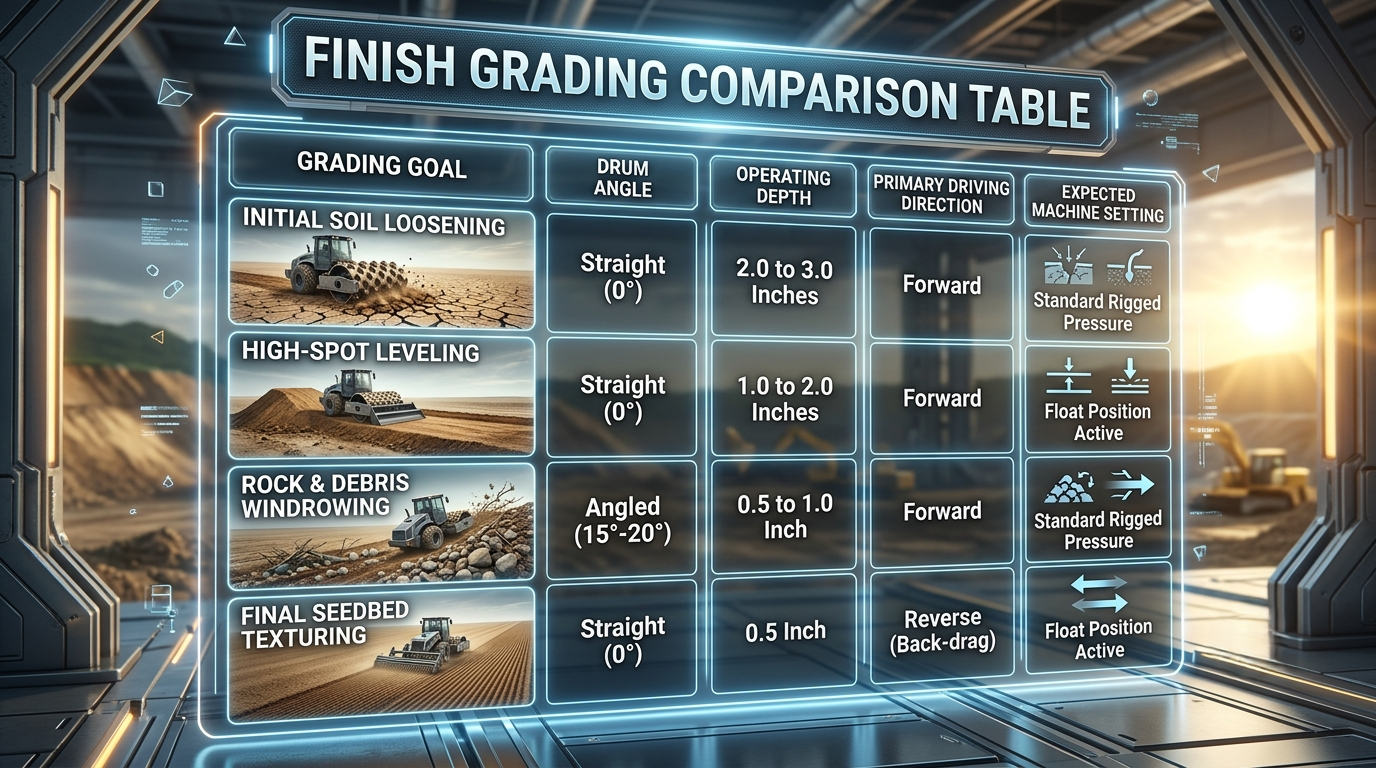
Finish Grading Comparison Table
| Grading Goal | Drum Angle | Operating Depth | Primary Driving Direction | Expected Machine Setting |
| Initial Soil Loosening | Straight (0°) | 2.0 to 3.0 Inches | Forward | Standard Rigged Pressure |
| High-Spot Leveling | Straight (0°) | 1.0 to 2.0 Inches | Forward | Float Position Active |
| Rock & Debris Windrowing | Angled (15°-20°) | 0.5 to 1.0 Inch | Forward | Standard Rigged Pressure |
| Final Seedbed Texturing | Straight (0°) | 0.5 Inch | Reverse (Back-drag) | Float Position Active |
Skid Steer Power Rake Table
FAQs – Skid Steer Power Rake for Perfect Finish Grading
What is the best ground speed when using a power rake on a skid steer?
Speed of power rake operation can be 1.5 to 3 mph (maximum). If one is moving so fast as to cause the attachment to jump off hard soil patches then a wavy, uneven surface will be the result. Slow and steady movement gives the very most out of the pulverizing action of the carbide teeth and the sorting out of hidden debris.
Can you use a power rake attachment in reverse?
Yes, in fact, using a power rake in reverse is a great finishing touch to produce a perfect grade. Forward strokes are perfect for the tasks of heavy cutting and windrowing rocks, but by shifting to the reverse mode, you have a back-drag capability that will also flatten out the track or tire imprints. The backdragging action will also refill small depressions, as well as soften and aerate the soil to be seeded.
How deep should a power rake go into the soil for finish grading?
When it comes to finish grading, a depth of 1 to 2 inches should not be exceeded. The purpose of finish grading is to condition the topsoil, create a smooth surface, and remove only shallow debris. If you dig any deeper, you could disturb compacted subbase layers and, as a result, develop soft spots on your landscaped areas.
Do I need a high-flow hydraulic system to run a power rake?
There is a wide variety of power rakes on the market today that are easily operable on standard-flow hydraulic systems. Typically, they require anywhere from 15 to 25 gallons per minute (GPM). However, it is very important that you consult your specific equipment manual. For example, a perfectly matched machine such as the TYPHON STOMP from SkidSteerLoader.net ensures that the engine runs at high torque without hydraulic overheating.
How do you prevent a power rake from creating waves or ripples in the dirt?
One such method is to make sure that the lift arms on your skid steer loader’s hydraulics are at the “float” position. In this way, the power rake is supported by its gauge wheels and not the soil surface. Another thing is to go at a steady pace, slowly, and keep your engine RPMs up so that the drum continues to spin at the same rate so that you do not get a washboard effect.
Is it better to use a power rake when the soil is wet or dry?
It is best to use a power rake when the soil is damp but crumbly – the so-called shuttle-dry condition. If the soil is too wet, then it becomes sticky mud which will bog down the drum as well as smear the surface. On the other hand, if the dirt is completely dry, then it hardens so much that it is quite difficult for the teeth to break through while at the same time you get excessive amounts of dust clouds.
What is the difference between a land leveler and a power rake?
A land leveler is a stationary attachment with fixed cutting blades used for heavy leveling, scraping, and filling large depressions. A power rake has a hydraulically powered spinning drum covered in carbide teeth. The power rake not only levels but also pulverizes the soil, separates stones from dirt, and creates a ready seedbed.