
How to Maintain Your Skid Steer Loader for 10,000+ Hours
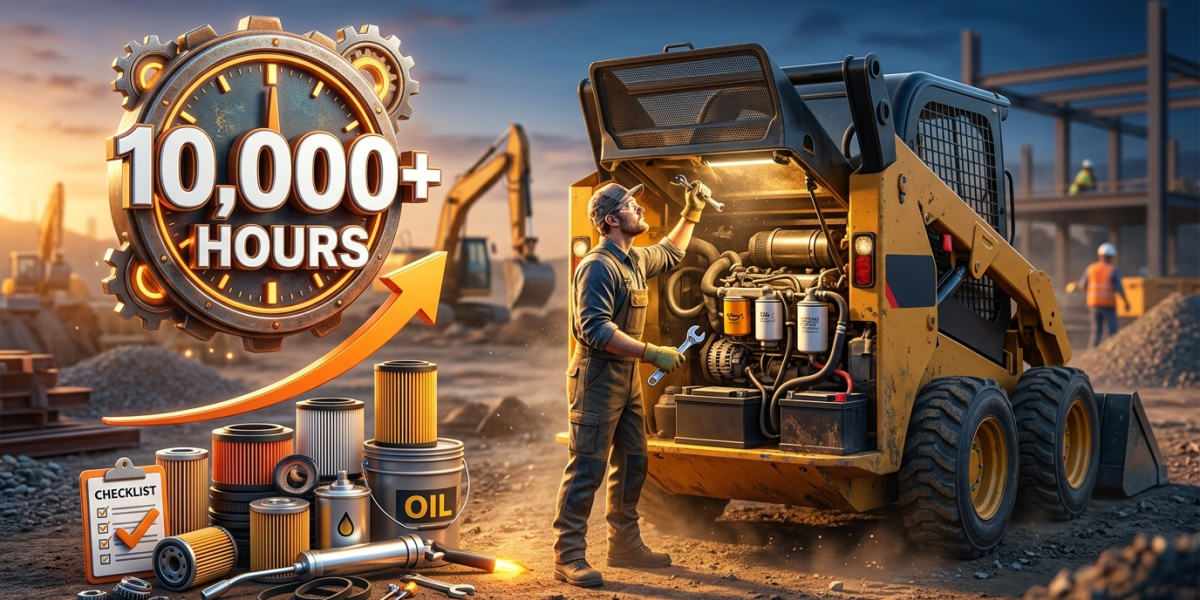
Many people see hitting 10,000 hours with a Skid Steer Loader as the ultimate achievement in heavy equipment management. Most users usually get their machine to trade in after 5,000 to 7,000 hours, but a well-planned maintenance approach can almost extend the machine’s life to double that.
In 2026, with new equipment prices going up and the use of advanced telematics being widespread, maintaining your existing fleet in top condition is not just a task but a financial necessity. This comprehensive guide aims to keep your loader working effectively at the job site even after a decade.
Skid Steer Loader Maintenance to achieve 10000+ hours
1. Basic: Daily Pre-Start Checks
The first step in achieving 10,000 hours of usage starts even before the engine is started. A daily walk-around will help find small issues that could lead to big tears if not fixed. By checking your equipment every morning, you get a good idea of its condition live that will help you notice any changes in performance or appearance.
- Check Fluid Levels: Don’t forget to check engine oil, hydraulic fluids, and coolant at least once per day. Running your engine with low fluids will cause increased friction and heat, which are the biggest enemies of engines with high hours.
- Leaks: Look for hydraulic leaks by checking for drops or puddles on the ground or on fittings. Even small leaks can lead to contamination of the system.
- Check Tires or Tracks: If you have a loader with wheels, ensure that the tire pressure matches the manufacturer’s recommendation; if you have a tracked machine, remove debris from the undercarriage to deter wear on sprockets and rollers.
2. Neural System: Skilled Liquid Management
If longevity of 10,000 hours is the goal for your Skid Steer Loader, then you have to consider the fluids inside it as the ones that keep you alive. Merely replenishing them will not do in 2026. Intricate machinery needs top quality fluids and is monitored by the sampling schedule for wear of internal components without dismantling the engine.
- Oil Testing: Take part in S•O•S (Scheduled Oil Sampling) every 250 hours. This “blood test” of your machine identifies tiny metal particles that indicate a bearing or piston is close to failure.
- Hydraulic Oil System: Change hydraulic filters every 500 hours, and conduct a complete system flush every 1,000 hours. Lack of clean hydraulic oil is the number one cause of pump failures in loaders with high hours.
- Coolant: Make sure not only to check the level of the coolant but also check its pH balance. Use Extended Life Coolant (ELC) to avoid engine block corrosion and cavitation.
3. Keeping the “Muscle”: Hydraulic System Care
The hydraulic system is the major component of a Skid Steer Loader that works day in, day out. It energizes the lift arms, drive motors, and every other attachment that you use with the loader. If you want to make 10,000 hours with your machine, it is absolutely crucial that you support the pumps and seals that help keep the system pressurized.
- In-depth seal and O-ring checks: Look at the chrome rods of the hydraulic cylinders every 1,000 hours and change the seals at the first wetness.
- Clean the Coupler: Wipe quick couplers thoroughly before hooking up any attachment. A single sand grain dropped inside hydraulic lines is enough to ruin a high-pressure pump within just a few hours.
- Pressure and Flow Checks: Get a technician to test the pressure and flow annually to confirm that the pump remains efficient and isn’t wearing internal metal particles to the point that it’s “shuttling” the components through the lines.
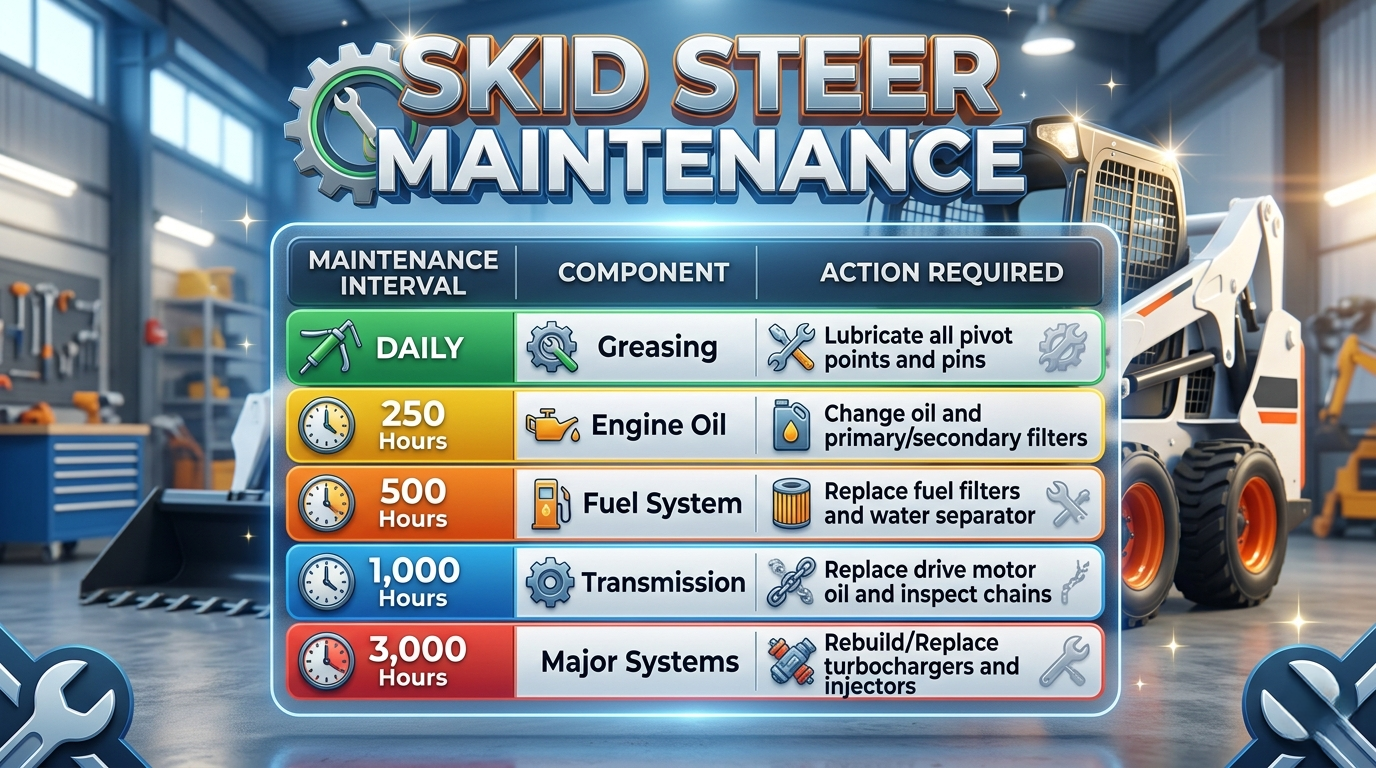
Table: Skid Steer Maintenance
| Maintenance Interval | Component | Action Required |
| Daily | Greasing | Lubricate all pivot points and pins |
| 250 Hours | Engine Oil | Change oil and primary/secondary filters |
| 500 Hours | Fuel System | Replace fuel filters and water separator |
| 1,000 Hours | Transmission | Replace drive motor oil and inspect chains |
| 3,000 Hours | Major Systems | Rebuild/Replace turbochargers and injectors |
Skid Steer Maintenance Components
The body and chassis: combating friction
Friction causes wear and wear causes loss of lifespan. If operatived without regular greasing, a Skid Steer Loader can literally end up as “a pile of dust.” Since these vehicles “skid” while turning, the load on axles, bearings, and pins gets increased significantly compared to traditional steering equipment.
- Heavy Greasing: In 2026, automated lubrication systems will be the norm, but if you are doing manual greasing, perform greasing after every 8-10 hours of machine operation. Concentrate on lift arm pivots and bucket tilt pins.
- Undercarriage Cleaning: Mud and stones trapped between the Compact Track Loader (CTL) parts may be compared to sandpaper. Wash the track with water every day to keep the rubber tracks in your machine coming for longer.
- Axle and Hub Maintenance: Check the chain case and hub oil levels regularly if you use wheeled loaders. Rusted chains entered here after water ingress can cause heavy load snap and damage the whole drive system.
Electrical & Software Optimization
Nearly every modern loader is a computer as much as it is a tractor. The sensors and ECMs (Electronic Control Module) will be further identified as the main cause of engine “meltdown” avoidance going into 2026. A simple sensor mistake ignored could allow other parts to ignore the engine shutdown safety protocols.
- Software Updates: Make sure your dealer updates your firmware to the latest version. Most often these updates come with better “limp mode” parameters that help protect the engine during overheating situations.
- Battery and Alternator Health: Inspect the battery terminals for corrosion monthly. Problems with voltage fluctuations can lead to wrong signals being sent to hydraulic controllers, causing jerky operations which may lead to different forms of pin damages.
- Wiring Loom Protection: Check the wiring harness for rubbing or “chafing.” After 10,000 hours of vibrations, the insulation can wear through and the resulting shorts are very difficult to diagnose.
Operator Influence on Machine Lifespan
Even if you have the most excellent maintenance plan in the world, a “cowboy” operator can kill a Skid Steer Loader in 2000 hours. Training goes hand in hand with your 10,000-hour maintenance guide as the machine driving method greatly defines how much “reserve life” can be left in the metal.
- Warm-up and Cool-down: Protect the turbocharger from coking (oil carbonization on hot surfaces) by idling the engine for at least 3-5 minutes both before and after operating the machine at full throttle.
- Stalling the Hydraulics: Train operators to never hold hydraulic levers in the “on” position once the cylinder reaches its limit as this creates huge heat and by-passes the relief valves.
Matching the right attachment and ensuring it keeps within the Rated Operating Capacity (ROC) limits of the machine will not only avoid undue stresses on the boom arms but will also significantly reduce the chances of structural frame cracks.
FAQ’s: Skid Steer Loader Maintenance (2026)
How long can a skid steer engine really last?
You can take a high-quality diesel engine (like Kubota or Yanmar) along for 10,000 to 12,000-hour rides if you use premium synthetic oils and change them every 250 hours. The trick is maintaining the fuel injection system and not overheating.
For longevity, is it better to buy a wheeled or tracked skid steer?
Over the course of 10,000 hours of operation, wheeled loaders usually have a lower cost of ownership as tires are cheaper to replace than tracks and undercarriage rollers. But tracks are better for soft terrains and also provide a smoother ride that helps in preserving the frame.
What is the most common cause of skid steer failure?
Hydraulic contamination. Over 70% of hydraulic component failures occur due to dirt or moisture getting into the system through couplers or damaged seals.
How often should I replace the hydraulic hoses?
Hoses don’t have a defined lifespan measured in hours, but as per a 2026 maintenance guide, we recommend visually inspecting them daily and “proactively” replacing any hose which shows cover layer wear or has “bubbles” visible every 3,000 hours.
Does “High Flow” hydraulics decrease the lifespan of the machine?
High-flow systems generate way more heat. If you are using high-flow attachments on a regular basis, you will have to double your cooling system maintenance and keep your radiator fins clean of debris at all times.
Can I use regular grease for my skid steer pins?
Using Molybdenum (Moly) grease with 3-5% moly content is highly recommended. Such a “extreme pressure” grease will remain longer on the pins and will protect metal-on-metal contact leading to “floppy” joints.
Is a 10,000-hour skid steer still worth something at resale?
Yes, if you have properly documented service records. In 2026, a machine with 10,000 hours and a “clean bill of health” from an oil analysis can still bring 30-40% of its original price to light-duty or farm users.