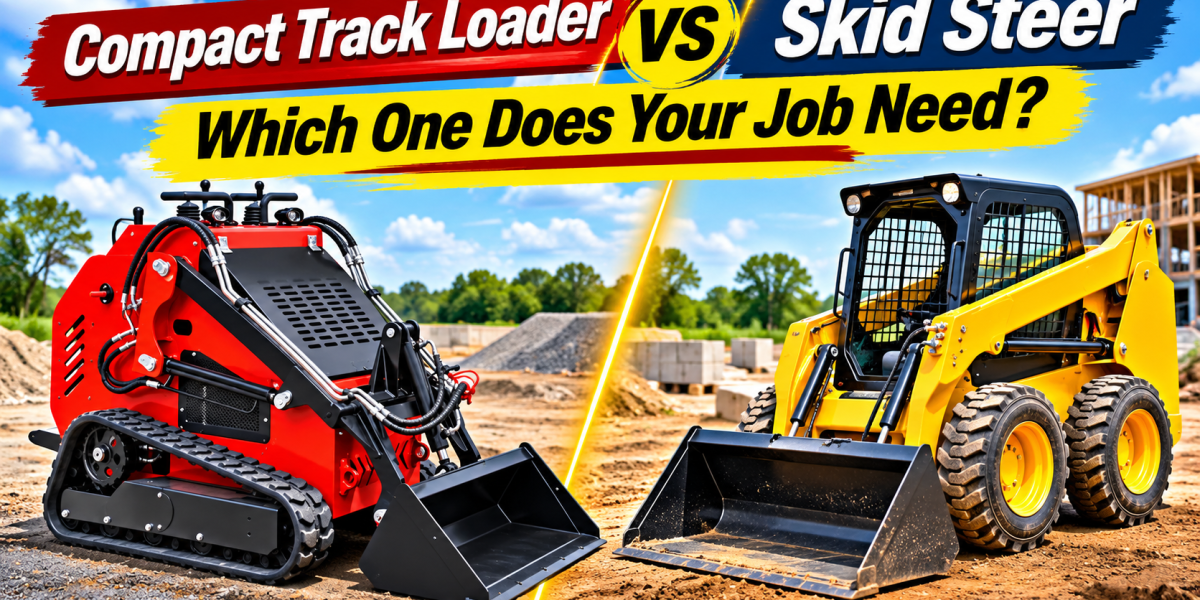
Compact Track Loader vs Skid Steer: Which One Does Your Job Need?
Choosing between a compact track loader vs skid steer is one of the most critical fleet investments you will make as an equipment owner, site supervisor, or earthmoving contractor. Both machines share identical hydraulic control platforms, accept universal quick-attach work tools, and tackle foundational earthmoving tasks with exceptional versatility.
But using wheeled loaders on soggy ground, or driving rubber-tracked undercarriages over cracked concrete may rapidly eat into equipment margins via significant downtime and premature maintenance wear. The correct equipment is selected based on ground pressure requirements, surface abrasiveness, seasonal working windows, transport payloads and long-term running expenses per hour.
- Drivetrain Interface: Wheeled skid steers typically come with four solid or pneumatic rubber tires whereas compact track loaders (CTLs) are equipped with dual continuous rubber tracks over multi-roller undercarriages.
- Footprint & Flotation: Wheeled loaders concentrate ground pressure in the 30 to 45 PSI range, whereas tracked equipment distributes its weight to around 4 to 6 PSI.
- Capital & Maintenance Variance: Skid steers have a reduced initial cost of ownership and easy tire replacement. CTLs demand disciplined tracking of undercarriage wear, but they also provide higher grip and productivity in difficult underfoot conditions.
Surface Impact, Flotation and Pressure on the Ground
The difference in operation between the two platform designs is in the ground pressure dynamics and surface contact area . A wheeled skid steer puts all of its operational weight into four individual contact patches, pushing downward force into the soil and generating instant rutting on soft, sandy or rain-soaked jobsites.
A compact track loader, in contrast, spreads its operational weight across two large, steel imbedded rubber tracks, making the ground pressure a fraction that of a wheeled equipment.
This widespread weight distribution ensures real float, enabling operators to glide over uncompacted loam, marshy clay and finished grass without digging in the chassis or damaging sensitive subgrades.
- Pounds Per Square Inch (PSI): Standard skid steers push 30 to 45 PSI directly into the ground, while standard CTLs maintain an ultra-low 4.0 to 6.2 PSI.
- Turf Preservation: Tracked loaders eliminate deep tire gouging on finished commercial lawns and golf courses when operators execute sweeping three-point turns.
- Jobsite Flotation: Track systems bridge across soft sand, marshy topsoil, and rain-saturated clay where wheeled machines inevitably spin, sink, and high-center.
Traction, Gradeability, and Pushing Force
Traction directly governs cycle times when aggressive excavation, site grading, or heavy material transport is required on unpaved surfaces. A compact track loader delivers continuous contact with the earth, translating engine horsepower and hydraulic output directly into raw drawbar pull and tractive effort.
When driving into stockpiles of crushed stone, dense clay, or wet topsoil, tracked units maintain continuous forward momentum without wheel slippage. On sloped landscapes, retention ponds, and steep retention berms, the extended track footprint provides low-center-of-gravity stability, preventing the tipping sensation and lateral slide common in short-wheelbase skid loaders.
- Drawbar Pull & Stockpile Penetration: Continuous track engagement generates maximum pushing power, enabling operators to load full bucket volumes without track slip.
- Slope Stability: Low ground-level track balance allows safe operation on steep inclines and side slopes where wheeled loaders lose downhill tire grip.
- Elimination of Wheel Spin: Tracked undercarriages eliminate the wheel spin that burns out tire rubber and leaves jagged ruts across soft cuts.
Maneuverability, Travel Speed, and Cycle Times
When your jobsite footprint consists of hard-packed gravel, asphalt roadways, warehouse concrete, or tight urban alleyways, the traditional wheeled skid steer remains a top performer.
Skid steer loaders feature shorter total wheelbases, allowing them to spin 360 degrees directly inside their own footprint without binding drive systems or scrubbing expensive rubber tracks. Furthermore, wheeled loaders travel noticeably faster across long distances, reaching top transport speeds between 10 and 12 mph, compared to 6 to 8 mph for typical tracked machines.
For expansive material-handling yards, road construction projects, and municipal utility work where machines routinely run down city curbs, wheeled units cut cycle times substantially.
- Zero-Radius Counter-Rotation: Wheeled machines spin instantly on hard pavement without incurring the accelerated track tearing seen on tracked units.
- Transit Velocity: Two-speed wheeled skid steers travel up to 12 mph, cutting down cycle times across sprawling jobsites.
- Compact Chassis Agility: Shorter tip-to-tail profiles allow operators to slip cleanly through narrow residential gates and between parked flatbeds.
Evaluating the Compact Track Loader vs Skid Steer Under Harsh Ground Conditions
Matching machine drivetrains to specific site conditions determines whether your crew beats project deadlines or spends non-billable hours winching equipment out of mud holes. In soft soils, heavy rainfall seasons, or virgin forestry clearing, a compact track loader keeps jobs moving long after rainstorms shut down wheeled operations.
However, abrasive surfaces such as broken asphalt milling, scrap yards, demolition concrete, and jagged quarry rock will quickly damage rubber tracks. On high-abrasion surfaces, skid steer loaders fitted with severe-duty solid or foam-filled tires deliver long service lives at a fraction of the cost per working hour.
- Wet & Inclement Weather: Tracked loaders extend your billable working season by weeks in early spring and late autumn when soil saturation stops wheels cold.
- Abrasive Concrete & Demolition: Wheeled loaders equipped with puncture-proof solid tires resist jagged rebar and concrete scrap that slice open rubber track carcases.
- Finished Pavement & Curbing: Rubber tires roll smoothly over asphalt parking lots during snow plowing without marring surfaces or scuffing sealcoats.
Fleet Management Takeaway: Before choosing your equipment platform, analyze your annual project logs; if more than 60% of your work takes place on dirt, clay, sand, or rough terrain, a track loader pays for itself in raw uptime. Explore heavy-duty options, check current machinery availability, or submit a direct fleet inquiry at skidsteerloader.net to find the right configuration for your job requirements.
Initial Purchase Price, Maintenance, and Total Cost of Ownership
Financial considerations extend well beyond initial dealer window pricing. A brand-new wheeled skid steer is generally 20% to 30% less expensive upfront than a compact track loader of comparable horsepower and rated operating capacity.
The major long-term cost difference comes from the undercarriage: a skid steer features a simple drivetrain with axle tubes and four standard tires, keeping routine maintenance straightforward.
Tracked machines, on the other hand, require continuous maintenance of rubber tracks, sprockets, idler wheels, track tensioners, and internal roller assemblies. When track components wear out, replacement costs for tracks and undercarriage parts easily outpace the price of standard skid steer tires.
- Acquisition Capital: Skid steers carry a lower entry price, freeing up working capital for high-flow attachments and transport trailers.
- Wear Component Replacement: Replacing four commercial skid steer tires typically costs between $800 and $1,800, whereas a complete CTL track set and drive sprocket replacement often ranges from $3,000 to $6,000+.
- Daily Undercarriage Maintenance: Track loaders require daily cleaning of packed dirt, mud, and frozen debris from track frames to prevent premature seal failures and idler wear.
Compact Track Loader vs Skid Steer Comparison
Machine Specifications and Operational Comparison
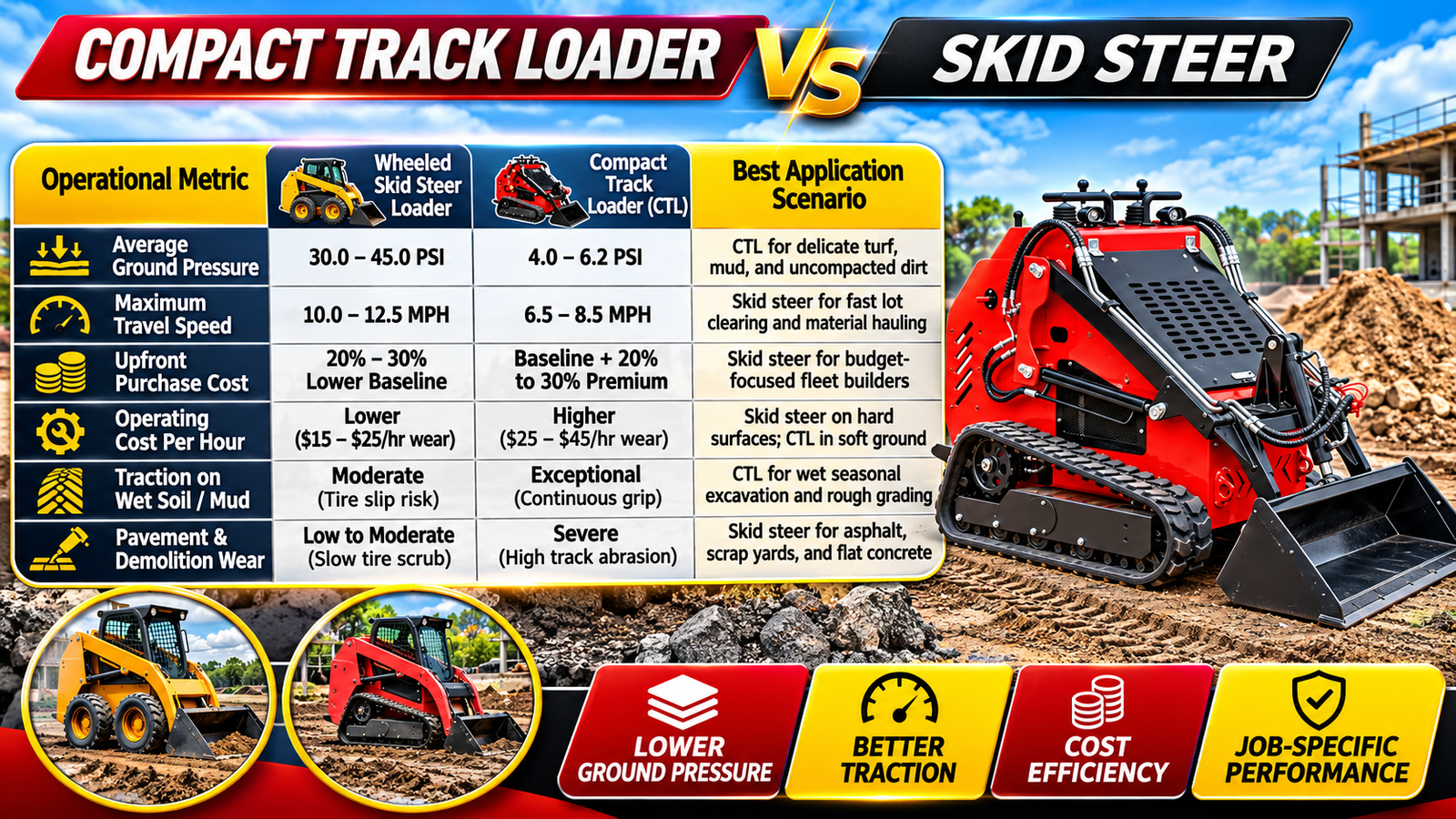
Evaluating performance metrics side-by-side clarifies how each platform translates engine power into productive jobsite output.
Table: Compact Track Loader Vs Skid Steer
| Operational Metric | Wheeled Skid Steer Loader | Compact Track Loader (CTL) | Best Application Scenario |
| Average Ground Pressure | 30.0 – 45.0 PSI | 4.0 – 6.2 PSI | CTL for delicate turf, mud, and uncompacted dirt |
| Maximum Travel Speed | 10.0 – 12.5 MPH | 6.5 – 8.5 MPH | Skid steer for fast lot clearing and material hauling |
| Upfront Purchase Cost | 20% – 30% Lower Baseline | Baseline + 20% to 30% Premium | Skid steer for budget-focused fleet builders |
| Operating Cost Per Hour | Lower ($15 – $25/hr wear) | Higher ($25 – $45/hr wear) | Skid steer on hard surfaces; CTL in soft ground |
| Traction on Wet Soil / Mud | Moderate (Tire slip risk) | Exceptional (Continuous grip) | CTL for wet seasonal excavation and rough grading |
| Pavement & Demolition Wear | Low to Moderate (Slow tire scrub) | Severe (High track abrasion) | Skid steer for asphalt, scrap yards, and flat concrete |
Towing, Machine Weight, and Trailer Logistics
Transport considerations are frequently overlooked until a newly purchased machine sits on your equipment yard. Compact track loaders weigh substantially more than wheeled skid steers with identical chassis dimensions and engine ratings, often carrying an extra 1,000 to 2,500 pounds of steel undercarriage, roller assemblies, and rubber tracks.
The added weight necessitates heavier-rated tandem-axle trailers, heavy tie-down chains and more robust commercial tow vehicles to properly transport the equipment within legal gross vehicle weight limits (GVWR).
A large-frame track loader with a strong hydraulic mulching head may push home landscapers and light contractors using Class 2b pickup trucks beyond legal towing restrictions and into commercial transport requirements.
- Gross Operating Weight: CTLs have 15% to 25% more operating curb weight because of hefty track frames, idlers and steel track cores.
- Trailer Capacity Checks: Wheeled loaders typically fit well on normal 10,000-lb GVWR utility trailers, however mid-to-large CTLs usually need 14,000-lb or 16,000-lb commercial trailers.
- Fuel Consumption in Transit: The additional weight of track machines and greater ground drag during loading somewhat increases fuel consumption in transit and in the field.
Attachment Versatility and Hydraulic Compatibility
Both platform designs utilize standardized universal quick-attach mounting plates and auxiliary hydraulic couplers, allowing operators to run shared tool inventories. Whether swapping a general-purpose dirt bucket for high-flow hydraulic brush cutters, trenchers, post-hole augers, or cold planers, both machines supply reliable hydraulic flow and pressure.
However, the track loader’s superior ground contact provides a steadier operating platform when handling front-heavy, high-torque attachments such as tree shears, stump grinders, and rock saws. The wider footprint acts as a solid counterweight, minimizing the front-to-rear chassis rocking common when wheeled skid steers handle heavy loads over uneven ground.
- Universal Tool Couplers: Both machines have standard ISO quick-attach plates, allowing buckets, pallet forks and hydraulic hammers to be quickly swapped between platforms.
- High-Flow Hydraulic Demands: High-flow auxiliary packages may be added to both platforms to support high-output attachments such as asphalt cold planers and forestry mulchers.
- Chassis Stability Under Load: When grading heavy with automated laser boxes or dual-mast GPS systems, track loaders provide a smoother, non-bouncing platform.
Pro Tip for Site Managers: High-torque hydraulic attachments perform best when paired with the right chassis stability. If your workflow relies on demanding attachments, visit skidsteerloader.net to view compatible machinery options, hydraulic flow ratings, and application-matched packages.
How to Select the Ideal Loader for Your Business
Making the final choice between a compact track loader vs skid steer comes down to your primary work surfaces, typical regional weather conditions, and operating budget. If your company focuses on municipal road maintenance, commercial snow removal on parking decks, demolition salvage inside structures, or material transport over paved yards, the wheeled skid steer remains the most efficient, cost-effective choice. Its lower purchase price, inexpensive tire upkeep, and rapid transport speeds keep operating margins solid on hard ground.
Conversely, if your crew tackles general site excavation, residential landscaping, forestry mulching, pool construction, or agricultural clearing across unpaved terrain, a compact track loader is the superior choice.
The machine’s low ground pressure, high flotation, and reliable traction prevent costly weather delays, protect client property from wheel ruts, and keep your crews working when wet ground would sideline wheeled equipment. Review your project history, check your ground conditions, and choose the platform that delivers maximum billable hours every season.
- Select a Wheeled Skid Steer if: Your operations run on asphalt, concrete, or compacted gravel; you require fast cycle speeds; and you want minimal maintenance overhead.
- Select a Compact Track Loader if: Your projects involve wet dirt, sand, steep slopes, or finished lawns where high traction and low ground pressure are mandatory.
- Balanced Fleet Strategy: Many growing excavation and landscaping firms run a hybrid fleet, deploying a compact track loader for rough grading and earthmoving alongside a wheeled skid steer for hard-surface material handling and road cleanup.
FAQs – Compact Track Loader vs Skid Steer
Which machine is best for muck and deep snow?
The small track loader with continuous rubber tracks floats well in heavy mud and loose, uncompacted snow at 4 to 6 PSI. Wheeled skid steers have ground pressure of 30 to 45 PSI and sink and spin in deep mud but are great for snow removal on concrete parking lots with tire chains.
So, a little track loader costs more to maintain than a skid steer?
The undercarriages of compact track loaders are complex, with track tensioners, drive sprockets, idler wheels and roller bearings that wear out in abrasive conditions. They cost more to fix on an hourly basis. The expense of replacing rubber tracks and damaged substructure is several times greater than skid steer tires.
Do you have tiny track loader attachments and skid steer attachments?
Most modern skid steers and compact track loaders are equipped with universal quick-attach mounting plates and auxiliary hydraulic hookups. Your auxiliary hydraulic flow rates (standard flow vs high flow) and engine horsepower need to fulfill attachment requirements to transport buckets, augers, forks and grapples between machines.
How long do skid steer tires last vs tracks on a track loader?
Depending on the surface conditions, pneumatic skid steer tires last between 600 and 1000 hours. Solid severe-duty tires may last over 2,000 hours. Compact track loader rubber tracks will last 1,200 to 1,800 hours on soil or grass, but abrasive asphalt or jagged blasted rock might reduce that lifespan.
Which loader is faster on commercial jobsites?
Wheeled skid steer loaders can travel at speeds of 10 to 12.5 mph and can back-rotate instantly without stressing the drivetrain, which reduces cycle times on flat, hard-packed terrain. They cycle more rapidly, at 6.5 to 8.5 mph, on soft or muddy terrain where wheeled vehicles lose traction.
Compact Track Loader vs Skid Steer: Streamlining Fleet Upgrades
Choosing the right heavy equipment for your daily task demands keeps projects going and helps you get the most bang for your buck. Whether you need all-terrain flotation on a new compact track loader or reliable speed and low operating cost on a commercial wheeled skid steer, make an educated choice to preserve your bottom line.
Need powerful loaders for your team to tackle challenging jobs? Visit skidsteerloader.net now for our full collection, equipment specifications and immediate, personalized prices. Call our equipment experts to help you choose the right platform, hydraulic package and accessories for your firm.