

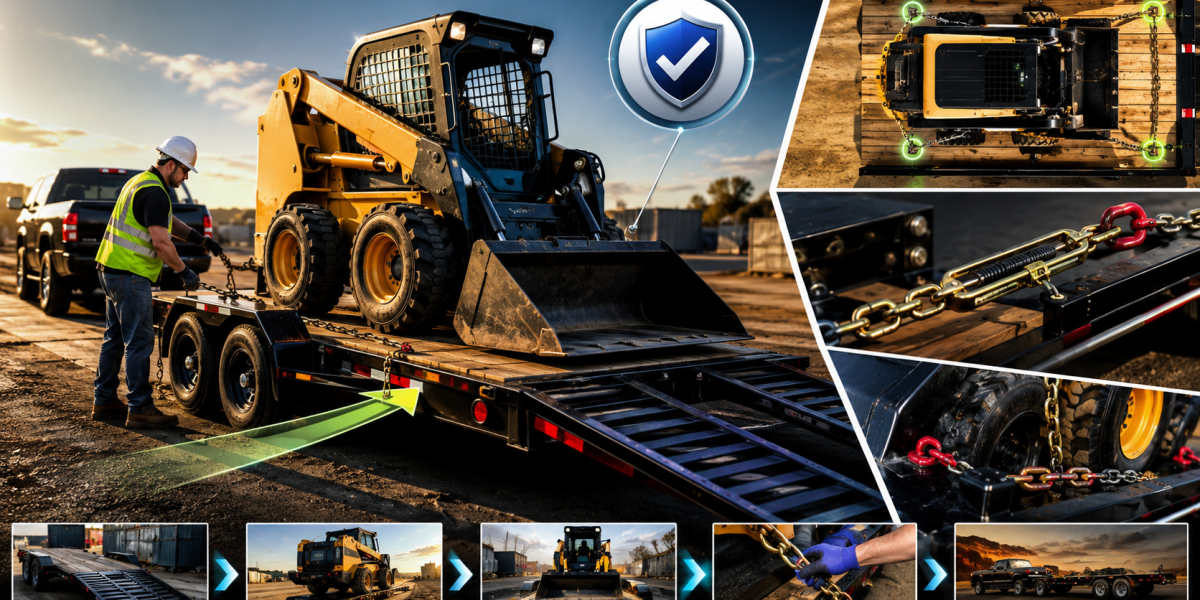
How to Load and Tie Down a Skid Steer Safely on a Trailer
If you are a contractor, landscaper, or heavy equipment operator, your machinery is the lifeblood of your business. Moving these powerful machines from one job site to another is an everyday task, but it should never be treated casually. Knowing exactly how to load and tie down a skid steer safely on a trailer is a critical skill that protects your investment, your crew, and everyone else on the highway.
A skid steer loader can easily weigh between 6,000 and 12,000 pounds. When that much weight is in motion, any mistake during the loading or securing process can lead to catastrophic accidents, severe equipment damage, or hefty Department of Transportation (DOT) fines.
At SkidSteerLoader.net, we understand that efficiency is key, but safety must always come first. This comprehensive guide will walk you through the entire process step by step, ensuring that every time you load and tie down a skid steer safely, you do it with absolute confidence and in full compliance with transport regulations.
Understanding the Basics to Load and Tie Down a Skid Steer Safely
Before we get into the heavy lifting, it is essential to understand why following a strict, standardized process is non-negotiable. Whether you are hauling a compact track loader or a wheeled skid steer, the physics of transporting heavy machinery remain the same.
The center of gravity on a skid steer can be unexpectedly high, making the machine prone to tipping if it is not handled smoothly on an incline. Furthermore, federal and state laws have stringent requirements concerning the aggregate working load limit (WLL) of your tie-downs.
When you learn how to load and tie down a skid steer safely on a trailer, you are not just ensuring that the machine stays put; you are actively preventing the load from shifting during sudden braking, sharp turns, or evasive maneuvers on the road.
Taking shortcuts can lead to tragic consequences, so mastering these foundational rules is paramount for any professional operator. Here are the critical reasons why standardizing your loading process is so important:
- Preventing Highway Accidents: A shifting load can cause trailer sway or even detachment, endangering the driver and the public.
- Avoiding Expensive Legal Fines: DOT inspectors are meticulous; improper securement can lead to massive fines and out-of-service violations.
- Protecting Your Equipment Asset: Proper tie-down procedures prevent structural damage to your skid steer’s frame, hydraulics, and undercarriage.
Pre-Loading Inspection and Equipment Preparation
Before a skid steer even approaches a ramp, you must conduct a thorough pre-loading inspection and prepare the machinery for transport. This step is often rushed, but it is one of the most critical aspects of learning how to load and tie down a skid steer safely.
Begin by cleaning off excess mud, grease, and debris from the machine’s tires or tracks. Rubber tracks and muddy tires can easily slip on steel trailer ramps, especially if the weather is wet or freezing.
Next, perform a swift walk-around inspection to check for any active hydraulic leaks, under-inflated tires, or loose components that might become hazards at highway speeds. If your machine is equipped with heavy attachments, decide whether it is safer to transport them attached and fully lowered to the trailer deck, or detached and secured separately.
Additionally, lowering the overall fluid levels—like not transporting with a completely full fuel tank—can help minimize unnecessary weight and reduce the risk of spills if an emergency occurs. To properly prepare your skid steer for the trailer, always complete the following steps:
- Thoroughly Clean the Undercarriage: Remove all caked-on dirt and rocks to ensure maximum traction on the trailer ramps.
- Check and Document Machine Condition: Inspect for leaks and take note of the equipment’s condition before transport to prevent disputes later.
- Manage Your Attachments Securely: Make sure buckets, forks, or sweepers are either removed or positioned to be safely lowered and chained down independently.
Selecting the Right Trailer and Ramps for the Job
Your ability to load and tie down a skid steer safely on a trailer depends heavily on the equipment you use to haul it. Never attempt to overload a trailer that does not have the appropriate Gross Vehicle Weight Rating (GVWR) and payload capacity.
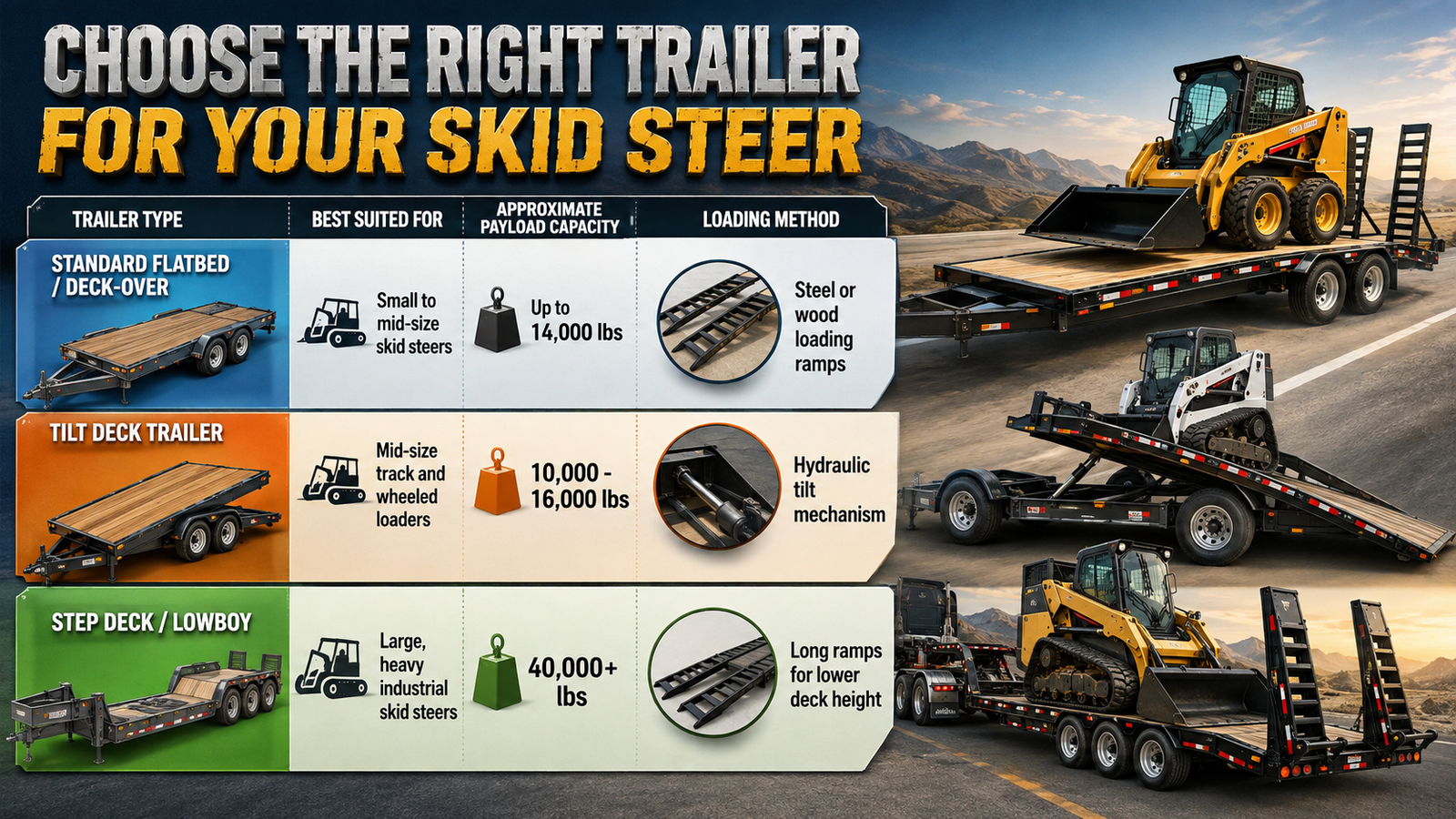
You must calculate the actual weight of your skid steer, including all attachments, fluids, and operator cabin modifications, and ensure it falls well within the trailer’s maximum payload. A standard flatbed or tilt-deck trailer is usually sufficient for small to mid-sized skid steers, while step-deck or Removable Gooseneck (RGN) trailers are reserved for heavier industrial loaders.
Furthermore, always verify that the trailer is parked on firm, perfectly level ground before attempting to load. Using wheel chocks on the trailer and the towing vehicle is a mandatory safety measure. If your trailer has rear stabilizer jacks, deploy them to prevent the trailer from popping up or swaying when the heavy machine transitions onto the ramps.
Below is a helpful table detailing common trailer types used for skid steer transport and their approximate payload capacities:
Table: Trailer Types – Load and Tie Down a Skid Steer Safely
| Trailer Type | Best Suited For | Approximate Payload Capacity | Loading Method |
| Standard Flatbed / Deck-Over | Small to mid-size skid steers | Up to 14,000 lbs | Steel or wood loading ramps |
| Tilt Deck Trailer | Mid-size track and wheeled loaders | 10,000 – 16,000 lbs | Hydraulic tilt mechanism |
| Step Deck / Lowboy | Large, heavy industrial skid steers | 40,000+ lbs | Long ramps for lower deck height |
Ensure you cross-check your setup with these vital trailer preparation rules:
- Verify Payload Capacity: Always subtract the empty weight of the trailer from the GVWR to find your true available payload limit.
- Park on Firm, Level Ground: Never load on a slope or soft mud, as the trailer could unexpectedly shift, tilt, or roll.
- Engage Trailer Stabilizers and Chocks: Use heavy-duty wheel chocks and rear support legs to keep the trailer deck perfectly stable during the loading transition.
Load and Tie Down a Skid Steer Safely Tab
The Step-by-Step Loading Process for Your Skid Steer
When it is time to drive the machine onto the deck, precision and patience are your best tools. The golden rule when moving up an incline is to keep the heaviest part of the machine pointed uphill.
For a standard skid steer with an empty bucket, the rear end (housing the engine and counterweights) is the heaviest part, meaning you should back the machine up the ramp. Conversely, if your loader has a heavy attachment filled with material, the front may be heavier, requiring you to drive forward up the ramp.
Always consult your specific manufacturer’s operation manual for the final word. Line the skid steer up perfectly straight with the trailer ramps before you begin your ascent. Do not try to steer or make sharp corrections while on the ramps, as this can easily cause the machine to slip off the edge.
Move at the lowest practical speed, using incredibly smooth, gradual control inputs to prevent the machine from jerking or rocking. Executing a flawless loading sequence requires strict adherence to these operational practices:
- Keep the Heavy End Uphill: Always back up the ramp if empty, or drive forward if the attachment makes the front end heavier.
- Maintain Perfect Alignment: Approach the ramps squarely and straight on; never attempt to correct your steering once the tracks or tires are on the incline.
- Use the Lowest Speed Range: Engage the machine’s slow mode and avoid sudden acceleration or braking to prevent dangerous weight shifts.
Correct Tie-Down Procedures and Chain Securement
Once the skid steer is perfectly positioned and balanced over the trailer axles (typically 60% of the weight ahead of the axles and 40% behind), you must secure it. Knowing how to load and tie down a skid steer safely on a trailer means following the Department of Transportation’s four-point tie-down rule.
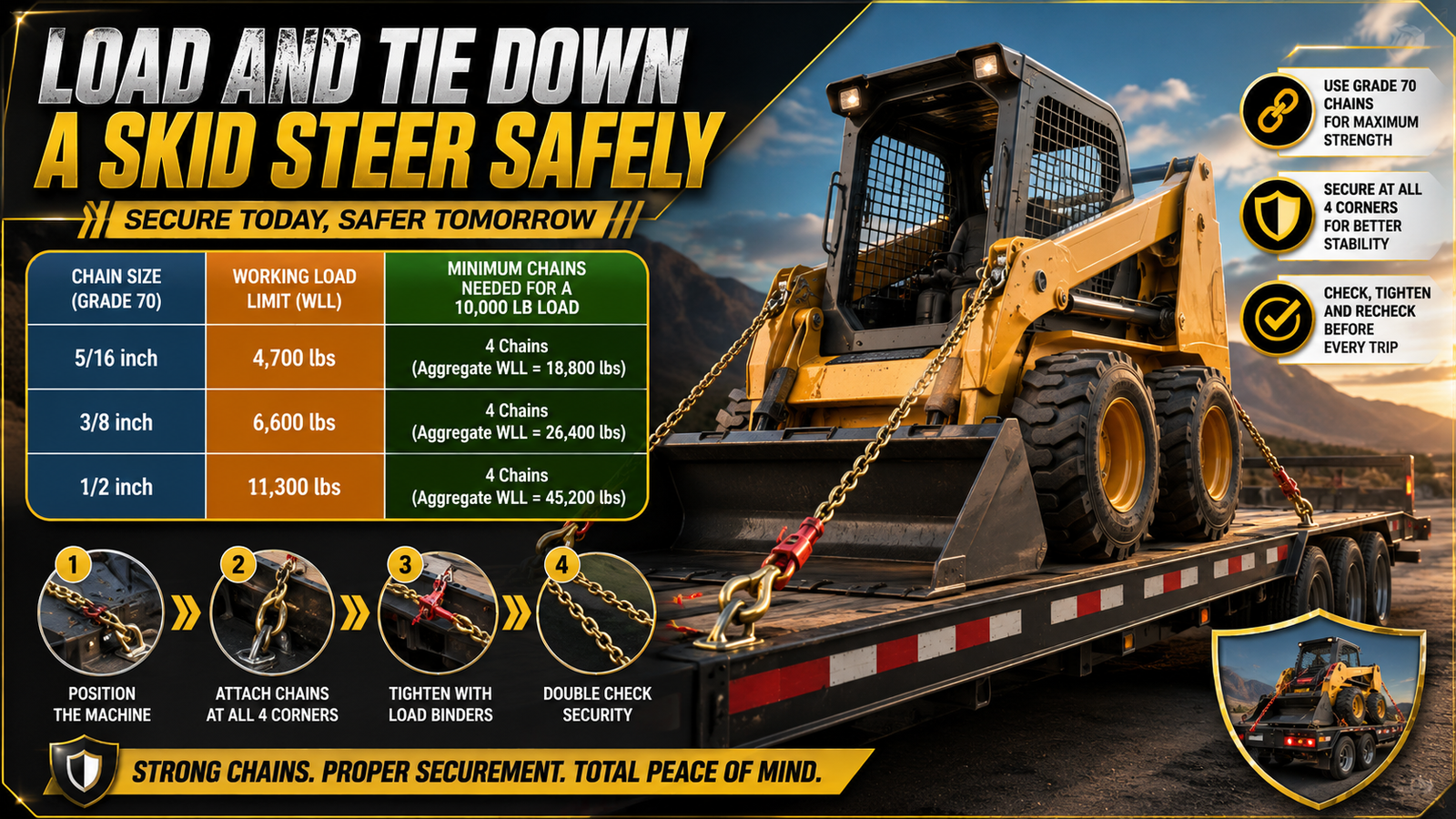
Heavy equipment weighing over 10,000 lbs requires a minimum of four separate tie-downs—one for each corner of the machine. Use Grade 70 steel transport chains or higher; nylon straps are completely unacceptable for securing heavy metal tracks and frames.
The aggregate Working Load Limit (WLL) of all your tie-downs must equal at least 50% of the total weight of the cargo. Attach the chains directly to the manufacturer-designated tie-down points on the skid steer frame.
Cross the chains appropriately to prevent lateral, forward, and rearward movement, and tighten them down firmly using high-quality chain binders. Finally, lower the bucket or attachment completely flat against the trailer deck and secure it with a separate, fifth tie-down chain.
Review this quick reference table for calculating your chain Working Load Limits (WLL) for Grade 70 Transport Chain:
Table: Load and Tie Down a Skid Steer Safely
| Chain Size (Grade 70) | Working Load Limit (WLL) | Minimum Chains Needed for a 10,000 lb Load |
| 5/16 inch | 4,700 lbs | 4 Chains (Aggregate WLL = 18,800 lbs) |
| 3/8 inch | 6,600 lbs | 4 Chains (Aggregate WLL = 26,400 lbs) |
| 1/2 inch | 11,300 lbs | 4 Chains (Aggregate WLL = 45,200 lbs) |
Do not compromise on your securement strategy; always double-check these bullet points:
- Implement the Four-Corner Rule: Always use at least four independent chains, anchoring each corner of the machine’s frame to the trailer.
- Secure Attachments Separately: Lower the bucket or forks flat against the deck and strap or chain them down independently from the main body.
- Check the WLL Specifications: Verify that the combined WLL of your chains and binders equals or exceeds 50% of your skid steer’s total weight.
Load and Tie Down a Skid Steer Safely Table
Unloading Your Skid Steer Safely at the Job Site
Unloading your equipment requires just as much vigilance as loading it. After transporting the machine, the very first thing you must do upon arriving at the job site is to park the truck and trailer on stable, level ground and chock the wheels.
Never remove the securement chains until you have verified that the environment around the trailer is completely clear of personnel, debris, and hazards. Once the chains and binders are removed and safely stowed, start the skid steer and let the engine warm up.
Release the parking brake and prepare to disembark. Just as you did during loading, you must keep the heaviest end of the machine uphill. This means if you backed onto the trailer empty, you should drive forward down the ramps. Proceed slowly, keeping the bucket low to the ground to maintain a low center of gravity.
As the machine transitions from the deck to the ramps, expect a slight shift in balance, and use smooth joystick controls to prevent sudden lurching. Ensure a safe, controlled unloading process by adhering to these crucial steps:
- Survey the Landing Area First: Make sure the ground behind the trailer is level, firm, and free of obstacles before deploying your ramps.
- Remove Chains Methodically: Step away from the direct path of the machine when undoing chain binders to avoid injury if the load has shifted in transit.
- Descend with Extreme Caution: Keep the heavy end uphill, lower your engine speed, and execute a slow, straight descent without any sudden steering movements.
Frequently Asked Questions – Load and Tie Down a Skid Steer Safely Transportation
How many tie downs are required for a skid steer?
According to the Federal Motor Carrier Safety Administration (FMCSA), heavy equipment weighing over 10,000 lbs requires a minimum of four direct tie-downs, connected to the independent corners of the machine. Additionally, any attachments (like a bucket or auger) require their own separate tie-down, meaning you typically need at least five chains total to remain perfectly compliant.
Should you back a skid steer onto a trailer?
Yes, in most cases, if the skid steer’s bucket is empty. The general rule of incline operation is to always keep the heaviest end of the equipment uphill. Because the engine and counterweights are in the rear, an unloaded skid steer is heavily rear-weighted, meaning you should safely back it up the ramp to prevent tipping backward.
What grade of chain is required to haul heavy equipment?
For hauling heavy equipment like a skid steer loader, DOT requires Grade 70 transport chain or higher. Grade 70 chain is easily identifiable by its gold chromate finish and is engineered explicitly for the rigorous, high-stress demands of load securement. Never use standard hardware store chain for hauling machinery.
Where should the weight be distributed on a trailer?
Proper weight distribution is vital to prevent extreme trailer sway. Generally, about 60% of the load’s weight should be positioned ahead of the trailer’s front axle, with the remaining 40% behind it. You want sufficient tongue weight pressing down on the tow vehicle’s hitch to maintain full steering control, but not so much that it severely sags the truck’s rear suspension.
Do you cross chains when tying down equipment?
Yes, crossing the securement chains in an “X-pattern” at the front and rear of the machine is highly recommended and often a standard practice. This method effectively restrains the equipment against lateral (side-to-side) movement, forward movement during hard highway braking, and rearward movement during acceleration.
Can I use nylon straps to tie down a skid steer?
It is highly discouraged and typically against regulations depending on the machine’s edges and weight. Synthetic nylon straps are extremely susceptible to being sliced or frayed by the sharp metal edges of a skid steer’s tracks, steps, or steel frame. Grade 70 steel transport chains are the standard regulatory requirement for heavy metal earthmoving machinery.
How do I secure the skid steer bucket during transport?
The bucket must be fully lowered until it rests completely flat against the deck of the transport trailer. Once it is lowered and the pressure is relieved, the operator must route a separate chain or appropriate strap across the designated tie-down points of the attachment to ensure the bucket cannot bounce or shift while traveling on the road.