The Best Skid Steer for Residential Landscaping Projects
Let’s talk about backyard renovations. You’ve got grand plans on the table—maybe it’s installing a massive new paver patio, building a retaining wall to hold back a stubborn slope, or just finally leveling out a front lawn that looks like a golf course with too many hazards. But before you grab a rusty shovel and commit to ruining your weekend, we need to talk about your equipment which is none other than the best models in the skid steer for residential landscaping.
When dealing with residential properties, you can’t exactly roll up with a massive, smoke-belching industrial excavator. You have narrow wooden gates to squeeze through, delicate flowerbeds to dodge, and expensive concrete driveways you definitely don’t want to crack under the weight of a ten-ton machine. That’s exactly why finding the best skid steer for residential landscaping completely changes the game for both professional contractors and ambitious DIYers.
It perfectly bridges the frustrating gap between weak manual labor and oversized construction equipment. You get the raw, mechanical muscle needed to haul heavy wet dirt, jagged rocks, and thick timber, but you also get the finesse required to not destroy your client’s property in the process. If you want to finish your outdoor projects on time and under budget—without waking up the next day needing a chiropractor—sizing down your machinery is the smartest move you can make.
Why Compact Machinery is the Ultimate Tool for Residential Landscaping
If you’ve ever spent a July afternoon trying to manually haul wheelbarrows full of crushed gravel across a sloped residential backyard, you already know the agonizing physical toll that landscaping takes on the human body. Finding a solid skid steer loader for landscaping instantly eliminates this backbreaking labor.
Suddenly, a job that used to take three guys two full days of sweating and cursing can be knocked out by one person before lunch. A high-quality mini skid steer is engineered specifically for the frustrating spatial limitations of standard neighborhood environments.
These machines give you unparalleled agility that larger, traditional tractors simply can’t pull off. Because they are designed with a zero-turn radius and a very tight physical footprint, you can glide right through standard 36-inch or 48-inch backyard fence gates. You can weave around delicate garden beds and patio furniture without causing collateral damage.
On top of that, these compact machines are built to distribute their weight evenly. This means they dramatically reduce ground pressure, preserving the structural integrity of paved sidewalks and keeping the existing grass intact instead of tearing it up into a muddy mess.
- Squeezing Through Tight Access Points: The meticulously designed compact footprint allows the machine to effortlessly pass through narrow residential gates, making backyard access a breeze instead of a logistical nightmare.
- Saving Your Back and Your Wallet: A high-quality mini skid steer completely replaces the need for grueling manual digging and endless wheelbarrow trips, protecting your physical health while speeding up your project timeline.
- Keeping the Lawn Looking Good: Designed to distribute weight evenly across tracks or wheels, these loaders prevent the deep, destructive tire ruts that heavier construction vehicles usually leave behind on manicured suburban lawns.
Features You Actually Need in a Landscaping Skid Steer
Before you pull the trigger and buy a piece of heavy machinery, you have to look past the shiny paint job and evaluate the actual mechanical features that separate a mediocre machine from a great one.
Not all compact loaders are built the same, and understanding the nuances of engine performance, lifting capacity, and hydraulics will save you from major headaches when you’re knee-deep in mud. First off, you really need to look at the machine’s lifting capacity, known in the business as the Rated Operating Capacity (ROC).
For standard residential jobs, you want a machine that can comfortably lift at least 800 pounds. You’re going to be moving heavy, water-logged tree root balls, massive pallets of fresh sod, and dense loads of retaining wall blocks, so you don’t want a machine that tips forward every time you scoop something up.
Next, think about tracks versus wheels. Tracks are an absolute lifesaver if you work on soft, muddy, or uneven suburban lawns because they offer amazing floatation and grip. Wheels, on the other hand, are fantastic if you spend most of your time zipping across solid asphalt or concrete.
Finally, the hydraulic flow rate is the unsung hero of any skid steer. The hydraulics dictate what kind of heavy-duty attachments the machine can run, so a strong system ensures your investment stays versatile for years to come.
- Real-World Lifting Power (ROC): You need to make sure the loader can safely handle at least 800 to 1,000 pounds so you aren’t struggling to lift wet soil, bulky rocks, or heavy paving stones.
- Picking Tracks or Wheels: Tracked models give you amazing traction over soft turf without sinking, while wheeled models let you move much faster across hard, paved surfaces.
- Punchy Hydraulic Systems: A consistent hydraulic setup is vital for powering the fun stuff—like heavy-duty earth augers and trenchers—giving you way more bang for your buck on the job site.
Getting to Know the TYPHON STOMP Mini Skid Steer
When you start digging into the heavy machinery market for the best skid steer for residential landscaping, one name that consistently pops up is the TYPHON STOMP mini boot loader.
Available over at SkidSteerLoader.net, this machine has become a go-to for professional landscapers and hardcore weekend warriors. Engineered specifically for tight construction tasks and intricate backyard jobs, this little beast punches way above its weight class. What’s great is that buyers have options under the hood.
You can choose between a highly reliable 23hp Briggs & Stratton engine or a bulletproof 22.1 HP Honda EPA Gasoline Engine. Both of these powerplants deliver smooth torque and are famously easy to maintain.
Despite looking small enough to park in a shed, the TYPHON STOMP boasts an impressive lifting capacity of over 830 pounds and can cruise at speeds up to 5.5 kph. It features an incredibly user-friendly design with hydraulic four-wheel drive or track options, pushing out enough torque to ensure even a total beginner can manage intense excavation and grading jobs.
It even arrives ready to work, coming fully equipped with a standard digging bucket, a digital manual, and a handy tool box. It’s pretty much the perfect blend of durability and ease-of-use you need to dominate a yard renovation.
- Engines You Can Actually Trust: Equipped with either a 23hp Briggs & Stratton or a 22.1 HP Honda engine, meaning it starts when you need it to and powers through the tough stuff.
- Surprising Lifting Strength: Don’t let the compact frame fool you; it’s built for tight residential access but still effortlessly handles a massive 830-pound lifting capacity.
- Controls Anyone Can Figure Out: Designed with highly intuitive controls and smooth hydraulic drives, making it incredibly accessible and easy to maneuver, even if it’s your first time in the driver’s seat.

Best Skid Steer for Residential Landscaping Info
Attachments That Pay for Themselves
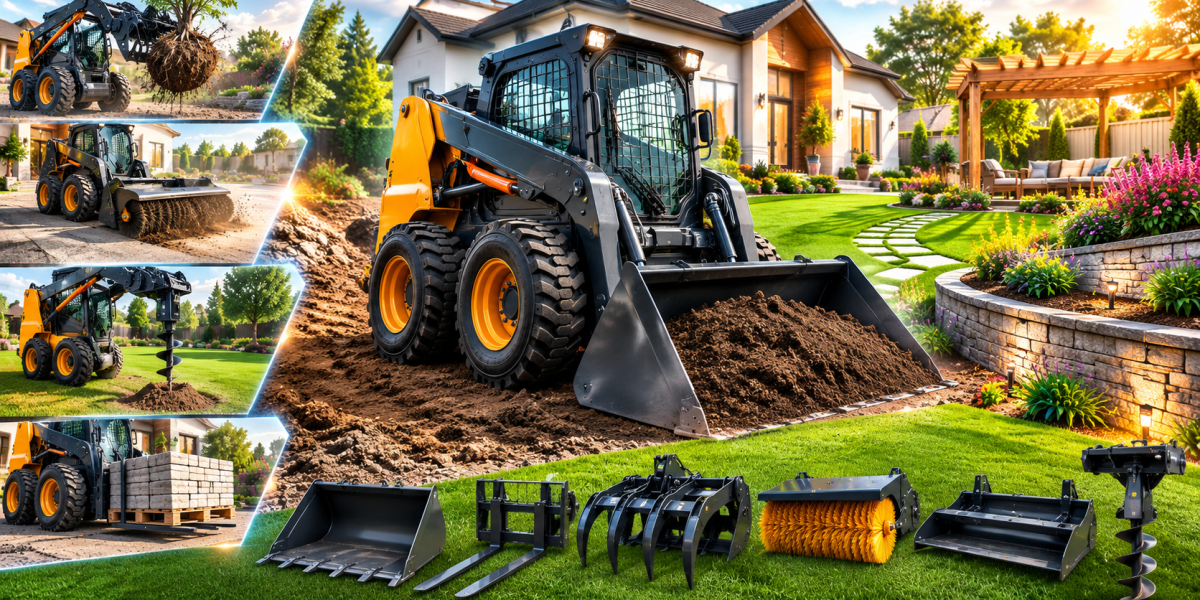
The real secret to getting the most out of your machinery isn’t just the loader itself—it’s the attachments. A skid steer without attachments is basically just a motorized wheelbarrow. The genius of these machines is their chameleon-like ability to transform into dozens of completely different tools using a universal quick-attach plate.
Instead of buying a fleet of expensive, single-use machines, you can just swap out heavy implements in seconds. Over at SkidSteerLoader.net, they carry some game-changing add-ons.
Take the Land Leveler attachment, for example. It is an absolute necessity for grading rough soil and prepping a perfectly flat foundation before you lay down expensive sod or build a patio.
Then there’s the Earth Auger attachment. It functions exactly like a giant drill bit, piercing straight into the hard earth to create deep, uniform holes for planting trees or setting fence posts. It totally eliminates the blister-inducing nightmare of manual post-hole digging.
And if you only buy one extra attachment, make it the 4-in-1 Bucket. This thing is the Swiss Army knife of landscaping. You can use it as a standard bucket, open it up to use as a dozer blade, clamp it down as a grapple for moving logs, or use it to back-drag soil to a flawlessly smooth finish.
- The Earth Auger for Fence Posts: Rapidly bores perfect, uniform holes into hard or frozen ground, making it an absolute must-have tool for planting mature trees and installing fences.
- The 4-in-1 Bucket Does It All: Acts as a traditional digging bucket, a bulldozer blade, a heavy debris grapple, and a soil scraper all at once, so you never have to stop working to switch tools.
- The Land Leveler for Perfect Grades: Effortlessly smooths out uneven terrain, quickly preparing your job site for fresh sod installation, garden beds, or concrete hardscaping.
Keeping It Running Without Going Broke
Owning the best skid steer for residential landscaping is a big financial commitment, and protecting that investment comes down to plain, old-fashioned maintenance. You can buy the toughest, most industrial-grade machinery on the planet, but if you ignore it, the harsh realities of dirt, dust, friction, and heavy lifting will eventually destroy it.
Preventative care is non-negotiable if you want to avoid costly breakdowns right in the middle of a time-sensitive project. Anyone operating a skid steer needs to build a strict habit of checking the engine oil, hydraulic fluids, and coolant levels before turning the key every single morning.
You also need to keep a close eye on your tracks or tires. Check rubber tracks for tension issues and uneven wear, or look over pneumatic tires for hidden sharp punctures that could leave you stranded in a client’s front yard.
Most importantly, grab a grease gun. Taking five minutes to properly grease all the moving pivot points—especially on heavy-duty attachments like the TYPHON STOMP mini skid steer grapple or the 4-in-1 bucket—will stop metal-on-metal grinding in its tracks and add years to the life of your equipment.
- Daily Fluid Checks Are Mandatory: Consistently checking hydraulic fluid levels, engine oil, and air filters stops catastrophic engine failures before they happen and keeps the machine humming.
- Kicking the Tires and Tracks: Closely monitoring track tension and inspecting tires for sidewall damage ensures you actually have traction and won’t get stuck in the mud.
- Grease is Cheaper than Parts: Generously applying high-quality grease to all moving joints and connection points drastically reduces friction and prevents parts from snapping under pressure.
Frequently Asked Questions – Best Skid Steer for Residential Landscaping Projects
What is a skid steer loader and why is it used in landscaping?
A skid steer loader is a super versatile, engine-powered machine with lift arms that connect to a massive variety of attachments. In landscaping, it’s the go-to machine because it packs enough power to excavate, lift, trench, and grade, but is compact enough to actually fit inside residential backyards without taking down fences.
What is the best size skid steer for residential landscaping?
For residential work, you definitely want a mini or small-frame skid steer. Look for something weighing under 2,000 pounds with an operating capacity around 700 to 900 pounds. Machines like the TYPHON STOMP are perfect because their narrow width lets you drive right through standard backyard gates without tearing up the whole neighborhood.
Can you use a mini skid steer for residential landscaping cleanup?
Absolutely. A mini skid steer is arguably the best tool for heavy yard cleanup. By hooking up a grapple or a 4-in-1 bucket, you can easily grab, lift, and haul away heavy piles of storm debris, huge branches, boulders, and old concrete in a fraction of the time it would take to do it by hand.
How do I choose the right skid steer loader for my needs?
To pick the right one, you have to look at your daily tasks. Consider the size of the properties you usually work on, the type of terrain (muddy vs. paved), and what attachments you plan to run. Balance how much weight you need to lift against how small the machine needs to be to fit where you work.
Are skid steer loaders easy to operate for beginners?
Yes, modern skid steers are designed to be incredibly intuitive, usually featuring simple joystick controls that are easy to pick up. However, even though they are beginner-friendly, you should always take the time to practice in an open area and read the safety manual before you start working near houses or people.
How often should I perform maintenance on my skid steer loader?
You should always follow the manufacturer’s timeline, which is usually based on engine hours. But on a daily basis, you must check your engine oil, hydraulic fluid, and air filters. You also need to grease the pivot points and check your tire or track health every single day before you start working.
What are the best skid steer attachments for landscaping?
The most valuable attachments for a landscaper include an earth auger for digging perfect fence post holes, a land leveler for smoothing out rough yards, and a heavy-duty grapple. The 4-in-1 bucket is also a huge favorite because it works as a standard bucket, a dozer blade, and a grapple all wrapped into one tool.